AMD PEPS Neural Texture Compression Reduces Model Size by 25%
AMD has introduced a new neural texture compression technique called PEPS (Positional Encoding Projected Sampling) at the I3D Symposium, demonstrating a significant advancement in neural graphics research. According to AMD, PEPS can reduce model parameters by approximately 25% while maintaining image quality comparable to existing neural texture compression techniques.
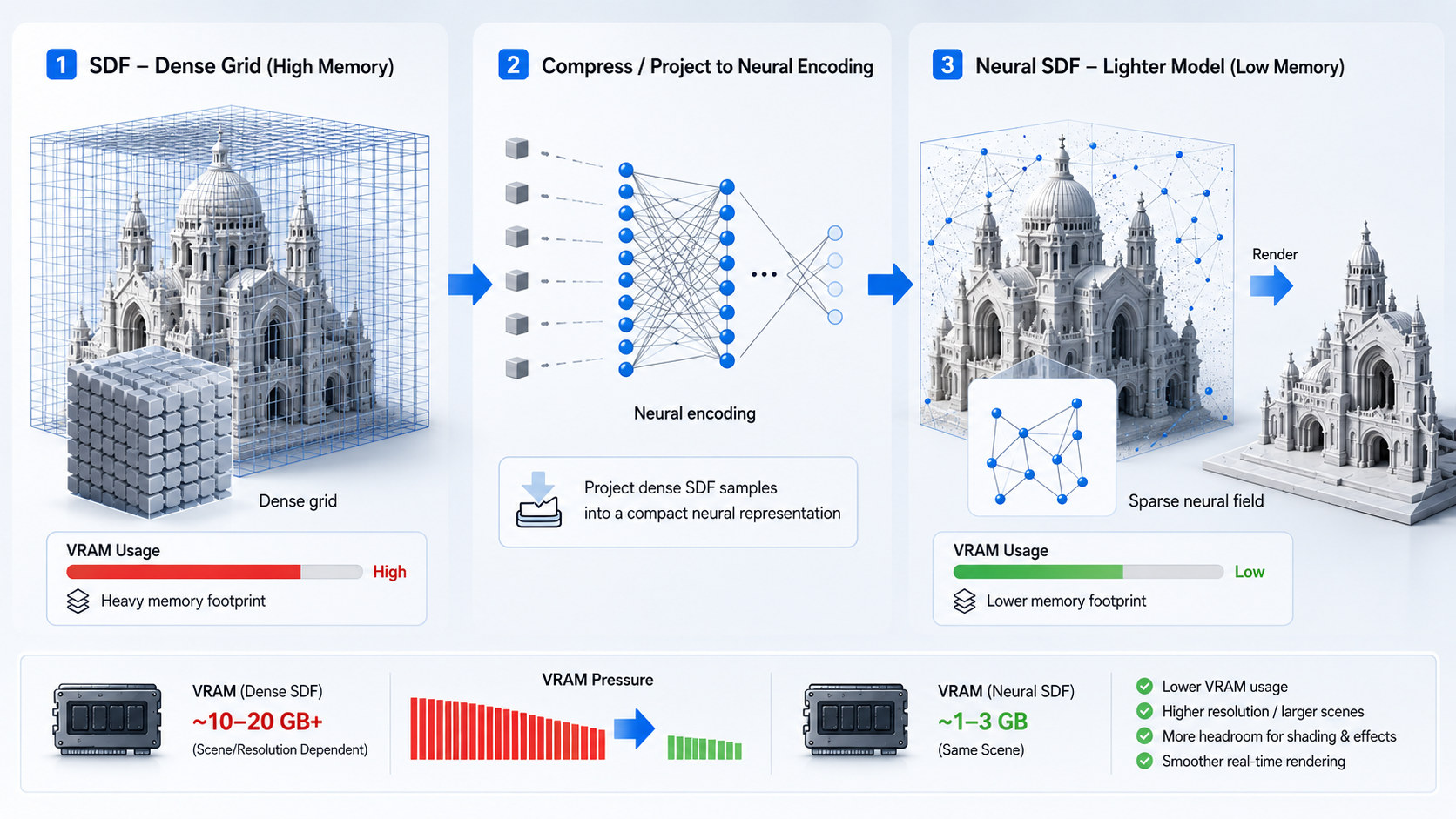
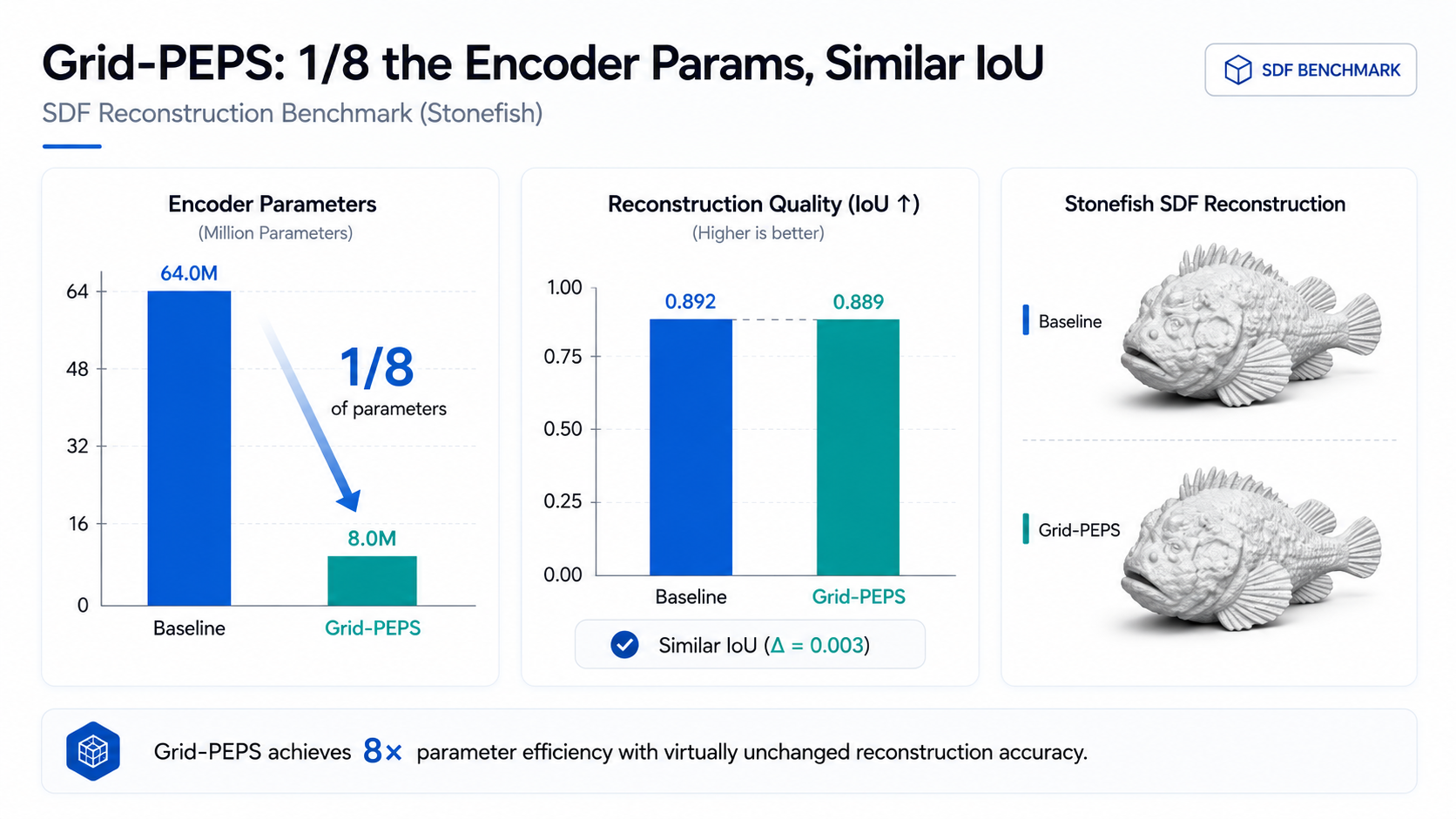
Beyond texture compression, the research also shows promising results for Signed Distance Field (SDF) representations, where PEPS substantially lowers memory requirements without sacrificing reconstruction accuracy. Although the technology remains in the research phase and has not yet been integrated into Radeon GPUs or commercial graphics pipelines, it highlights a promising direction for future GPU memory optimization.
🚀 PEPS: A More Efficient Neural Texture Compression Method #
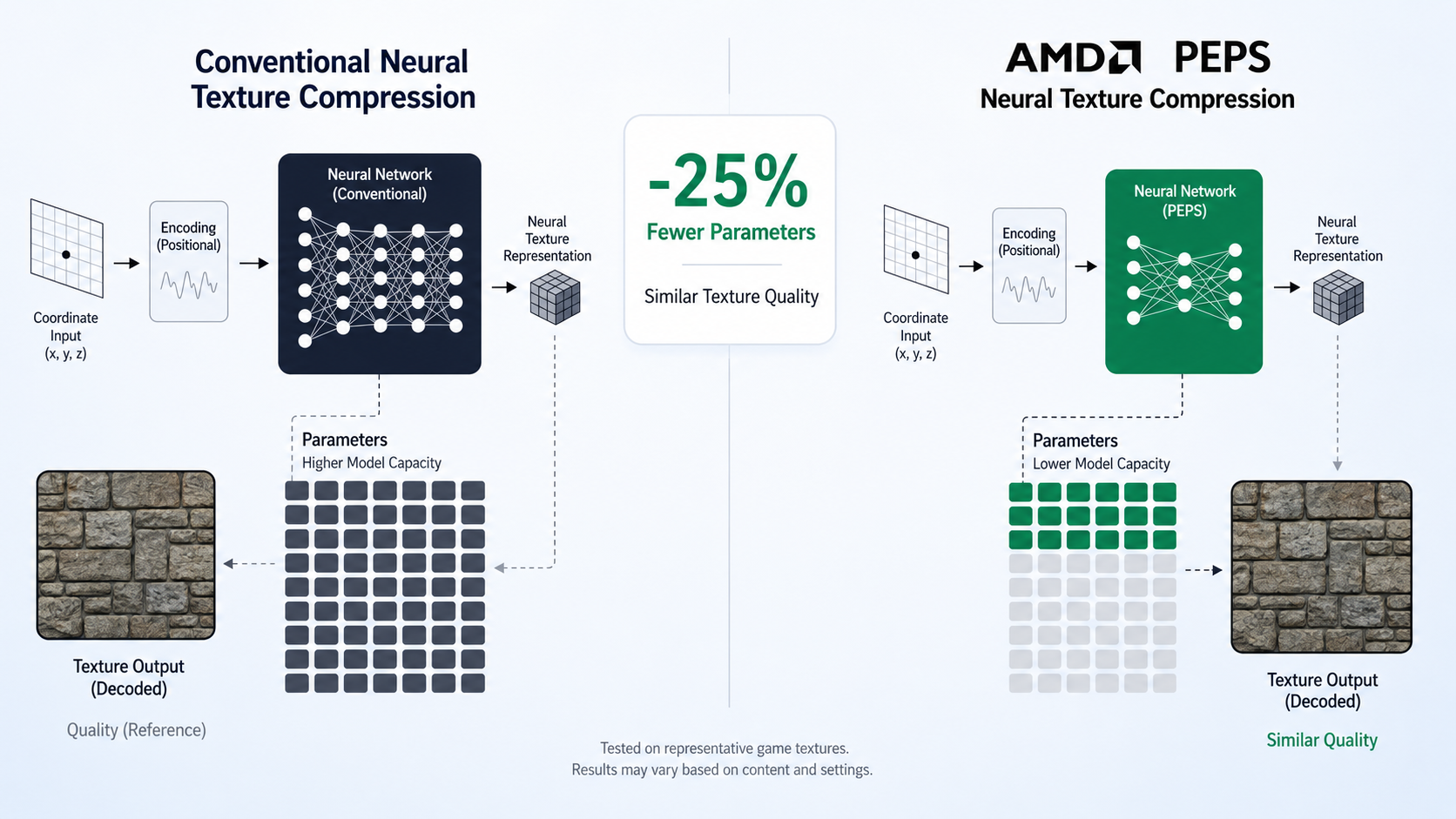
Neural texture compression has emerged as an attractive alternative to conventional texture encoding by replacing large texture assets with compact neural networks capable of reconstructing textures during rendering.
AMD’s PEPS focuses on improving the efficiency of the positional encoding stage used by these neural representations, allowing models to achieve equivalent visual quality using significantly fewer parameters.
The primary achievement reported in the research is:
- 25% fewer model parameters
- Comparable reconstructed image quality
- Lower memory requirements for compressed texture representations
Reducing parameter count directly translates into lower VRAM consumption, making the approach particularly attractive for graphics workloads where memory capacity is a limiting factor.
How Neural Texture Compression Works #
Neural texture compression relies on Implicit Neural Representations (INRs).
Instead of storing every texel explicitly, an INR learns a mathematical function that maps texture coordinates to color values.
A typical workflow involves:
- Converting texture coordinates into high-dimensional positional embeddings.
- Feeding these embeddings into a compact Multi-Layer Perceptron (MLP).
- Reconstructing texture values on demand during rendering.
This approach dramatically reduces storage requirements while preserving visual fidelity.
🔮 What Makes PEPS Different? #
Traditional positional encoding projects low-dimensional coordinates into higher-dimensional sine and cosine vectors.
PEPS introduces a more information-efficient sampling strategy.
Instead of treating each sine and cosine projection independently, PEPS interprets those projections as sampling locations along a Lissajous curve. These projected positions are then used to sample encoding grids or feature maps, enabling the neural network to capture richer spatial information using fewer parameters.
The result is improved representational efficiency without requiring substantially larger neural networks.
📊 Performance Results #
AMD evaluated PEPS using a Radeon RX 9070 XT while generating a 1024 × 1024 RGB texture.
Measured execution times include:
| Method | Processing Time |
|---|---|
| BI-Grid Baseline | 4.32 ms |
| Grid-PEPS | 5.47 ms |
| Grid-PinkPEPS (Optimized) | 4.86 ms |
The additional processing cost originates from the extra sampling operations introduced by the new positional encoding strategy.
Although this represents a modest increase in execution time, AMD’s optimized Grid-PinkPEPS implementation reduces the overhead to roughly 0.5 ms over the baseline.
For offline rendering, this latency is largely insignificant, while real-time applications may require further optimization before widespread deployment.
🎨 Extending PEPS Beyond Texture Compression #
AMD also explored applying PEPS to Signed Distance Fields (SDFs).
SDFs are widely used in modern graphics pipelines for representing complex geometry, procedural objects, and volumetric scenes. However, high-resolution SDFs often consume considerable GPU memory.
PEPS enables these neural representations to become substantially more compact.
Pitted Stonefish Benchmark #
In AMD’s SDF evaluation, PEPS demonstrated remarkable compression efficiency.
Using the Grid-PEPS implementation:
- Only one-eighth as many encoder parameters were required compared to conventional methods.
- Comparable Intersection over Union (IoU) accuracy was maintained.
IoU measures how closely the reconstructed geometry matches the original model, making it a common metric for evaluating SDF reconstruction quality.
These results suggest that PEPS could significantly reduce VRAM requirements for geometry-heavy rendering workloads without introducing major quality degradation.
💾 Why Lower Parameter Counts Matter #
Reducing neural model size provides several practical advantages for graphics hardware:
- Lower VRAM consumption
- Higher cache efficiency
- Reduced memory bandwidth pressure
- Improved scalability for complex scenes
- Better suitability for GPUs with limited memory capacity
These benefits are particularly relevant as modern game engines increasingly experiment with neural rendering techniques while continuing to target GPUs equipped with 8 GB to 12 GB of VRAM.
🔬 Commercial Adoption Still Appears Distant #
Although neural texture compression has attracted growing industry interest, commercial deployment remains limited.
To date:
- NVIDIA has publicly demonstrated Neural Texture Compression (NTC) through research and developer toolkits.
- No mainstream commercial game has fully integrated neural texture compression into its production rendering pipeline.
- AMD has not announced any consumer-facing implementation of PEPS or introduced it as a Radeon feature.
At present, PEPS remains an academic research project rather than a shipping graphics technology.
As a result, Radeon users should not expect immediate software or driver support.
📈 Why PEPS Is Worth Following #
Despite its early-stage status, PEPS addresses one of the most persistent challenges facing modern graphics hardware: efficient VRAM utilization.
As game assets continue to grow in complexity and neural rendering techniques mature, reducing memory consumption without sacrificing image quality will become increasingly valuable.
Potential future applications include:
- Neural texture compression
- Procedural asset generation
- Signed Distance Field acceleration
- Neural scene representations
- Memory-efficient rendering pipelines
If these techniques eventually become standardized across graphics APIs and game engines, they could extend the practical lifespan of memory-constrained GPUs while enabling richer visual content.
🏁 Final Thoughts #
AMD’s PEPS research demonstrates that smarter positional encoding can meaningfully improve neural graphics efficiency. By reducing model parameters by roughly 25% while preserving visual quality—and achieving even greater compression gains for Signed Distance Fields—the technology highlights an important direction for future GPU rendering architectures.
Although commercial deployment remains uncertain, PEPS contributes to a broader industry effort to make neural rendering both more practical and more memory efficient. As VRAM continues to be a critical resource across gaming, content creation, and real-time graphics, advances like PEPS could eventually play a key role in next-generation rendering pipelines.