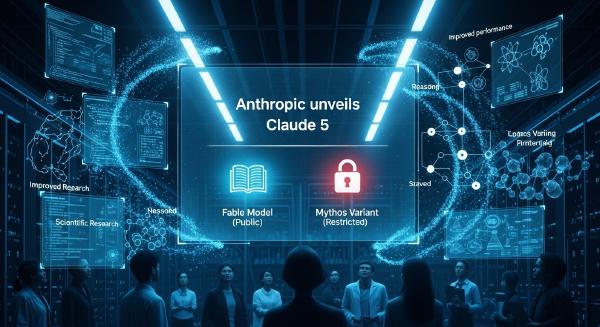
Anthropic Fable 5.1: A New Era for Coding and AI Science
Anthropic’s latest model generation is positioned around a broader goal than simply improving chatbot benchmarks: enabling AI systems to execute long-horizon technical work with substantially less human intervention.
Claude Fable 5.1 is now broadly available, while the more unrestricted Mythos 5.1 remains limited to vetted cybersecurity and life-sciences teams. Together, the models target workloads ranging from complex software engineering and debugging to scientific research, molecular design, and GPU performance optimization.
The reported benchmark results point to a substantial generational improvement. Fable 5.1 reaches 52.6% on Terminal-Bench-Science 0.1, compared with 24.7% for the previous Fable 5 generation and 22.4% for OpenAI’s GPT-5.6 Sol. On Terminal-Bench 4.0, Fable 5.1 rises from 42.0% to 55.8%, while Mythos 5.1 reaches 60.9%.
The larger story, however, is not any individual benchmark.
Anthropic is increasingly positioning its models as technical agents capable of completing multi-stage knowledge work, including reading documentation, writing and executing code, analyzing failures, iterating on solutions, and maintaining context across long-running tasks.
📊 Fable 5.1 Benchmark Results Show a Major Capability Jump #
The new generation posts substantial gains across scientific reasoning, software engineering, and broader knowledge-work evaluations.
Scientific Exploration #
On Terminal-Bench-Science 0.1, Fable 5.1 reportedly scores 52.6%.
For comparison:
| Model | Terminal-Bench-Science 0.1 |
|---|---|
| Fable 5.1 | 52.6% |
| Fable 5 | 24.7% |
| GPT-5.6 Sol | 22.4% |
The result is particularly significant because the benchmark targets technical tasks involving tools and scientific workflows rather than conventional question-answering.
Software Engineering #
On Terminal-Bench 4.0, Fable 5.1 improves from the previous generation’s 42.0% to 55.8%.
Mythos 5.1 reportedly pushes the score further to 60.9%.
This reflects the models’ focus on tasks that require more than generating syntactically correct code. Long-running engineering workloads require an agent to understand an existing codebase, make changes, execute those changes, inspect failures, and recover from incorrect assumptions.
Complex Reasoning and Knowledge Work #
Fable 5.1 also reports strong results on broader reasoning and professional-work benchmarks.
On GDPval-AA, it reaches a score of 1853. On Humanity’s Last Exam, tool-assisted evaluation reportedly exceeds 65%.
Another notable characteristic is efficiency. Even when reasoning effort is reduced to its minimum setting, Fable 5.1 reportedly remains ahead of previous-generation performance while consuming substantially fewer tokens.
For production workloads, that combination matters as much as raw benchmark accuracy: a model that reaches the same result with fewer inference tokens can materially reduce the cost of long-running agents.
💵 Fable 5.1 Keeps Base Pricing While Cutting Cache Costs #
Anthropic is also changing the economics of extended model usage.
The base Fable 5.1 pricing reportedly remains unchanged at:
- $10 per million input tokens
- $50 per million output tokens
The more significant change comes from cache reads.
Cache-read pricing falls from $1 to $0.25 per million tokens, representing a 75% reduction.
That matters particularly for agentic workloads, where the same large context may be reused across multiple reasoning and tool-calling iterations.
According to Anthropic’s reported estimates, total costs can fall by approximately 25% in typical workloads, while long-horizon agentic applications may see savings of up to 45%.
For comparison, the cited short-context promotional pricing for GPT-5.6 Sol is $2 per million input tokens, $10 per million output tokens, and $0.20 per million cache reads.
The pricing comparison should be interpreted carefully because actual costs depend heavily on context length, caching behavior, reasoning configuration, and workload structure.
🔬 Fable and Mythos Move Beyond Assistance Into Scientific Work #
The most consequential part of the announcement is not the benchmark table.
Anthropic presented several real-world case studies intended to demonstrate that its models can participate directly in scientific and engineering workflows.
Three examples stand out: planetary mapping, protein design, and GPU optimization.
Reconstructing One-Third of Venus #
More than three decades ago, NASA’s Magellan mission collected radar imagery of Venus. The available elevation data had relatively coarse resolution, reportedly around 10–20 kilometers.
Only a fraction of the planet had previously been converted into detailed elevation maps.
Fable 5.1 was given the raw dataset and used a neural-network-based workflow to generate a higher-resolution topographic map covering approximately one-third of Venus.
The resulting map reportedly reaches a spatial detail level of roughly 2–3 kilometers and improves height-estimation accuracy by up to 25%.
The significance is less about replacing conventional scientific pipelines than demonstrating that an AI agent can combine existing datasets, machine-learning methods, and computational tooling to execute a substantial research workflow.
Protein and Molecular Design #
Biological design represents a more difficult challenge because computational predictions ultimately need to survive experimental validation.
One important target in therapeutic protein design is binding affinity: how strongly a designed protein interacts with a particular biological target.
Anthropic reports that designs produced by Mythos 5.1, after integration with open-source design tools, were submitted to external institutions for wet-lab validation.
Across three target sites, including EGFR and Nipah G, the reported binding affinity was approximately 10× higher than the best submissions in Adaptyv Bio competitions.
Across 12 target sites, the overall reported hit rate approached 50%, compared with typical rates of approximately 10%–15% cited in the announcement.
These results are particularly notable because the workflow extends beyond generating theoretical candidates. The generated designs were subjected to physical laboratory testing.
GPU Kernel Optimization for Bioinformatics #
The third case study focuses on computational efficiency rather than scientific discovery itself.
Genomics and protein research can require enormous numbers of model inferences. A genome-scale analysis may evaluate millions of variants, meaning that even relatively small performance improvements can translate into significant reductions in GPU expenditure.
Manual GPU kernel optimization is traditionally a specialist task requiring substantial knowledge of:
- GPU architecture.
- Memory hierarchies.
- Parallel execution.
- Kernel scheduling.
- Numerical behavior.
- Performance profiling.
Mythos 5.1 reportedly completed this type of optimization using publicly available source code.
It generated custom GPU kernels for seven open-source biological models and improved execution speed by up to 2.5×.
The reported outputs remained bit-for-bit identical to the original implementations.
One example illustrates the economic impact. For an analysis scanning three million variants with the large Evo 2 model, the estimated compute cost reportedly fell from approximately $18,000 to $8,000 after optimization.
That type of workload is where coding-agent performance becomes directly relevant to scientific computing economics.
💻 Long-Horizon Coding Is Becoming the Core Differentiator #
Fable 5.1’s scientific capabilities are closely tied to its software-engineering performance.
Modern coding agents can already generate functions, fix straightforward bugs, and modify isolated files. The harder problem is maintaining a coherent objective through a long sequence of actions.
A production-scale engineering task may require an agent to:
Read repository documentation → Decompose the task → Modify the code → Run tests → Inspect results → Diagnose failures → Iterate.
Fable 5.1 is designed around this closed-loop workflow.
Instead of treating successful code generation as the endpoint, the model is expected to continue operating until it can verify whether the implementation actually works.
This distinction becomes especially important when failures are indirect or intermittent.
CursorBench and AutomationBench #
On CursorBench 3.2, which evaluates coding performance in realistic IDE environments, Fable 5.1 reportedly achieves 73.4%.
On AutomationBench, a benchmark focused on commercial workflow automation, its score rises to 31.4%, nearly doubling the previous result.
These benchmarks attempt to measure something closer to practical agent behavior than isolated code-generation accuracy.
The reported real-world examples reinforce this positioning.
Anthropic says Fable 5.1 helped Millennium resolve a high-priority bug that had persisted for approximately four or five years. The failure reportedly occurred only once in roughly one million executions.
The model traced the issue through external dependencies, analyzed third-party libraries, identified the underlying failure mechanism, and corrected the root cause.
This type of debugging is fundamentally different from generating a code snippet. It requires maintaining a hypothesis over multiple investigative steps and continuously validating that hypothesis against observed behavior.
🎨 Early Real-World Tests Put Fable 5.1 Under Pressure #
Following the release, early demonstrations and independent tests began highlighting both the strengths and trade-offs of the new model.
Visual and Multimodal Workflows #
In a side-by-side demonstration from AI/ML API, Fable 5.1 and GPT-5.6 Sol were given the same prompt and evaluated on a visual-generation task.
The reported cost was $5.69 for Fable 5.1 versus $0.88 for GPT-5.6 Sol.
The outputs reflected different optimization priorities. Fable 5.1 reportedly emphasized visual realism, including wave behavior, depth of field, and environmental details, while Sol produced a more minimalist and consistent visual style across the scenes.
The comparison illustrates an important point: benchmark leadership does not necessarily translate into the lowest cost for every workload.
Autonomous Design and Simulation #
Anthropic researcher Alex Albert also demonstrated Fable 5.1 using a photograph of a piece of land.
The model reportedly progressed from the source image to house design, high-quality rendering, and a cinematic walkthrough video.
In another demonstration, Fable 5.1 generated an interactive human-brain visualization directly in code. The application represented cortical structures and allowed users to trace a neural pathway associated with the sentence “Pass the salt.”
The model also reportedly generated and completed an ARC-style survival game in a single attempt.
These demonstrations are useful primarily as evidence of workflow breadth: the model is being tested not only as a text generator, but as an agent capable of combining programming, visualization, reasoning, and tool use.
🛡️ Vulnerability Discovery Gets More Access While Exploit Generation Stays Restricted #
Anthropic is also changing how Fable 5.1 handles cybersecurity workflows.
The company reportedly relaxed some of its previous vulnerability-detection restrictions.
Developers auditing their own codebases could previously trigger security safeguards even when performing legitimate defensive analysis. Under the new approach, Fable 5.1 can identify vulnerabilities in code, with Anthropic reporting a 60% reduction in cybersecurity false positives.
The boundary remains at exploit development.
The model can identify and analyze vulnerabilities but is not intended to generate exploit payloads. Higher-risk penetration-testing operations remain subject to stricter controls and are handled by more restricted systems.
This creates a deliberate separation between defensive vulnerability discovery and offensive exploitation.
🔒 Anti-Distillation Controls Become More Aggressive #
At the same time that Anthropic is expanding certain legitimate security capabilities, it is tightening controls around model-output extraction.
The new mechanism targets attempts to manipulate multi-turn context in order to expose hidden reasoning or thinking blocks.
Under the reported API behavior, the service checks whether submitted context matches the context associated with previously generated thinking blocks.
If the context does not match, the API may either return an error or remove the relevant thinking block rather than allowing it to be reused under a modified prompt.
The mechanism currently applies to new API accounts created after August 31, according to the announcement, with Anthropic indicating that similar protections will become mandatory for future new models.
The move reflects a broader industry concern around model distillation: using the outputs or internal reasoning traces of a stronger model to improve another model.
From a platform perspective, the trade-off is straightforward. More restrictive context validation can protect proprietary model behavior, but it can also constrain legitimate workflows that depend on manipulating or replaying long-lived reasoning contexts.
🌍 The Bigger Shift: AI as a Technical Research Agent #
The most important development surrounding Fable 5.1 is arguably not a single benchmark score or pricing change.
It is the convergence of three capabilities:
- Long-horizon reasoning
- Reliable software execution
- Tool-driven scientific workflows
When these capabilities operate together, an AI system can move through a research loop that looks increasingly similar to traditional computational science:
Hypothesis → Code → Experiment → Measurement → Debugging → Iteration → Result
The Venus mapping example demonstrates large-scale data processing. Protein design demonstrates a computational-to-experimental loop. GPU kernel optimization demonstrates the ability to improve the infrastructure used by scientific models themselves.
This is a fundamentally different use case from asking an AI assistant to explain a paper or write a short script.
The model becomes part of the execution pipeline.
🏁 Conclusion #
Fable 5.1 represents Anthropic’s attempt to push AI agents beyond conventional assistance and toward sustained technical execution.
Its reported benchmark improvements are substantial, but the more important capability is the model’s ability to maintain a goal across long sequences of coding, tool use, testing, debugging, and iteration.
The scientific case studies provide the clearest demonstration of this direction. Fable 5.1 reportedly reconstructed high-resolution terrain across a large portion of Venus, while Mythos 5.1 generated protein candidates that achieved strong wet-lab validation results and optimized GPU kernels for biological models by up to 2.5×.
At the same time, Anthropic is reducing the cost of long-context workloads through a major cache-read price reduction and tightening controls intended to prevent model distillation.
The emerging picture is therefore two-sided.
AI systems are becoming increasingly capable of performing complex scientific and engineering work, lowering the expertise and compute barriers required for certain tasks. At the same time, model providers are becoming increasingly protective of the capabilities and reasoning artifacts that make these systems valuable.
The long-term significance of Fable 5.1 may ultimately be less about winning another benchmark and more about demonstrating a new operating model for technical work: AI systems that can independently execute, evaluate, debug, and iterate through complex research workflows over extended horizons.