Early DLSS 5 Tests Reveal RTX 5090 Power Bottleneck
Early unofficial testing of NVIDIA’s upcoming DLSS 5 technology suggests that the RTX 5090 Founders Edition may encounter a surprising limitation: power delivery rather than raw GPU compute.
In preliminary benchmarks using a leaked DLSS 5 DLL, the RTX 5090 Founders Edition reportedly lost between 42% and 49% of its frame rate when neural rendering was enabled. The card repeatedly reached its 575W power limit, while a higher-power RTX 5090 design with dual power connectors experienced substantially smaller performance losses.
The results are particularly interesting because DLSS 5 introduces a much heavier AI-based rendering workload than conventional super-resolution techniques. However, these measurements were produced through a community injection method using a leaked DLL rather than NVIDIA’s final official implementation. They should therefore be treated as early technical evidence rather than representative launch performance.
🧪 How the Early DLSS 5 Tests Were Conducted #
NVIDIA is scheduled to officially launch DLSS 5 on September 3, 2026, alongside NBA 2K27. Before the official release, a DLSS 5 DLL appeared in an early-access build of the game.
Community developers subsequently reverse-engineered the library and used tools such as OptiScaler to inject the technology into titles that were not officially supported.
Tom’s Hardware tested the leaked implementation on two RTX 5090 models:
| GPU | Power Configuration | Maximum Power |
|---|---|---|
| RTX 5090 Founders Edition | Single 12V-2x6 connector | 575W |
| MSI RTX 5090 Lightning Z | Dual power connectors | Up to 1000W |
Testing covered Cyberpunk 2077, Hogwarts Legacy, and Control.
The implementation was not NVIDIA’s official Streamline integration, so the results should not be interpreted as a final measurement of DLSS 5 performance. Nevertheless, the observed per-frame processing overhead was reportedly close to the approximately 8 ms figure previously disclosed by NVIDIA, making the tests useful as an early indication of the technology’s computational and power requirements.
⚡ Power Delivery Becomes the Bottleneck #
The most striking result came from the RTX 5090 Founders Edition.
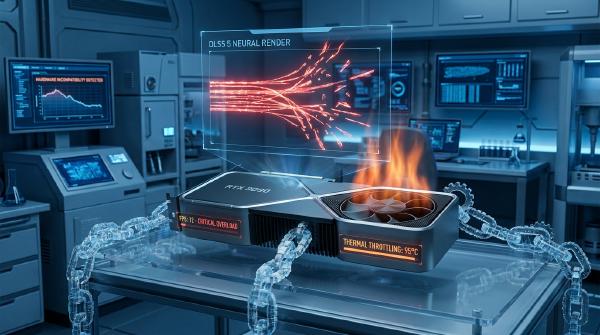
With DLSS 5 neural rendering enabled, the card reportedly experienced a 42% to 49% frame-rate reduction while continuously reaching its 575W power ceiling.
This suggests that the additional neural-rendering workload can push the GPU beyond the available power envelope. Instead of simply consuming more compute resources, the workload appears to create a situation where the GPU cannot sustain the required operating conditions without exceeding its configured power limit.
In other words, the limiting factor may shift from:
GPU compute capacity → available power headroom
That distinction could become increasingly important as AI-based rendering moves more of the graphics pipeline onto dedicated or semi-dedicated neural workloads.
🔌 Dual-Power RTX 5090 Models Have More Headroom #
The MSI RTX 5090 Lightning Z produced a different result.
Its dual-connector design and substantially higher power limit allowed the GPU to sustain a considerably larger power budget. As a result, its frame-rate losses with DLSS 5 neural rendering were smaller, and its 1% low performance was more stable.
The trade-off is obvious: more performance headroom comes with dramatically higher power consumption.
In Hogwarts Legacy, for example, the Lightning Z reportedly increased power consumption from approximately 480W to 720W when neural rendering was enabled.
That represents a roughly 50% increase in power consumption.
| Scenario | Approx. Power |
|---|---|
| Without neural rendering | 480W |
| With neural rendering | 720W |
| Increase | ~50% |
The comparison demonstrates why power delivery can become a first-order performance constraint for increasingly sophisticated AI graphics workloads.
🎮 Why DLSS 5 Changes the GPU Power Equation #
Traditional DLSS features primarily focus on reconstructing higher-resolution frames from lower-resolution inputs. DLSS 5 expands the role of neural processing within the rendering pipeline, potentially adding a significantly heavier computational workload.
That changes the performance equation.
A GPU can have sufficient shader and tensor compute resources on paper, yet still fail to sustain maximum performance if its power budget prevents those resources from operating at the required frequency and utilization levels.
This creates an increasingly important relationship between:
- GPU architecture
- AI compute capacity
- Memory bandwidth
- Power limits
- Voltage and frequency behavior
- Cooling capacity
- Power-connector configuration
- Sustained thermal performance
For flagship GPUs, peak performance may therefore depend not only on the silicon itself, but also on how aggressively the board is designed to deliver and dissipate power.
⚠️ The Results Are Still Preliminary #
There are several reasons not to draw definitive conclusions from these tests.
First, the benchmarks used a leaked DLSS 5 DLL rather than NVIDIA’s final public implementation. Second, the technology was injected through a community-developed OptiScaler workflow instead of NVIDIA’s official Streamline integration.
These differences could affect:
- Rendering overhead
- Frame-generation behavior
- Neural-rendering scheduling
- GPU utilization
- Power consumption
- Image quality
- Driver interaction
- Overall frame rate
Consequently, the reported 42%–49% performance loss on the Founders Edition should not be interpreted as the definitive performance penalty of DLSS 5.
The final release could behave differently once NVIDIA’s official software stack, drivers, and game integrations are available.
🔋 The 12V-2x6 Connector Could Become More Important #
The early results nevertheless raise an interesting hardware-design question.
The RTX 5090 Founders Edition’s single 12V-2x6 power connector and 575W power limit were sufficient for its existing workload profile. DLSS 5 introduces another variable: substantially increased AI processing demand during rendering.
If that additional workload consistently pushes the GPU toward its power ceiling, cards with more aggressive power delivery systems could gain an unexpected advantage.
This does not necessarily mean that a higher-power RTX 5090 is inherently faster in every workload. Instead, it suggests that sustained power headroom may become increasingly important for advanced neural-rendering features.
For future flagship GPUs, board-level power design could become almost as relevant to AI-rendering performance as the GPU architecture itself.
📊 What to Watch When DLSS 5 Officially Launches #
The most useful follow-up tests will need to compare the same GPU across official DLSS 5-supported titles and multiple power configurations.
Important measurements will include:
- Average FPS — to quantify overall rendering performance.
- 1% lows — to determine whether neural rendering introduces frame-time instability.
- GPU power consumption — to establish whether cards are power-limited.
- Performance per watt — to determine whether additional power produces proportional performance gains.
- Frame-time overhead — to measure the real cost of neural rendering.
- Image quality — because higher performance is irrelevant if reconstruction quality degrades.
- Sustained performance — to determine whether thermal throttling becomes another limitation.
These measurements will help distinguish a genuine architectural limitation from an artifact of the early software implementation.
🔮 DLSS 5 Could Expose a New Flagship GPU Constraint #
The most interesting implication of these early results is not simply that DLSS 5 can consume more power.
It is that AI-driven graphics may change what determines GPU performance.
As neural rendering becomes a larger component of real-time graphics, flagship GPUs could increasingly be constrained by power delivery, cooling, and sustained operating limits rather than by traditional shader throughput alone.
The RTX 5090 Founders Edition’s reported behavior provides an early example of this possibility. However, the evidence remains unofficial, and NVIDIA’s final DLSS 5 implementation could produce substantially different results.
The real verdict will come from independent testing after the official release, when DLSS 5 can be evaluated under standardized software, drivers, and game integrations.