How Corning Became the Hidden Backbone of AI Infrastructure
The generative AI boom is often framed around GPUs, accelerator architectures, and hyperscale cloud providers. Yet beneath the headlines sits a less visible constraint that increasingly determines how far AI infrastructure can scale: the physical transport and precision material layer.
While companies like NVIDIA and AMD dominate discussions around compute performance, Corning Incorporated has quietly positioned itself as a critical supplier across two foundational AI infrastructure domains:
- High-density optical interconnect systems for AI data centers
- Ultra-precision optical materials used in advanced semiconductor lithography
Historically recognized for Gorilla Glass and consumer electronics materials, Corning now occupies a strategically important position in the physical AI supply chain.
🧱 Corning’s Diversified Materials Strategy #
Rather than relying on a single consumer product cycle, Corning operates across multiple long-term engineering disciplines that reinforce one another technologically and commercially.
CORNING CORE TECHNOLOGY STACK

┌────────────────────────────────────────┐
│      CORNING MATERIAL FOUNDATIONS      │
└───────────────────┬────────────────────┘
                    │
 ┌──────────────┬──────────────┬──────────────┬──────────────┬──────────────┐
 │ Glass Science│ Ceramics     │ Optics       │ Surface Eng. │ Precision Mfg│
 └──────────────┴──────────────┴──────────────┴──────────────┴──────────────┘
These foundational capabilities enable Corning to supply highly specialized products across several industries:
| Technology Domain | Core Capability | Strategic Application |
|---|---|---|
| Glass Composition | High-purity glass chemistry | Optical fibers, lithography substrates |
| Optical Physics | Signal transmission engineering | AI networking and photonics |
| Surface Engineering | Chemically strengthened materials | Consumer electronics and industrial glass |
| Ceramics | Thermal and structural materials | Automotive filtration and industrial systems |
| Precision Manufacturing | Ultra-low-defect fabrication | Semiconductor optics and advanced packaging |
This diversification creates exceptionally high switching costs for customers. Once Corning materials are integrated into hyperscale or semiconductor manufacturing pipelines, replacing them becomes operationally and financially difficult.
🌐 The AI Networking Bottleneck: Why Fiber Matters #
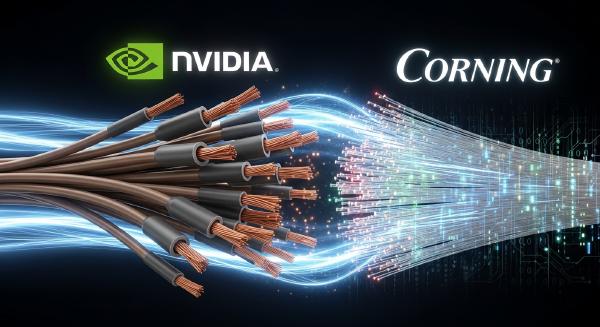
As large language models and distributed AI systems continue scaling, traditional electrical interconnects increasingly become a performance limitation.
Copper-based signaling struggles at extreme bandwidth densities due to:
- Signal attenuation at higher frequencies
- Thermal dissipation challenges
- Increased power consumption
- Physical routing constraints inside dense server racks
The industry response is a rapid migration toward optical interconnect architectures.
AI NETWORK SCALING TRANSITION

[Copper Interconnects]
• Higher heat generation
• Distance limitations
• Signal degradation

                ↓

[Optical Interconnect Fabrics]
• Higher bandwidth density
• Lower latency scaling
• Improved thermal efficiency
• Better rack-level scalability
This transition directly benefits Corning’s Optical Communications division, which manufactures:
- High-density optical fiber
- Multicore fiber systems
- Micro-cabling infrastructure
- Photonic connectivity solutions
- Data center routing assemblies
The impact is already visible financially.
📈 Optical Communications Becomes an AI Growth Engine #
Corning’s Q1 2026 results highlighted how aggressively AI infrastructure deployments are accelerating demand for optical networking systems.
Key metrics included:
| Financial Metric | Q1 2026 Result |
|---|---|
| Optical Communications Revenue | $1.85 Billion |
| Year-over-Year Revenue Growth | 36% |
| Segment Net Income Growth | 93% |
| Segment Net Income | $387 Million |
The scale-out of hyperscale AI clusters is driving this expansion.
Corning previously disclosed a multi-year $6 billion connectivity partnership with Meta Platform. The company has since announced additional long-term agreements with other major hyperscale operators, signaling that optical infrastructure is becoming a permanent capital expenditure priority for AI factories.
🔬 The Semiconductor Manufacturing Connection #
Corning’s role in AI infrastructure extends beyond networking. The company also participates directly in the semiconductor fabrication ecosystem through advanced optical materials used in lithography systems.
Modern Deep Ultraviolet (DUV) and Extreme Ultraviolet (EUV) lithography equipment requires extraordinary optical precision and thermal stability.
Corning supplies critical upstream materials including:
| Material | Function in Semiconductor Manufacturing |
|---|---|
| High-Purity Fused Silica (HPFS) | Lithography lens systems |
| Ultra-Low Expansion (ULE) Glass | Thermal-stable optical assemblies |
| Calcium Fluoride ($CaF_2$) Crystals | Precision optical components |
These materials are essential because even microscopic thermal expansion or atomic-level defects can disrupt advanced chip manufacturing processes.
The barrier to entry is extremely high. Producing EUV-grade optical substrates requires:
- Ultra-pure material processing
- Precision thermal control
- Defect minimization at atomic scales
- Decades of process optimization
As a result, Corning maintains a dominant position in several high-purity optical material categories used throughout semiconductor manufacturing supply chains.
⚡ AI Infrastructure Is Becoming a Physical Engineering Problem #
The AI market is increasingly constrained by physical infrastructure rather than purely computational capability.
Modern AI scaling now depends on:
- High-bandwidth optical fabrics
- Advanced thermal management
- Low-loss signal transport
- Precision lithography optics
- Co-packaged photonics
This shift changes which suppliers capture long-term infrastructure value.
A GPU without sufficient networking bandwidth cannot maintain cluster efficiency. Likewise, advanced chip architectures cannot exist without EUV lithography systems and the optical materials supporting them.
Corning therefore occupies a strategic position at both ends of the AI compute pipeline:
AI INFRASTRUCTURE DEPENDENCY STACK

[Semiconductor Manufacturing]
        │
        ▼
[EUV / DUV Optical Materials]
        │
        ▼
[AI Accelerator Production]
        │
        ▼
[Optical Interconnect Networks]
        │
        ▼
[Hyperscale AI Clusters]
🚀 Corning’s Long-Term AI Expansion Strategy #
At a May 2026 investor presentation at the New York Stock Exchange, Corning expanded its long-term “Springboard” growth framework to account for accelerating AI infrastructure demand.
CORNING LONG-TERM REVENUE TARGETS

2026 Target  →  ~$20 Billion
2028 Target  →  ~$30 Billion
2030 Target  →  ~$40 Billion
A major driver behind this roadmap is Corning’s new Photonics Market-Access Platform (MAP), which focuses on:
- Co-packaged optics (CPO)
- Advanced optical interfaces
- AI photonics integration
- Specialized glass packaging systems
The company expects photonics-related operations to evolve into a standalone multi-billion-dollar business segment by 2030.
Strategic partnerships with AI hardware vendors, including NVIDIA, further reinforce Corning’s importance in next-generation AI hardware ecosystems.
🔍 The Bigger Industry Shift #
The AI market is gradually transitioning from a compute-centric narrative toward a full-stack infrastructure model.
Early AI competition revolved primarily around:
- GPU performance
- Model parameter counts
- Training benchmarks
The next phase increasingly depends on:
- Optical bandwidth density
- Power efficiency
- Physical routing constraints
- Packaging technologies
- Manufacturing precision
Corning’s rise illustrates how deeply material science and photonics are becoming intertwined with AI scalability.
While GPU vendors remain the visible face of the AI revolution, companies controlling the underlying physical transport and optical infrastructure may ultimately capture some of the most durable long-term strategic leverage in the industry.