Huawei Ascend Overtakes Nvidia in China’s AI Chip Market
Huawei’s Ascend AI accelerators have reportedly surpassed Nvidia in market share in China, according to figures presented by Huawei Rotating Chairman Eric Xu at Huawei Connect. If the company’s estimates accurately reflect domestic shipments and deployments, the shift would mark a dramatic change in China’s AI accelerator market.
Huawei’s data puts Ascend at approximately 50% of China’s AI chip market, compared with around 8% for Nvidia. In 2022, Huawei estimated that Nvidia held roughly 95% of the market while Ascend accounted for only about 3%.
The change illustrates how rapidly China’s AI computing ecosystem has evolved over the past four years. It also highlights the growing importance of domestic AI accelerators, software compatibility, production capacity, and supply-chain resilience.
However, the market-share figures require an important qualification: they are based primarily on Huawei’s own tracking rather than independently verified third-party market statistics.
📊 From 3% to 50% in Four Years #
Huawei’s reported figures show an extraordinary change in the competitive landscape.
In 2022, Nvidia was estimated to control approximately 95% of China’s AI accelerator market, while Huawei Ascend held only around 3%. The latest figures presented by Eric Xu put Ascend at approximately 50%, with Nvidia at roughly 8%.
If these figures are directionally accurate, China’s AI accelerator market has undergone a major structural realignment.
The change is particularly notable because AI accelerators are not conventional semiconductor products. Their competitiveness depends not only on processor performance but also on memory bandwidth, interconnect technology, software frameworks, compiler support, developer tools, model optimization, and the ability to deploy large clusters reliably.
Ascend’s reported market-share growth therefore represents more than increased chip shipments. It suggests that Huawei has built a broader domestic AI computing platform around its hardware.
⚠️ Huawei’s Market-Share Figures Need Context #
The claim that Ascend has overtaken Nvidia should not be interpreted as an independently verified global market statistic.
Eric Xu acknowledged that accurately determining Nvidia’s current market share in China is difficult. Huawei’s estimates are therefore based substantially on its own shipment and deployment information.
That distinction matters.
A company-specific measurement can provide valuable insight into market direction, but it is not equivalent to a comprehensive market study conducted by an independent research organization with access to all suppliers and deployments.
Even with that limitation, the underlying trend is significant. The reported change from Nvidia’s historical dominance toward substantially greater Ascend adoption indicates that the competitive environment in China has changed considerably.
The exact percentages may vary depending on the methodology, but the broader shift toward domestic AI computing is increasingly difficult to ignore.
🏭 Domestic Demand Is Absorbing Ascend Capacity #
Huawei’s current challenge is not simply finding customers for Ascend. It is reportedly producing enough hardware to satisfy existing domestic demand.
When asked about exporting Ascend SuperNode systems to overseas markets, Eric Xu indicated that Huawei currently lacks sufficient capacity to fully satisfy demand within China. As a result, Huawei is not planning a broad international rollout at this stage.
However, Xu also indicated that demand from several countries is strong enough to justify testing and limited supply.
This creates an unusual situation for an AI accelerator supplier: domestic demand is reportedly consuming much of the available production capacity before Huawei has the opportunity to pursue large-scale international expansion.
That constraint could become one of the most important factors determining Ascend’s next stage of growth.
🔗 Huawei Is Building a Broader AI Computing Stack #
Ascend’s progress cannot be explained by silicon alone.
Huawei has been developing SuperNode systems around its Peerium Computing Architecture and Lingqu UnifiedBus high-speed interconnect technology. Huawei says these technologies can support large-scale processor interconnection and coordinated computing across extremely large clusters.
Large AI models increasingly require distributed computing rather than individual accelerator performance. Once model training and inference reach sufficient scale, communication bandwidth between processors becomes a major system-level constraint.
This makes high-speed interconnects and cluster architecture strategically important.
Huawei’s approach therefore extends beyond building an alternative accelerator. The company is attempting to provide the hardware, networking, system architecture, and software infrastructure required to operate large AI workloads.
💻 The Software Ecosystem Is Becoming Critical #
Hardware adoption also depends heavily on software.
Nvidia’s long-standing advantage has not come exclusively from GPU hardware. The CUDA ecosystem provides developers with mature libraries, development tools, optimized frameworks, and a large body of existing AI software.
Huawei has been working to establish an alternative software ecosystem around Ascend.
An increasing number of Chinese AI foundation models are reportedly being adapted for Ascend, allowing domestic developers and enterprises to deploy workloads without depending entirely on Nvidia’s hardware and CUDA software stack.
This creates an important feedback loop.
More Ascend-compatible models can make the platform easier to deploy. Greater deployment can encourage developers to optimize additional software for Ascend. More software support can then reduce the migration cost for enterprises considering domestic accelerators.
If that cycle continues, software compatibility could become as important as raw accelerator performance.
🌏 China’s AI Market Is Becoming More Self-Sufficient #
The reported market-share shift also reflects a broader transformation in China’s AI infrastructure.
Domestic AI accelerator adoption initially faced the classic chicken-and-egg problem: enterprises needed mature software and proven hardware before committing to a new platform, while developers needed significant commercial deployment before investing heavily in optimization.
The growth of Ascend changes those incentives.
As more Chinese AI models, data centers, and enterprise workloads run on Ascend, the platform gains a larger installed base. That installed base can support further investment in software, tooling, system integration, and accelerator production.
The result is a more self-contained AI computing ecosystem.
This does not mean Ascend has eliminated the technical advantages of Nvidia across all workloads or markets. Instead, it shows that domestic deployment can create a viable alternative ecosystem within a large regional market.
⚔️ Nvidia Still Has Significant Advantages #
Ascend’s reported lead in China’s market does not mean Huawei has surpassed Nvidia across every dimension of AI computing.
Nvidia continues to benefit from a mature global software ecosystem, extensive developer adoption, broad hardware support, and experience deploying large AI accelerator clusters worldwide.
There are also differences in semiconductor manufacturing technology, product availability, performance across specific workloads, and international ecosystem breadth.
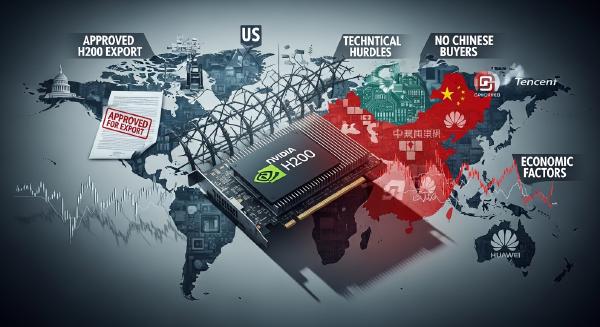
Furthermore, Nvidia’s reduced presence in China has been heavily influenced by export restrictions and changes in the availability of its advanced AI accelerators. Its current market position therefore cannot be interpreted purely as a result of direct product competition.
If regulatory and supply conditions change, the competitive dynamics could change as well.
🚀 The Next Battle Is About Scale and Sustainability #
Ascend’s reported rise from approximately 3% market share in 2022 to around 50% today would represent one of the most significant changes in the AI accelerator market in recent years.
But gaining market share is only one stage of building a sustainable computing platform.
Huawei still needs to expand production capacity, maintain competitive accelerator performance, improve software compatibility, support increasingly large AI clusters, and continue attracting developers and enterprise customers.
Production capacity may be particularly important in the near term. If domestic demand already exceeds Huawei’s available supply, expanding manufacturing output could determine how quickly Ascend can consolidate its position.
The long-term question is whether Huawei can transform its current domestic momentum into a durable AI computing ecosystem that remains competitive as processor architectures, AI models, and system requirements evolve.
🔮 Ascend’s Market-Share Gain Is Only the Beginning #
Huawei’s reported figures point to a fundamental change in China’s AI accelerator landscape.
Nvidia once dominated the domestic market, while Ascend occupied only a small share. Four years later, Huawei claims that the positions have effectively reversed.
The exact market percentages should be treated cautiously because the available figures come primarily from Huawei’s own tracking. Nevertheless, the combination of growing domestic demand, expanding Ascend deployments, increasingly mature software support, and large-scale AI infrastructure development demonstrates that China’s AI computing market is no longer dependent on a single accelerator ecosystem.
For Huawei, the next challenge is no longer simply proving that Ascend can compete. It is scaling production, strengthening the software ecosystem, and maintaining technological momentum over the long term.
For Nvidia, the Chinese market presents a different challenge: maintaining relevance in a market where domestic alternatives are becoming increasingly integrated into the hardware and software stack.
The reported reversal is therefore less about one market-share statistic than the emergence of a parallel AI computing ecosystem—and the competition between these ecosystems is likely to become increasingly important in the years ahead.