OpenAI and Samsung: Is Its AI Chip Supply Chain Shifting?
OpenAI appears to be expanding its custom AI silicon strategy beyond a single manufacturing partner.
At a press conference in Seoul on September 9, Harrison Kim, General Manager of OpenAI Korea, said OpenAI’s cooperation with Samsung Electronics has expanded into the joint R&D and production of next-generation chips.
The statement potentially marks an important change in OpenAI’s hardware strategy. Previous cooperation between OpenAI and Samsung has focused heavily on memory and enterprise AI services, while the newly disclosed work extends into core chip development and manufacturing.
However, important details remain undisclosed. Neither company has identified the specific chip involved, Samsung’s precise manufacturing role, or whether a formal foundry agreement has been signed.
If Samsung eventually becomes a production partner for OpenAI’s custom AI accelerators, the company could establish a dual-source manufacturing strategy involving both Samsung and TSMC.
🔍 OpenAI and Samsung Expand Beyond Memory #
OpenAI’s relationship with Samsung is becoming broader than conventional memory procurement.
The latest public statement describes cooperation involving:
- Next-generation chip R&D
- Chip production
- AI hardware development
- Memory supply
- Enterprise AI services
The key uncertainty is what “production” means in practice.
Samsung could potentially participate in logic-chip wafer fabrication, chip design collaboration, advanced packaging, or another stage of the semiconductor manufacturing process. No specific division of responsibilities has been publicly confirmed.
The lack of technical details also makes it difficult to determine whether the cooperation concerns an inference accelerator, another AI ASIC, or a broader future silicon platform.
For now, the safest interpretation is that OpenAI is expanding its semiconductor partnership network rather than assuming Samsung has already become an official foundry supplier.
🧩 The Next-Generation Chip Is Not Confirmed as Jalapeño #
OpenAI has been developing custom AI accelerators for some time.
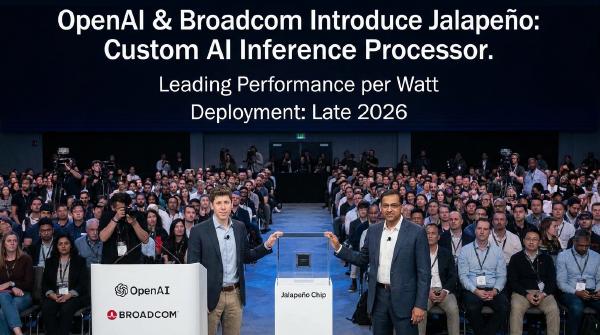
Its first reported custom inference accelerator, Jalapeño, was developed around OpenAI’s workload requirements. The project involved internal engineering, collaboration with Broadcom, and manufacturing through TSMC, including wafer fabrication and advanced packaging.
Industry speculation has suggested that Samsung’s new involvement could be related to a successor to Jalapeño.
That connection, however, remains unconfirmed.
The publicly described Samsung cooperation concerns a next-generation chip, and there is currently insufficient public information to establish whether it is a direct successor to Jalapeño or an entirely different OpenAI silicon project.
This distinction matters because OpenAI’s custom-chip roadmap could eventually include multiple accelerators optimized for different workloads rather than a single-generation product family.
⚙️ OpenAI’s Custom ASIC Strategy Is Expanding #
The move toward custom silicon reflects a broader shift in how large AI companies approach infrastructure.
Instead of relying exclusively on commercially available GPUs or other general-purpose accelerators, OpenAI can design ASICs around its own workloads, software stack, inference requirements, memory behavior, and data-center architecture.
A simplified development model looks like this:
OpenAI workload requirements
          │
          ▼
   Custom accelerator
       architecture
          │
          ▼
      Broadcom
   design collaboration
          │
          ▼
   Foundry + packaging
          │
     ┌────┴────┐
     ▼         ▼
   TSMC     Samsung?
The potential addition of Samsung would therefore represent more than another supplier relationship. It could give OpenAI additional manufacturing capacity and another path for scaling custom silicon.
🏭 Broadcom Could Be the Key Link #
Broadcom is particularly important to this potential supply-chain expansion.
OpenAI has reportedly agreed to procure 10 GW of custom AI accelerators from Broadcom, while Broadcom already has relationships spanning advanced semiconductor manufacturing and packaging.
Samsung and Broadcom also announced a strategic partnership covering AI infrastructure technologies, including advanced foundry, memory, and packaging, with a reported value exceeding $200 billion through 2030.
If OpenAI eventually decides to move some custom accelerator production from TSMC to Samsung, Broadcom could potentially serve as an important bridge between OpenAI’s chip requirements and the manufacturing ecosystem.
Conceptually, the relationship could look like:
                  OpenAI
                    │
          AI architecture /
          workload requirements
                    │
                    ▼
                Broadcom
                    │
          ┌─────────┴─────────┐
          │                   │
          ▼                   ▼
        TSMC              Samsung
    Wafer + packaging   Potential foundry
          │                   │
          └─────────┬─────────┘
                    ▼
             AI accelerators
                    │
                    ▼
             OpenAI data centers
This remains a strategic possibility rather than a confirmed production arrangement.
🔀 Dual-Sourcing Could Reduce Manufacturing Risk #
If Samsung eventually manufactures OpenAI accelerators alongside TSMC, OpenAI could gain a dual-source semiconductor supply chain.
The primary advantages would be straightforward.
Production capacity #
AI infrastructure demand is growing rapidly, and custom accelerator deployments can require enormous volumes of wafers, advanced packaging capacity, high-bandwidth memory, and other semiconductor components.
A second foundry could increase the pool of manufacturing resources available to OpenAI.
Supply-chain resilience #
Depending on a single foundry creates concentration risk.
Using multiple manufacturing partners can provide additional flexibility if one supplier encounters:
- Capacity constraints
- Yield problems
- Packaging bottlenecks
- Geopolitical disruptions
- Unexpected demand spikes
- Manufacturing schedule delays
However, dual sourcing is not automatically simple.
A chip cannot necessarily be transferred between foundries without engineering work. Differences in process technology, design rules, libraries, packaging flows, yield characteristics, and performance targets can require substantial redesign and validation.
That means OpenAI would need to balance supply-chain flexibility against the engineering cost of supporting multiple manufacturing platforms.
🔮 Memory Remains a Major Part of the Relationship #
The potential logic-chip partnership builds on an existing relationship in AI memory.
Samsung and SK Hynix have previously signed letters of intent related to supplying memory for OpenAI’s Stargate data-center project.
This is strategically important because modern AI accelerators depend heavily on high-bandwidth memory and advanced packaging.
A simplified AI accelerator supply chain therefore extends well beyond the compute die:
             AI Accelerator
                    │
        ┌───────────┼───────────┐
        ▼           ▼           ▼
      Logic       Memory     Packaging
       Die         HBM       Technology
        │           │           │
        └───────────┴───────────┘
                    │
                    ▼
              AI Server System
                    │
                    ▼
              Data Center
Samsung’s ability to participate across multiple semiconductor categories could make it strategically valuable to OpenAI as the company scales its AI infrastructure.
📈 TSMC May Not Be Losing OpenAI—But Samsung Could Gain a Role #
The emergence of Samsung as a potential manufacturing partner should not automatically be interpreted as OpenAI abandoning TSMC.
TSMC remains central to OpenAI’s reported first-generation custom accelerator manufacturing, including the Jalapeño program.
Instead, the more likely strategic interpretation is supply-chain diversification.
OpenAI could continue using TSMC for some generations or products while adding Samsung for future accelerators, additional capacity, or specific manufacturing requirements.
That approach would give OpenAI greater negotiating leverage and potentially more flexibility when allocating future production.
                    OpenAI
                       │
              Custom AI Silicon
                       │
            ┌──────────┴──────────┐
            │                     │
            ▼                     ▼
           TSMC               Samsung
        Existing role        Potential role
            │                     │
            └──────────┬──────────┘
                       ▼
              Larger Supply Base
                       │
                       ▼
              Scaled AI Infrastructure
The exact structure will depend on whether Samsung’s participation eventually extends to production-grade logic wafers.
⚠️ Samsung’s Foundry Role Is Still Unconfirmed #
Despite the strategic implications, several important questions remain unanswered.
OpenAI and Samsung have not publicly disclosed:
- The exact chip model involved
- The chip’s architecture
- Whether the design is a Jalapeño successor
- Samsung’s exact manufacturing responsibilities
- The process node being considered
- The packaging technology involved
- Whether Samsung will fabricate production wafers
- A mass-production schedule
- Whether a formal foundry agreement has been signed
As a result, it would be premature to describe Samsung as OpenAI’s confirmed second AI-chip foundry.
What can be said with greater confidence is that OpenAI is broadening its collaboration with Samsung into next-generation chip development and production.
🚀 OpenAI’s Silicon Strategy Is Becoming More Diversified #
OpenAI’s reported chip strategy is evolving from a relatively straightforward model—custom accelerator design combined with external manufacturing—toward a broader semiconductor ecosystem.
The company already has relationships involving Broadcom, TSMC, Samsung, SK Hynix, memory suppliers, packaging technologies, and large-scale AI infrastructure.
The potential addition of Samsung as another manufacturing source could eventually give OpenAI more options for scaling custom silicon.
For TSMC, this does not necessarily mean losing OpenAI. For Samsung, however, it could represent an opportunity to move deeper into one of the world’s most strategically important AI hardware ecosystems.
The key question is no longer whether OpenAI is interested in custom silicon. Its existing accelerator program makes that clear.
The bigger question is how many manufacturing partners OpenAI ultimately needs to build AI infrastructure at the scale of its long-term ambitions.
For now, Samsung’s role remains unconfirmed—but the latest statement suggests that OpenAI’s custom-chip supply chain is becoming increasingly diversified.