AMD Ryzen 9 9950X3D PassMark Scores: Benchmark Analysis
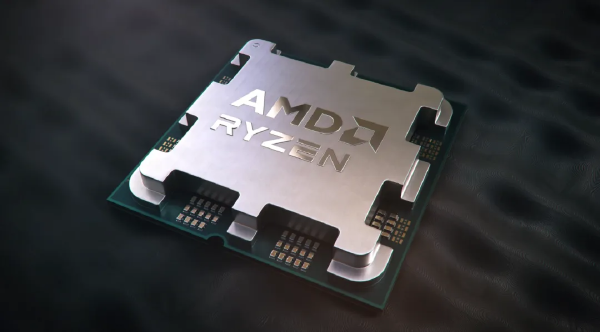
Early PassMark results for AMD’s Ryzen 9 9950X3D offered a first look at the performance potential of the company’s Zen 5 flagship desktop processor. With 16 cores, 32 threads, and second-generation 3D V-Cache technology, the CPU targets enthusiasts who want strong gaming performance without sacrificing multithreaded computing power.
The benchmark figures reported at the time suggested improvements over the previous-generation Ryzen 9 7950X3D, along with competitive results against AMD’s own Ryzen 9 9950X and Intel’s Core Ultra 9 285K.
However, leaked benchmark results are only one part of the performance picture. Results can vary with system configuration, firmware, background processes, and benchmark version, so the figures below should be understood as reported test results rather than guaranteed real-world performance.
📊 PassMark Results: Strong Single- and Multi-Threaded Performance #
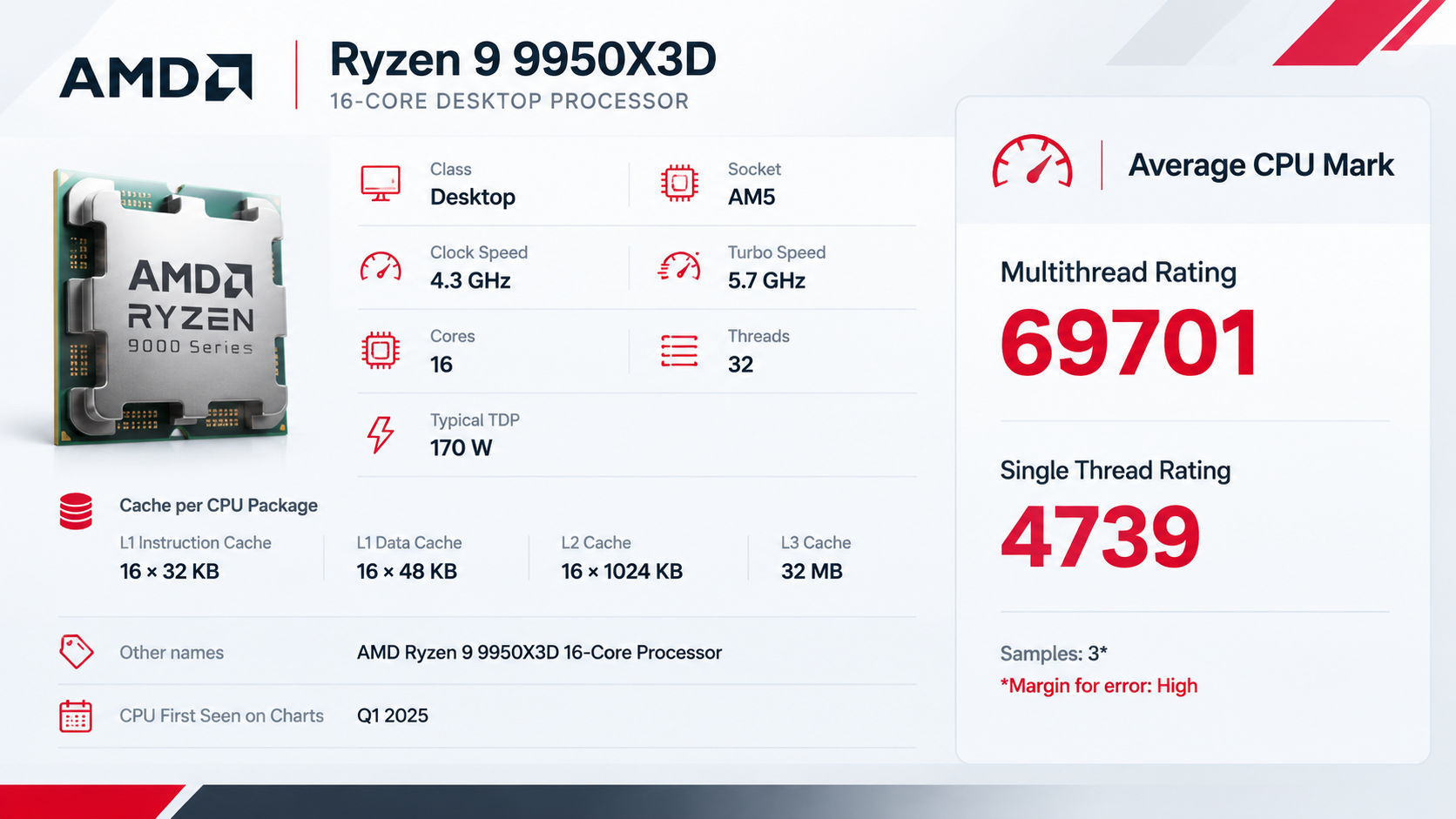
The reported Ryzen 9 9950X3D scores were:
- Multi-threaded score: 69,702
- Single-threaded score: 4,739
These results suggest that the processor combines high single-threaded performance with substantial throughput across its 16 cores. That balance is important for a flagship CPU expected to serve both gaming systems and productivity workstations.
PassMark is useful for comparing processors under a standardized test, but its scores do not directly predict frame rates in every game or completion times in every professional application.
The reported figures also need to be interpreted in context: a single benchmark submission is not equivalent to an independently repeated review using multiple systems and workloads.
🧠 Ryzen 9 9950X3D Specifications and Architecture #
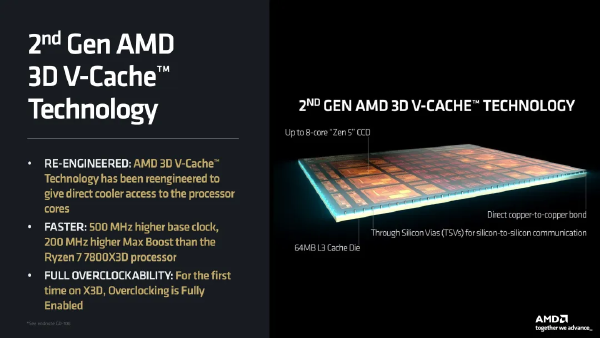
The Ryzen 9 9950X3D is based on AMD’s Zen 5 architecture and uses a chiplet design with two eight-core compute chiplets, or CCDs. One CCD incorporates additional stacked cache, while the other uses a conventional cache configuration.
Key specifications include:
- CPU architecture: Zen 5
- Cores and threads: 16 cores / 32 threads
- Base clock: 4.3 GHz
- Maximum boost clock: Up to 5.7 GHz
- Default TDP: 170 W
- Total L3 cache: 128 MB
The cache configuration is central to the processor’s gaming strategy. Additional L3 cache can keep frequently accessed game data closer to the CPU cores, reducing the need to retrieve that data from system memory.
This can improve performance in cache-sensitive workloads, although the size of the benefit depends on the game engine, thread placement, memory behavior, and graphics settings.
AMD’s 170 W TDP also places the processor in the high-performance desktop category. TDP is a thermal design specification, not a direct measurement of maximum power consumption, so actual power draw depends on workload and platform settings.
📈 How the 9950X3D Compares with Other Flagship CPUs #
The reported PassMark results suggest that the Ryzen 9 9950X3D improves on the previous-generation Ryzen 9 7950X3D and performs competitively against Intel’s Core Ultra 9 285K.
| Processor | Reported multi-thread score | Reported single-thread score |
|---|---|---|
| Ryzen 9 9950X3D | 69,702 | 4,739 |
| Ryzen 9 9950X | Approximately 66,363 | Not specified |
| Core Ultra 9 285K | Not specified | Not specified |
According to the original comparison, the 9950X3D leads the Ryzen 9 9950X by approximately 5% in multi-threaded PassMark performance. The article also reports an 11.5% multi-threaded improvement and a 14.1% single-threaded improvement over the Ryzen 9 7950X3D.
These percentages should be treated as results from the cited comparison rather than universal performance guarantees. A reliable ranking requires comparable test conditions and multiple benchmark runs.
The Core Ultra 9 285K comparison is similarly workload-dependent. PassMark scores can help establish a broad performance baseline, but they cannot determine which processor is better for every game or professional application.
🎯 Gaming Performance: Where 3D V-Cache Matters Most #
AMD’s X3D processors are particularly attractive to gamers because large L3 caches can reduce the frequency with which CPU cores need to retrieve frequently used data from system memory.
The original report cites AMD’s gaming tests at 1080p with high settings, claiming average performance improvements of:
- 8% over the Ryzen 9 7950X3D
- 20% over the Core Ultra 9 285K
- Up to 58% in Counter-Strike 2 in the reported comparison
These are vendor-reported figures, not independent results that necessarily apply to every system. Gaming performance varies with the titles selected, graphics card, resolution, game settings, and benchmark methodology.
At 1080p, a powerful graphics card is more likely to encounter a CPU bottleneck, making differences between processors easier to observe. At higher resolutions, the GPU often becomes the limiting factor, potentially narrowing the gap between CPUs.
For a related discussion of AMD’s cache-focused design, see AMD Ryzen 9000X3D: How the New 3D V-Cache Design Works.
🛠️ Productivity and Content Creation #
The Ryzen 9 9950X3D is not exclusively a gaming processor. Its 16 cores and 32 threads also make it suitable for demanding workloads such as 3D rendering, video editing, software compilation, and data compression.
The source article reports that AMD’s tests across 20 applications showed the 9950X3D outperforming the Ryzen 9 7950X3D by 13% and the Core Ultra 9 285K by 10% in productivity performance.
Applications such as Blender and 7-Zip can benefit from substantial multithreaded throughput, although the exact advantage depends on how each application uses CPU cores, cache, and memory bandwidth.
For professional users, the important distinction is that 3D V-Cache does not accelerate every workload equally. Cache-sensitive tasks may benefit significantly, while workloads dominated by raw computation, memory bandwidth, or GPU acceleration may show smaller gains.
⚙️ Power, Cooling, and Platform Considerations #
With a rated TDP of 170 W, the Ryzen 9 9950X3D requires an appropriately designed cooling solution and a motherboard capable of supporting its power and thermal requirements.
TDP should not be confused with maximum system power consumption. Actual CPU power draw depends on the workload, firmware settings, and processor boost behavior.
Before choosing the 9950X3D for a new build, buyers should consider:
- Cooling: A capable CPU cooler helps maintain sustained boost performance.
- Motherboard compatibility: Confirm BIOS support and the required AM5 platform features.
- Memory configuration: Stable DDR5 settings and suitable memory timings can affect performance.
- Power delivery: A well-designed motherboard is important for sustained workloads.
- Total system cost: Compare the processor, motherboard, memory, and cooling costs rather than CPU prices alone.
🧩 Ryzen 9 9900X3D: An Alternative for High-End Builds #
The Ryzen 9 9900X3D occupies a lower core-count tier, with 12 cores and 24 threads. It uses the same general Zen 5 and 3D V-Cache strategy, targeting users who want strong gaming performance alongside additional multithreaded capacity.
Its appeal depends on pricing and workload. For primarily gaming-focused systems, the Ryzen 7 9800X3D may also be worth considering, while users with heavier rendering or compilation workloads may benefit from the extra cores in the Ryzen 9 family.
The best choice is therefore not necessarily the processor with the highest synthetic benchmark score. It is the one that delivers the right balance of gaming performance, productivity throughput, power requirements, and cost for the intended workload.
🏁 Conclusion #
The reported PassMark results position the Ryzen 9 9950X3D as a strong Zen 5 flagship, combining 16 cores and 32 threads with 128 MB of L3 cache and second-generation 3D V-Cache technology.
The early figures suggest improvements over the Ryzen 9 7950X3D and competitive multithreaded performance against Intel’s Core Ultra 9 285K. AMD’s gaming and productivity claims also point to a processor designed to serve both enthusiasts and demanding creators.
Nevertheless, synthetic benchmark scores and manufacturer-selected application tests provide only part of the picture. Independent reviews, repeatable gaming benchmarks, application-specific testing, and power measurements are essential for evaluating its real-world value.
For buyers seeking one desktop processor for both high-refresh-rate gaming and multithreaded productivity, the Ryzen 9 9950X3D is a compelling option to evaluate against its direct competitors.