
AMD DGF and DGFS: Geometry Compression for RDNA 5
As real-time rendering moves toward film-quality geometric density, modern GPUs are increasingly constrained not only by shader throughput, but also by geometry bandwidth, memory footprint, and acceleration structure construction overhead.
To address these challenges, AMD has introduced two complementary technologies:
- DGF (Dense Geometry Format) — a hardware-oriented geometry storage format
- DGFS (DGF SuperCompression) — an advanced compression layer for geometry data
Together, they represent AMD’s attempt to bring texture-style compression efficiency to modern 3D geometry pipelines.
Unlike traditional approaches that rely purely on brute-force GPU scaling, DGF and DGFS focus on improving the efficiency of geometry storage, streaming, and ray tracing preparation.
🚀 Why Geometry Compression Matters #
Modern game engines increasingly rely on:
- Ultra-dense meshes
- Nanite-like virtualized geometry systems
- Hardware ray tracing
- Massive open-world asset streaming
- Real-time cinematic detail
As triangle counts move into the hundreds of millions, geometry itself becomes a major bandwidth consumer.
Traditional GPU pipelines were optimized around:
- Texture streaming
- Shader execution
- Raster throughput
But in next-generation rendering workloads, geometry processing introduces several new bottlenecks:
| Bottleneck | Impact |
|---|---|
| BVH construction overhead | Slower ray tracing updates |
| Vertex bandwidth pressure | Increased VRAM traffic |
| Geometry storage size | Larger install footprints |
| Streaming latency | Asset pop-in and stuttering |
| Cache inefficiency | Reduced GPU utilization |
AMD’s DGF ecosystem directly targets these issues.
🧩 Understanding DGF: Dense Geometry Format #
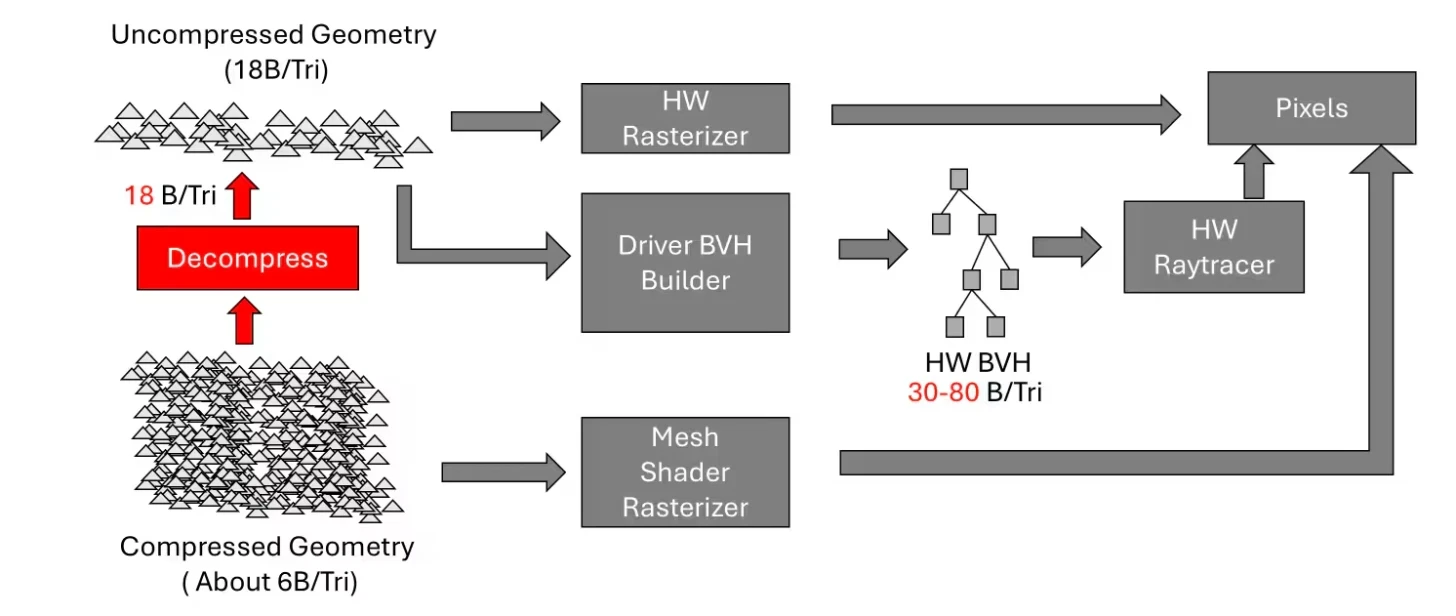
At its core, DGF transforms geometry into a compact, fixed-size block structure optimized for GPU processing.
Instead of treating a mesh as one enormous stream of vertices and triangles, DGF partitions geometry into small clusters called Meshlets.
Core DGF Characteristics #
| Feature | Specification |
|---|---|
| Block Size | 128 bytes |
| Maximum Vertices | 64 |
| Maximum Triangles | 64 |
| Data Layout | Fixed-size hardware-friendly blocks |
| Primary Goal | Efficient streaming and ray tracing preparation |
This design provides several advantages:
- Predictable memory access patterns
- Improved cache locality
- Reduced geometry management overhead
- Faster traversal during ray tracing
- More efficient GPU scheduling
Meshlets as the Fundamental Unit #
Meshlets are increasingly becoming the preferred geometry unit in modern rendering architectures.
Instead of processing massive monolithic meshes, GPUs operate on small geometry clusters independently.
This aligns well with:
- Mesh shaders
- GPU-driven rendering
- Cluster culling
- Virtualized geometry systems
- Hardware ray tracing acceleration
DGF standardizes this concept into a compact transport and storage format.
⚙️ DGFS: The Compression Layer #
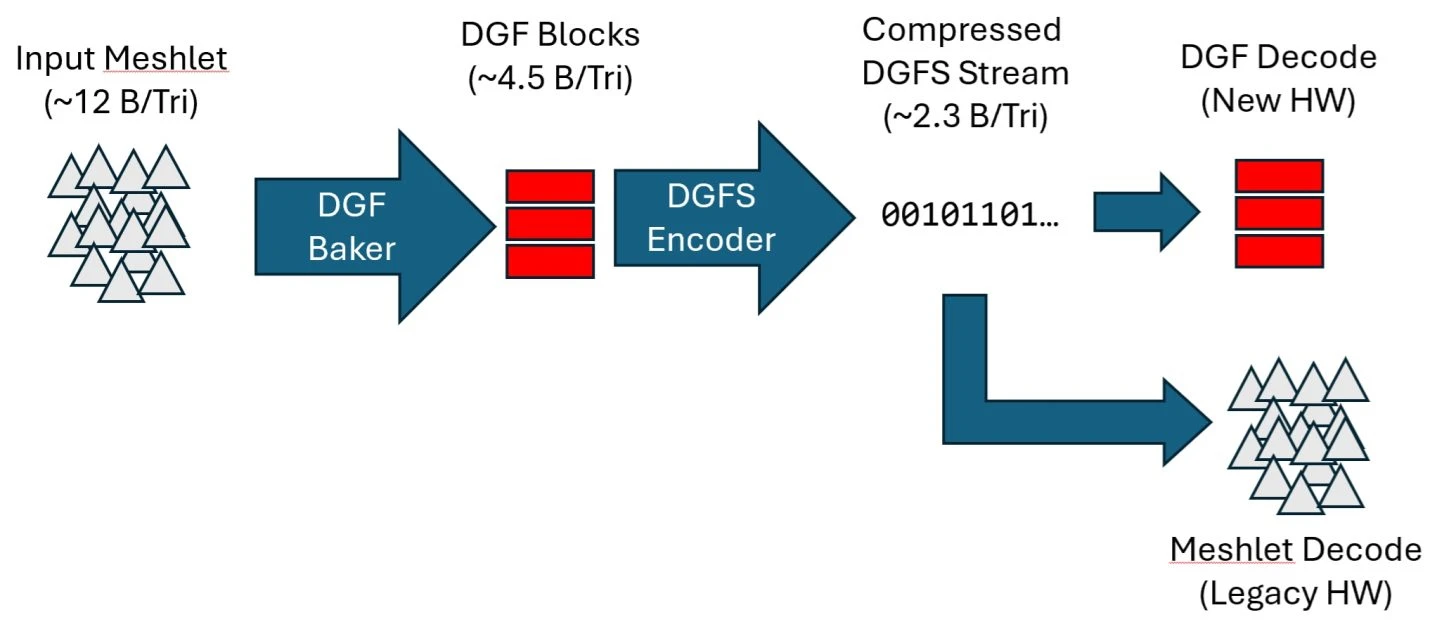
If DGF defines the geometry container, DGFS provides the compression engine.
DGFS introduces a secondary optimization stage that significantly reduces storage and streaming overhead without visibly degrading visual quality.
Key Compression Techniques #
Vertex De-Duplication #
DGFS detects repeated vertices across mesh blocks and eliminates redundant storage.
This is particularly effective for:
- Shared edges
- Smooth surfaces
- Repeated topology regions
Delta Encoding #
Rather than storing absolute coordinates for every vertex, DGFS stores relative differences between nearby points.
Example:
Absolute:
V1 = (1000, 500, 200)
V2 = (1002, 501, 201)

Delta:
V2 = (+2, +1, +1)
Since neighboring vertices are often spatially close, delta values require far fewer bits.
Quantization #
DGFS intelligently reduces precision where full floating-point accuracy is unnecessary.
Benefits include:
- Smaller geometry footprint
- Lower bandwidth requirements
- Faster streaming
Importantly, the quantization strategy is designed to minimize visible artifacts.
📊 Compression Results #
AMD demonstrated DGFS using a high-density dragon model benchmark.
Dragon Benchmark Results #
| Metric | Raw DGF | After DGFS |
|---|---|---|
| Geometry Size | ~20.3 MB | ~15.2 MB |
| Reduction | — | ~25.1% |
Across broader testing datasets, AMD reports:
- Typical compression savings of 20%–30%
- Minimal visual degradation
- Reduced geometry streaming cost
These savings become increasingly important at scale.
For example:
| Scene Complexity | Potential Savings |
|---|---|
| 100 GB geometry dataset | 20–30 GB reduction |
| Large open-world games | Reduced SSD bandwidth demand |
| Ray-traced scenes | Lower BVH preparation cost |
🎮 Ray Tracing and BVH Optimization #
One of DGF’s most important goals is accelerating ray tracing workloads.
Modern ray tracing pipelines rely heavily on:
- BVH (Bounding Volume Hierarchy) generation
- Geometry traversal efficiency
- Memory coherence
Dense geometry significantly increases BVH complexity.
By organizing geometry into compact Meshlets, DGF improves:
- BVH construction efficiency
- Traversal locality
- GPU cache utilization
This is especially relevant for:
- Dynamic scenes
- Path tracing
- Real-time global illumination
- Large-scale virtualized geometry
💾 VRAM Efficiency in RDNA 5 #
AMD’s long-term vision extends beyond storage compression.
On future RDNA 5 hardware, DGF may support:
- Direct GPU consumption of compressed geometry
- Reduced decompression overhead
- Lower active VRAM usage
Potential Benefits #
| Scenario | Traditional Pipeline | DGF Pipeline |
|---|---|---|
| Geometry Storage | Fully decompressed | Partially compressed |
| VRAM Footprint | Higher | Lower |
| Streaming Bandwidth | Heavy | Reduced |
| Asset Density | Limited by VRAM | Increased |
AMD suggests that:
- A 12GB GPU could potentially handle geometry workloads comparable to a conventional 16GB card.
This is particularly valuable as:
- GPU memory prices rise
- Asset sizes continue expanding
- Real-time path tracing becomes mainstream
🕹️ Console Strategy: PlayStation 6 and Xbox #
DGF is also strategically important for next-generation consoles.
Since AMD supplies semi-custom APUs for:
- PlayStation
- Xbox
its geometry pipeline innovations can directly influence console architecture.
Why Consoles Need DGF #
Future console workloads will likely demand:
- Movie-quality geometry density
- Real-time ray tracing
- Massive open-world streaming
- AI-assisted asset generation
However, consoles remain constrained by:
- Fixed memory pools
- Limited power budgets
- Bandwidth ceilings
DGF enables:
- Higher geometric detail without proportional VRAM increases
- More efficient SSD streaming
- Better scalability for ray tracing
Industry expectations suggest:
- PlayStation 6
- Next-generation Xbox (“Project Helix”)
could integrate hardware support for DGF-style geometry processing.
🔄 DGF vs NVIDIA RTX Mega Geometry #
AMD’s strategy differs from NVIDIA’s RTX Mega Geometry initiative.
NVIDIA Approach #
NVIDIA focuses heavily on:
- Massive GPU throughput
- Aggressive hardware acceleration
- AI-assisted geometry processing
AMD Approach #
AMD emphasizes:
- Data efficiency
- Compression
- Memory optimization
- Scalable geometry streaming
The philosophical difference is important:
| Vendor | Primary Focus |
|---|---|
| NVIDIA | Raw geometry processing power |
| AMD | Geometry efficiency and compression |
Both approaches aim to solve the same industry problem:
- Exploding geometric complexity.
🏗️ Implications for Game Engines #
If widely adopted, DGF-style geometry formats could reshape engine design.
Potential engine-level impacts include:
- New asset import pipelines
- Meshlet-native rendering architectures
- Reduced installation sizes
- Improved streaming systems
- More scalable ray tracing workflows
Future engines may increasingly treat geometry similarly to textures:
- Streamable
- Compressed
- Virtualized
- Dynamically decoded
This mirrors the evolution already seen with:
- Texture compression
- Virtual textures
- Shader compilation pipelines
📌 Conclusion #
AMD’s DGF and DGFS technologies signal a broader industry transition from brute-force rendering toward geometry-aware data efficiency.
Rather than simply increasing:
- Shader counts
- Memory bandwidth
- Raw compute throughput
AMD is targeting one of the next major bottlenecks in graphics:
- Geometry storage and movement.
By introducing:
- Fixed-size geometry blocks
- Meshlet-centric pipelines
- Advanced geometry compression
- Ray tracing optimization
AMD aims to make ultra-dense 3D worlds more practical on mainstream hardware.
As rendering complexity continues rising, geometry compression may become as essential to future GPUs as texture compression is today.