An unreleased X3D processor has once again appeared in the public Geekbench database. This time, the spotlight is on the Ryzen 9 9950X3D2, a chip that reportedly features the largest L3 cache ever seen on a desktop CPU.
With the same platform and core count as existing Ryzen 9000 flagships, the comparison is unusually clean—and the performance uplift is immediately noticeable.
📊 Geekbench Results: Around 7% Faster #
According to Geekbench 6.5.0 entries, the Ryzen 9 9950X3D2 posts:
- Single-core: 3,553
- Multi-core: 24,340
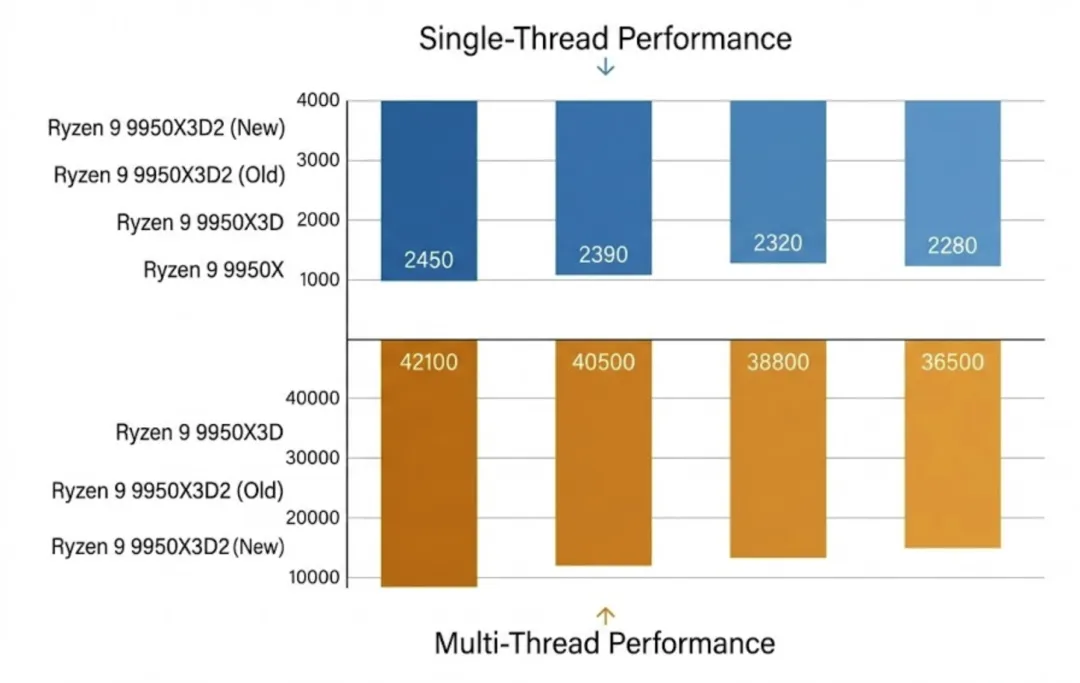
Compared with previously leaked results for the 9950X3D, this translates into an approximate 7% improvement in both single-core and multi-core performance.
What makes this especially notable is that clock speeds remain unchanged:
- Maximum boost clock: 5.6 GHz
- This is actually lower than the 5.7 GHz boost of the standard Ryzen 9 9950X
The gains, therefore, are not frequency-driven.
🔮 Dual-X3D Cache Architecture Explained #
The real innovation lies entirely in the cache configuration.
- 16 cores / 32 threads, unchanged
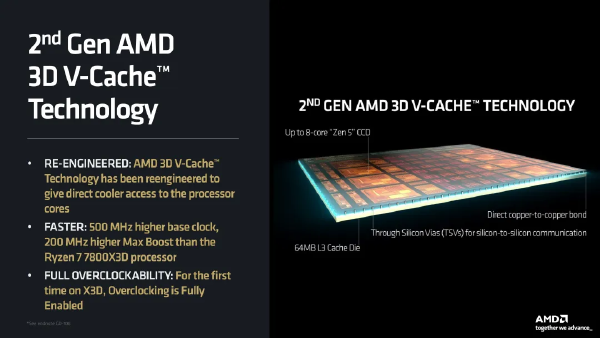
- Two CCDs, each equipped with 96 MB of 3D V-Cache
- Total L3 cache: 192 MB
This marks the first known desktop CPU with 3D V-Cache stacked on both CCDs simultaneously. By contrast, the standard 9950X3D uses a single X3D CCD design, where only one chiplet carries the additional cache.
The architectural shift alone explains nearly all of the observed benchmark improvement.
⚙️ Why Cache Matters More Than Clock Speed #
Geekbench workloads emphasize mixed instruction paths and memory access patterns. When scores rise without higher clocks, cache efficiency is usually the reason.
Key advantages of the dual-X3D layout include:
- Improved cache locality: Threads are less likely to access data across CCD boundaries.
- Lower effective latency: Reduced reliance on cross-CCD L3 lookups.
- Stronger multi-core scaling: Multi-threaded gains slightly exceeding single-core gains reinforce the cache-efficiency hypothesis.
In short, the CPU spends less time waiting for data and more time executing instructions.
🔥 Power and Thermal Considerations #
To accommodate the denser cache configuration, AMD appears to have adjusted power limits:
- TDP increased to 200W
- Standard 9950X3D TDP: 170W
Rather than pushing frequencies higher, this extra headroom likely helps manage thermal density and stability introduced by dual stacked V-Cache layers. It suggests AMD is prioritizing sustained performance and reliability over peak boost numbers.
🧭 Product Positioning and Strategy #
If current rumors are accurate, the 9950X3D2 will sit at the very top of the Ryzen 9000 stack. Its role appears strategic rather than mainstream:
- Architectural validation: Proving that dual X3D CCDs are viable on desktop platforms.
- Minimal trade-offs: Early Geekbench data shows no obvious regression in general-purpose performance.
- Halo product: A showcase of what Zen + 3D V-Cache can achieve when cache constraints are removed.
🎮 What This Means for Gamers #
While Geekbench highlights compute efficiency, gaming performance remains the big unknown. An additional 64 MB of L3 cache could offer diminishing returns depending on engine behavior and thread distribution.
Real-world gaming benchmarks will ultimately determine whether the dual-X3D design is a revolution—or simply an impressive technical milestone.
For now, the leak strongly suggests that cache architecture, not clock speed, is the next frontier of high-end desktop CPU performance.