AMD Ryzen PRO 9000 Brings 3D V-Cache to Enterprise PCs
AMD has officially expanded its enterprise desktop portfolio with the introduction of six new Ryzen PRO 9000 Series processors based on the Zen 5 architecture.
The launch resolves months of speculation surrounding several previously rumored X3D processors. Rather than debuting as enthusiast gaming chips, AMD has positioned these cache-heavy designs as commercial workstation processors targeted at enterprise deployments and OEM-integrated professional systems.
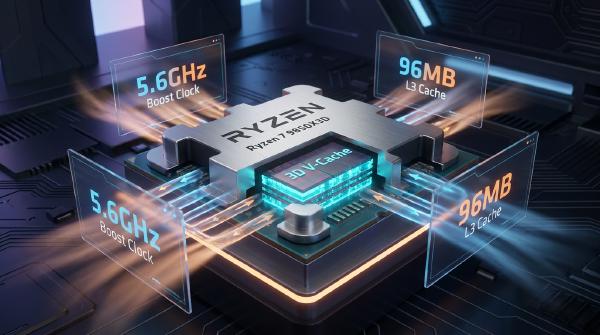
Most importantly, this marks the first time AMD has brought 3D V-Cache technology into its PRO workstation lineup.
That decision signals a broader evolution for X3D architecture. What was once viewed primarily as a gaming-focused innovation is now being repositioned as a serious acceleration layer for professional engineering, simulation, rendering, and data-intensive workstation workloads.
🚀 Ryzen PRO 9000 Lineup Overview #
The Ryzen PRO 9000 family supplements AMD’s existing low-power business desktop stack with significantly higher-performance workstation-oriented models.
These processors operate within a sustained 120W to 170W TDP envelope, enabling higher all-core frequencies and long-duration workload stability for professional compute environments.
| Processor | Cores / Threads | Base / Boost Clock | Cache | TDP | Target Workloads |
|---|---|---|---|---|---|
| Ryzen 9 PRO 9965X3D | 16C / 32T | 4.3 GHz / 5.5 GHz | 144 MB | 170W | Simulation, VFX, 8K media |
| Ryzen 9 PRO 9965 | 16C / 32T | 4.3 GHz / 5.5 GHz | 80 MB | 170W | Compilation, analytics |
| Ryzen 9 PRO 9955 | 12C / 24T | 3.4 GHz / 5.4 GHz | 76 MB | 120W | Virtualization, CAD |
| Ryzen 7 PRO 9755X3D | 8C / 16T | 4.7 GHz / 5.2 GHz | 104 MB | 120W | Cache-heavy analytics |
| Ryzen 7 PRO 9755 | 8C / 16T | 3.8 GHz / 5.4 GHz | 40 MB | 120W | Enterprise desktops |
| Ryzen 5 PRO 9655 | 6C / 12T | 3.9 GHz / 5.4 GHz | 38 MB | 120W | Entry workstation fleets |
All six processors also integrate a compact dual-core RDNA 2 graphics engine, allowing enterprise systems to operate without dedicated GPUs for standard office, development, and non-visual workstation tasks.
For businesses deploying thousands of systems, this reduces both acquisition cost and power consumption.
🧠 Why AMD Is Bringing 3D V-Cache Into Workstations #
Historically, AMD’s X3D branding became synonymous with gaming performance.
The massive vertically stacked L3 cache dramatically improved frame rates in CPU-bound titles by reducing memory access latency and improving data locality.
However, many professional workloads exhibit very similar architectural bottlenecks.
How 3D V-Cache Accelerates Professional Applications #
TRADITIONAL MEMORY ACCESS

CPU Core ─────► System DDR5 Memory ─────► Latency Bottleneck


3D V-CACHE WORKSTATION FLOW

Zen 5 Core ─────► Massive On-Die L3 Cache ─────► Reduced Memory Stall Time
Applications that repeatedly access large structured datasets can benefit enormously from expanded cache pools.
Examples include:
- Finite element analysis (FEA)
- Computational fluid dynamics (CFD)
- CAD simulation
- Physics modeling
- Scientific visualization
- Real-time engineering workloads
- AI-assisted local inference
- Complex geometry rendering
In these environments, CPUs often spend significant time stalled while waiting for data retrieval from external memory.
Larger L3 cache dramatically reduces those delays.
The result is not simply higher peak throughput, but more consistent computational responsiveness during sustained workloads.
⚙️ Ryzen 9 PRO 9965X3D: AMD’s Flagship Workstation Chip #
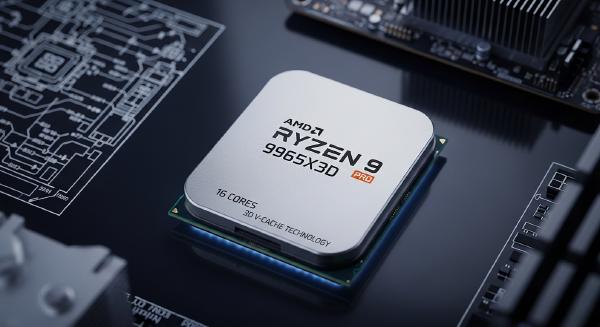
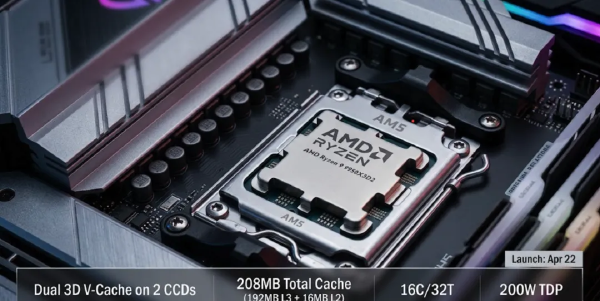
The centerpiece of the launch is the Ryzen 9 PRO 9965X3D.
Key specifications include:
- 16 Zen 5 cores
- 32 threads
- 5.5 GHz boost frequency
- 144 MB total cache
- 170W TDP
The processor combines:
- High clock speeds
- Large core counts
- Expanded L3 cache
- Enterprise security features
within a standard AM5 workstation ecosystem.
AMD is clearly targeting professionals running mixed workloads where both single-thread responsiveness and parallel throughput matter simultaneously.
Examples include:
- Video editing
- Unreal Engine compilation
- Architectural rendering
- AI-enhanced production pipelines
- Engineering simulation
- Scientific computing
The large cache footprint may prove particularly valuable in heavily iterative workloads where memory latency becomes the dominant bottleneck.
🏗️ AM5 Platform Continuity Matters for Enterprises #
Another important aspect of the Ryzen PRO 9000 launch is AMD’s continued use of the AM5 platform.
This provides enterprise customers with:
- Long-term socket stability
- Simplified fleet upgrades
- Lower platform migration costs
- Existing ecosystem compatibility
For corporate deployments, motherboard continuity is often just as important as raw performance gains.
Organizations deploying workstation fleets typically prioritize:
- Predictable lifecycle management
- Standardized deployment images
- Stable firmware ecosystems
- Long-term procurement consistency
AM5 continuity helps AMD strengthen its position against enterprise Intel deployments where platform transitions can sometimes require broader infrastructure replacement.
🔒 Enterprise Security and Reliability Features #
The PRO series differentiates itself from consumer Ryzen products primarily through enterprise management and security capabilities.
ECC DDR5 Memory Support #
Ryzen PRO 9000 processors officially support up to:
- 256 GB ECC DDR5 memory
ECC support is particularly important for workloads involving:
- Scientific simulation
- Long-duration rendering
- Financial modeling
- Large virtualization environments
- Mission-critical engineering tasks
Error-correcting memory reduces the risk of silent data corruption during extended computational workloads.
AMD PRO Security Framework #
AMD also includes several hardware-enforced security features under its AMD PRO Security platform.
Key technologies include:
- AMD Memory Guard
- Shadow Stack
- Hardware memory encryption
- Firmware-level protections
Memory Guard #
AMD Memory Guard transparently encrypts system memory to defend against physical attack vectors such as cold-boot extraction attacks.
This is particularly valuable for enterprise laptops and mobile workstation deployments containing sensitive intellectual property or regulated data.
Shadow Stack Protection #
Shadow Stack introduces hardware-assisted mitigation against return-oriented programming (ROP) attacks and certain classes of malware exploitation.
This reflects a broader trend across enterprise hardware vendors toward silicon-level security enforcement rather than relying solely on operating system protections.
💼 Why These CPUs Are OEM-Focused #
Although the specifications may attract enthusiast attention, the Ryzen PRO 9000 lineup is not designed for mainstream DIY consumers.
These processors are intended primarily for:
- OEM workstation vendors
- Enterprise fleet integrators
- Corporate procurement channels
Expected deployment partners include systems from manufacturers such as:
- Lenovo
- HP
- Dell
- Enterprise workstation integrators
Consumers are unlikely to find boxed retail variants through standard online retailers.
🎮 Why Ryzen PRO X3D Chips Are Not Ideal for Consumers #
For home users and gaming enthusiasts, the Ryzen PRO lineup offers little practical advantage over standard retail Ryzen X3D products.
Consumer buyers already have access to highly optimized gaming processors such as:
- Ryzen 7 9800X3D
- Ryzen 9 9950X3D
Those retail chips generally provide:
- Better consumer pricing
- Retail warranty coverage
- Easier motherboard compatibility
- Full enthusiast BIOS support
By contrast, gray-market PRO workstation chips may involve:
- Limited firmware support
- Enterprise-oriented feature overhead
- Inflated reseller pricing
- Restricted warranty handling
For most desktop enthusiasts, standard Ryzen X3D processors remain the better purchasing option.
📈 AMD’s Larger Strategy for X3D Technology #
The most important implication of this launch extends beyond the processors themselves.
AMD is repositioning 3D V-Cache as a broader compute acceleration technology rather than a niche gaming feature.
That transition is strategically significant.
As workloads increasingly become:
- Data-heavy
- Latency-sensitive
- AI-assisted
- Simulation-driven
cache capacity is becoming a critical scaling layer across both enterprise and consumer computing.
By integrating X3D into commercial workstation products, AMD is effectively validating that expanded on-die cache can deliver measurable value in:
- Professional rendering
- Scientific computing
- Industrial engineering
- AI inference
- High-throughput workstation pipelines
This could mark the beginning of a wider shift where large on-die cache architectures become standard across future enterprise compute platforms.
🎯 The Bottom Line #
The Ryzen PRO 9000 launch demonstrates that AMD now sees 3D V-Cache as far more than a gaming optimization.
By combining:
- Zen 5 architecture
- Large cache pools
- Enterprise security
- ECC memory support
- AM5 platform continuity
AMD has created a workstation-focused processor family optimized for modern professional workloads where latency and data locality increasingly dominate performance characteristics.
While mainstream consumers are unlikely to purchase these processors directly, the broader industry implication is clear:
Large on-die cache is evolving into a foundational enterprise compute technology, not merely an enthusiast gaming enhancement.