AMD Unveils Zen 6 EPYC Venice and Expands CPU Portfolio Across Servers, Gaming, and OEM Markets
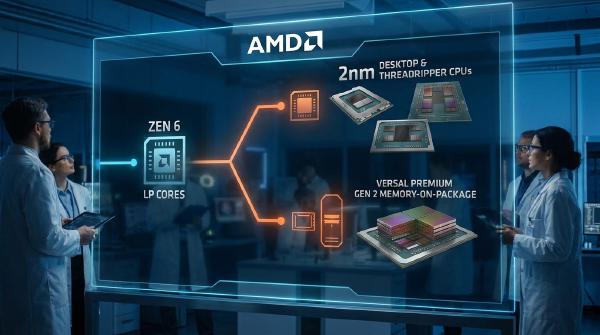
AMD has officially confirmed that its next-generation EPYC Venice server processor, built on the Zen 6 architecture, will debut during the company’s Advancing AI event on July 22–23. More than a routine product launch, Venice represents a major milestone for the semiconductor industry as the first high-performance computing (HPC) processor manufactured using TSMC’s 2nm process technology.
Beyond its next-generation server platform, AMD has also expanded its CPU portfolio across multiple market segments. While Zen 6 pushes the performance envelope in enterprise computing, the company continues to maximize the value of mature architectures through new OEM processors, mobile APUs, and gaming-focused platforms, illustrating a multi-tier strategy that spans data centers, consumer PCs, and esports ecosystems.
🚀 Zen 6 EPYC Venice Marks AMD’s First 2nm Server CPU #
AMD Chief Technology Officer Mark Papermaster confirmed that EPYC Venice will be officially unveiled during the company’s upcoming AI event.
Venice is the sixth generation of AMD’s Zen microarchitecture since the original Zen platform debuted in 2017 and becomes the industry’s first mass-produced HPC processor fabricated on TSMC’s 2nm node.
The new platform targets hyperscale cloud providers, AI infrastructure operators, and enterprise data centers demanding higher compute density and improved energy efficiency.
Two Zen 6 Variants Target Different Workloads #
AMD will introduce Venice in two core configurations:
- Zen 6, optimized for maximum per-core performance
- Zen 6C, optimized for high-density cloud and AI deployments
The flagship Zen 6C SKU scales to:
- 256 CPU cores
representing approximately a 33% increase over the current 192-core EPYC Turin generation.
Meanwhile, the standard Zen 6 lineup will support configurations of up to:
- 96 high-performance cores
allowing customers to prioritize either maximum throughput or stronger single-threaded performance depending on deployment requirements.
⚡ Major Performance and Efficiency Improvements #
AMD positions Venice as a substantial architectural upgrade rather than a simple process shrink.
According to the company, the new platform delivers:
- More than 70% higher overall performance-per-watt
- Over 30% higher thread density
- Up to 50% higher performance in SPEC benchmark workloads
These improvements are particularly significant for AI inference, virtualization, high-performance computing, and cloud-native enterprise workloads where rack density and operating efficiency directly influence total cost of ownership.
🏗️ New SP7 Platform Brings Next-Generation I/O #
Venice introduces an entirely new server platform built around the SP7 socket.
Key platform enhancements include:
Sixteen-Channel DDR5 Memory #
The processor supports:
- 16-channel DDR5 memory
- Up to 1.6 TB/s memory bandwidth
The expanded memory subsystem is designed to accommodate increasingly memory-intensive AI and scientific computing applications.
PCIe Gen 6 Support #
AMD also upgrades the platform to:
- PCI Express Gen 6
Compared with the previous generation, PCIe Gen 6 effectively doubles communication bandwidth between CPUs and GPUs, an increasingly important capability as AI clusters rely on accelerator-rich server architectures.
🏭 Production Is Already Underway #
AMD confirmed that EPYC Venice has already entered production using TSMC’s advanced 2nm manufacturing lines.
Initial production is centered in Taiwan, with future manufacturing expected to expand to TSMC’s Arizona fabrication facility, reflecting broader industry efforts to diversify advanced semiconductor manufacturing capacity.
📊 AMD Continues Expanding Its Server Market Share #
Venice arrives as AMD continues strengthening its position within the global server CPU market.
Recent industry data indicates that AMD EPYC accounted for approximately:
- 33.2% of global server CPU shipments during the first quarter of 2026.
The company’s consistent architectural improvements, aggressive core scaling, and strong AI platform positioning have steadily increased competitive pressure within the enterprise processor market.
Industry observers expect Venice to further reinforce AMD’s presence in cloud computing, AI infrastructure, and high-performance computing deployments.
Consumer-oriented Zen 6 desktop processors, however, are expected to arrive later in the year or during CES 2027.
🧩 AMD Continues Supporting Mature CPU Architectures #
While Zen 6 represents AMD’s technological frontier, the company continues extending the commercial life of previous processor generations.
Rather than replacing older architectures immediately, AMD is maintaining a layered product strategy that serves markets with varying performance, pricing, and lifecycle requirements.
💻 Ryzen 7 4700LE Quietly Joins the Lineup #
AMD recently introduced the Ryzen 7 4700LE, although the processor received almost no public announcement at launch.
Officially released in March 2026, the processor targets OEM system builders rather than retail consumers.
Key specifications include:
- Zen 2 architecture
- 7nm Renoir silicon
- 8 cores and 16 threads
- 3.6 GHz base clock
- Up to 4.2 GHz boost frequency
- 65W default TDP
- Configurable 45W–65W cTDP
- AM4 platform compatibility
Unlike the earlier Ryzen 7 4700G, the 4700LE completely removes integrated graphics and requires a discrete GPU.
Its cache configuration consists of:
- 4 MB L2 cache
- 8 MB L3 cache
- 12 MB total cache
The processor is positioned as an entry-level desktop solution despite its eight-core configuration, reflecting AMD’s continued utilization of mature silicon for cost-sensitive OEM platforms.
🖥️ OEM-Only Availability #
The Ryzen 7 4700LE is currently limited to system integrators and is unavailable through retail channels.
One example includes prebuilt gaming systems configured with:
- Ryzen 7 4700LE
- NVIDIA GeForce RTX 3050
- 16 GB DDR4-3200
- 512 GB SSD
targeting budget-conscious gaming consumers.
Alongside the desktop processor, AMD also introduced two Zen+ mobile processors aimed at affordable notebooks and embedded applications:
- Ryzen 5 3501U
- Ryzen 3 3100U
🎮 AMD Strengthens Its Gaming Ecosystem at BilibiliWorld 2026 #
AMD is simultaneously expanding its gaming ecosystem through strategic partnerships with esports organizations and hardware manufacturers.
At BilibiliWorld 2026, the company showcased a complete gaming platform built around four core initiatives:
- 1000 FPS esports computing
- Official VCTCN tournament hardware
- Next-generation Radeon graphics
- Prebuilt gaming systems
Official Hardware for VCTCN #
Working alongside TJ Sports, AMD introduced a collector’s edition hardware package supporting the Valorant Champions Tour China (VCTCN) 2026.
The platform includes:
- Ryzen 7 9800X3D
- Radeon RX 9070 XT
- Lenovo Legion R9000P
- Lenovo Blade 7000P desktop
The Ryzen 7 9800X3D serves as the tournament’s official processor.
Built on Zen 5, it features:
- 8 cores
- 16 threads
- Up to 5.2 GHz boost frequency
- Second-generation 3D V-Cache
- 96 MB L3 cache
Combined with the RX 9070 XT, the platform targets sustained ultra-high frame rates in competitive esports titles such as Valorant.
RDNA 4 Graphics Push Competitive Gaming #
The Radeon RX 9070 XT is based on AMD’s RDNA 4 architecture and includes:
- 16 GB GDDR6 memory
- FSR 4 upscaling
- Frame Generation
- Anti-Lag 2
Together, these technologies significantly improve gaming responsiveness while maintaining high image quality.
AMD also announced expanded collaboration with NetEase Games, integrating technologies including:
- FSR 4
- Ray Reconstruction
- Anti-Lag 2
- Neural Radiance Caching
into current and upcoming game titles.
📱 Hawk Point Lineup Expands with Eleven New Mobile Processors #
AMD has also quietly expanded its Hawk Point mobile processor family by introducing 11 additional models across the Ryzen 200 and Ryzen 100 series.
Ryzen 200 Series #
Seven processors join the Ryzen 200 lineup:
- Ryzen 3 205
- Ryzen 5 216
- Ryzen 7 217
- Ryzen 5 224
- Ryzen 5 225
- Ryzen 7 249
- Ryzen 7 253
These processors feature combinations of:
- Standard Zen 4 cores
- Zen 4c efficiency cores
For example, the Ryzen 3 205 combines:
- 2 Zen 4 cores
- 4 Zen 4c cores
creating a six-core, eight-thread hybrid design.
Ryzen 100 Series #
Four additional processors expand the Ryzen 100 family:
- Ryzen 9 180
- Ryzen 7 165
- Ryzen 7 155
- Ryzen 5 125
Although branded under the Ryzen 100 series, these processors are not based on the original Zen 3+ architecture.
Instead, they also belong to the Hawk Point family utilizing Zen 4, creating a notable crossover between product branding and underlying microarchitecture.
🎨 Integrated Radeon 700M Graphics Across the Lineup #
All newly introduced Hawk Point processors integrate Radeon 700M graphics.
Available GPU configurations include:
- Radeon 740M
- Radeon 760M
- Radeon 780M
Higher-end models such as the Ryzen 7 249 and Ryzen 7 253 include the Radeon 780M with 12 Compute Units, while mainstream Ryzen 5 variants utilize the Radeon 760M with 8 Compute Units.
This provides capable integrated graphics performance for mainstream notebooks without requiring discrete GPUs.
📈 AMD Is Building a Complete CPU Portfolio #
AMD’s latest announcements demonstrate a strategy extending well beyond flagship server processors.
At the high end, EPYC Venice introduces a new generation of 2nm server computing optimized for AI, cloud infrastructure, and high-performance computing. Simultaneously, the company continues extracting value from mature architectures through OEM-exclusive desktop processors, expanded mobile APU families, and gaming-focused hardware partnerships.
Rather than relying solely on leading-edge products, AMD is constructing a comprehensive processor portfolio that spans enterprise infrastructure, consumer desktops, laptops, embedded systems, and competitive gaming. This balanced approach enables the company to address multiple market segments while maximizing manufacturing efficiency and extending the commercial lifespan of proven architectures.