AMD Zen 6 Rumors: 13% IPC Gains and TSMC 2nm Process
AMD’s upcoming Zen 6 processor architecture is attracting attention following reports of potential performance improvements over the Zen 5 generation. A leak shared by AnandTech forum user adroc_thurston, as reported by OC3D, suggests that Zen 6 could deliver an approximately 13% increase in instructions per clock (IPC), alongside higher operating frequencies, larger core complex dies (CCDs), and improvements to memory and interconnect technology.
Although these performance figures remain unconfirmed, AMD has officially identified Zen 6 as its next-generation CPU architecture and included TSMC’s 2nm process in its manufacturing roadmap. The company has also outlined broader goals involving IPC, energy efficiency, and AI-related capabilities across future client and server processors.
The distinction between confirmed roadmap information and unofficial specifications is important. AMD has not verified the rumored 13% IPC improvement, 12-core CCDs, or the full scope of the proposed memory-subsystem changes. Reports suggesting a 2027 launch for desktop Zen 6 Ryzen processors should likewise be treated as estimates rather than an official release commitment.
If the rumors prove accurate, Zen 6 could improve performance through several complementary changes rather than relying on a single architectural enhancement. Higher IPC, increased clock speeds, additional cores per chiplet, and better memory behavior could collectively affect gaming, content creation, software development, and data-intensive workloads.
🚀 AMD Zen 6 Could Deliver a 13% IPC Improvement #
The most prominent claim in the latest Zen 6 leak is an approximately 13% IPC increase compared with Zen 5. The figure has attracted attention because IPC improvements can increase processor performance without requiring a corresponding increase in clock frequency or power consumption.
However, the number remains an unofficial estimate. AMD has not confirmed this specific percentage, and the available report does not establish the complete testing methodology, workload selection, or conditions under which the improvement was measured.
What IPC Means for CPU Performance #
Instructions per clock, commonly abbreviated as IPC, describes how efficiently a processor executes instructions during each clock cycle. It is a useful architectural metric, although actual instruction throughput depends on the workload, instruction mix, execution dependencies, and other microarchitectural factors.
A processor with higher IPC can potentially complete more work at the same clock frequency. If two CPUs operate at identical frequencies and one delivers 13% higher performance on a representative workload, that result indicates a substantial architectural improvement for that workload.
IPC is not a universal performance multiplier. Different applications place different demands on execution units, branch prediction, cache hierarchy, memory access, and instruction scheduling. A workload that benefits significantly from one architectural change may see only a small improvement from another.
The reported 13% figure should therefore be understood as a rumored generational improvement, not a guaranteed increase in every application. Without official testing details, it is also unclear whether the figure represents an average across selected benchmarks or another measurement methodology.
Why a 13% IPC Gain Could Matter #
A double-digit IPC improvement would be meaningful for a new CPU generation, particularly if AMD achieves it without substantially increasing power consumption or sacrificing clock speeds.
Higher IPC can improve workloads limited by execution throughput, instruction dependencies, or front-end efficiency. Potential beneficiaries include compilation, productivity applications, simulation, lightly threaded software, and games that depend heavily on CPU-side processing.
The actual benefit would still vary. Some applications are limited primarily by graphics performance, storage, memory capacity, or software synchronization rather than raw CPU throughput. In those cases, a generational IPC increase may translate into a smaller improvement in overall performance.
It is consequently too early to translate the rumored 13% IPC gain into a definitive claim about gaming frame rates, rendering times, or application benchmarks. Those comparisons require retail hardware and repeatable independent testing.
⚡ Higher Clock Speeds Could Increase Zen 6 Performance Further #
The same reports suggest that Zen 6-based Ryzen processors may operate at higher frequencies than their Zen 5 predecessors. If confirmed, higher clock speeds could complement the rumored IPC improvements and produce a larger performance increase than either factor would deliver independently.
CPU performance depends on several variables, including IPC, frequency, core count, cache behavior, and the degree to which software can execute work in parallel. In simplified CPU-bound scenarios, single-threaded performance is influenced by both the amount of work completed per clock cycle and the number of clock cycles completed per second.
How IPC and Frequency Work Together #
Assuming both IPC and frequency improve, their combined theoretical effect can exceed the IPC increase alone.
For illustration, suppose a future processor delivers 13% more performance per clock on a particular workload and operates at a sustained frequency 5% higher than its predecessor. Under otherwise comparable conditions, the combined performance ratio would be:
\[ 1.13 \times 1.05 = 1.1865 \]This represents an illustrative improvement of approximately 18.7% for that workload, not a prediction of actual Zen 6 performance. It assumes that the IPC gain and frequency increase apply to the same workload and that other factors do not limit performance.
Real processors do not necessarily maintain their maximum boost frequencies under every workload. Temperature, power limits, voltage requirements, cooling capacity, and the number of active cores can all affect operating frequency. Memory latency and software bottlenecks can also limit the realized performance gain.
Consequently, higher advertised boost clocks alone would not establish the size of the generational improvement. Sustained clock behavior, power efficiency, and benchmark results would be needed to evaluate Zen 6 accurately.
The Importance of Power Efficiency #
Frequency increases require careful management of voltage, power consumption, and thermal output. Pushing a processor toward higher frequencies can increase power requirements disproportionately, depending on the operating conditions.
Moving to a more advanced manufacturing process may provide opportunities to improve performance per watt, but process technology alone does not guarantee a specific efficiency gain. Architectural changes, manufacturing characteristics, voltage behavior, and product-level power limits all contribute to the final result.
AMD’s stated goals for Zen 6 include improved energy efficiency. If the company combines higher IPC and clock speeds with better performance per watt, the resulting processors could offer a more balanced generational upgrade than one based solely on frequency increases.
🧠 Zen 6 and Zen 4: A Potentially Similar Generational Step #
The rumored IPC improvement has prompted comparisons with AMD’s earlier Zen generations, particularly the transition from Zen 3 to Zen 4.
AMD’s Zen 4 architecture delivered a substantial IPC improvement over Zen 3 and introduced higher operating frequencies in its desktop products. Together, these changes contributed to a meaningful generational performance increase, although the magnitude varied by workload and processor model.
The reported 13% IPC improvement for Zen 6 has therefore led to speculation that the transition from Zen 5 to Zen 6 could follow a broadly similar pattern.
Why Historical Comparisons Need Context #
Generational comparisons can help establish expectations, but two architecture transitions rarely produce identical results. Differences in manufacturing technology, cache design, power limits, memory support, core configuration, and software behavior can all change the outcome.
The performance increase from Zen 3 to Zen 4 cannot be used to predict Zen 6 results directly. Even if the rumored IPC figure proves accurate, the final improvement in application performance will depend on how the new architecture interacts with clock speeds, core counts, cache capacity, and workload characteristics.
AMD’s use of separate design teams for different CPU generations has also encouraged speculation about similarities between future and previous architectures. However, the involvement of particular engineering teams does not establish that Zen 6 will reproduce Zen 4’s performance profile.
The most reliable comparison will come from independent benchmarks that test Zen 6 and Zen 5 processors under controlled conditions, including comparable power settings and memory configurations.
🧩 Zen 6 May Increase CCD Core Counts From 8 to 12 #
Beyond IPC and frequency, another important rumor concerns the organization of AMD’s chiplet-based CPU architecture. Reports suggest that Zen 6 could increase the number of CPU cores in each core complex die from eight to twelve.
If implemented in shipping products, this would represent a 50% increase in cores per CCD. It could allow AMD to deliver more processing capacity within a given chiplet-based design, particularly in workloads that scale efficiently across multiple cores.
The rumored configuration has not been confirmed by AMD, and it should not be assumed that every Zen 6 Ryzen or EPYC processor will use the same core count or chiplet arrangement.
How AMD’s CCD Design Works #
AMD uses a chiplet-based approach in several modern desktop and server processors. Rather than manufacturing an entire CPU as one large monolithic die, the company combines separate silicon components that perform different functions.
A core complex die, or CCD, contains CPU cores and associated cache resources. Other components, such as the I/O die responsible for memory connectivity and external interfaces, are separate in chiplet-based designs.
This modular approach provides manufacturing and product-design flexibility. AMD can build processors with different core counts by combining chiplets in different configurations, subject to the design and product limits of each generation.
For example, a processor built from multiple CCDs can contain more cores than a model using a single CCD. The exact configuration varies across desktop and server product families, so a rumored CCD specification should not be interpreted as a confirmed specification for every Zen 6 processor.
Potential Benefits of 12-Core CCDs #
If Zen 6 CCDs increase from eight to twelve cores, the additional cores could improve throughput in heavily multithreaded workloads. Applications such as rendering, software compilation, scientific computing, and data processing can often distribute work across multiple CPU cores, although scaling efficiency varies considerably.
A higher core count per CCD could also give AMD more flexibility when designing processors with different total core counts. Depending on the final product architecture, the company could potentially deliver higher-core-count CPUs using fewer CCDs than would otherwise be required.
However, a larger CCD introduces engineering trade-offs. More cores can increase the demands on power delivery, thermal management, interconnects, and shared cache resources. Manufacturing yield and die area also influence the economics of chiplet design.
The practical benefits will depend on how AMD balances these factors. Additional cores do not guarantee proportional performance gains if a workload is limited by memory bandwidth, synchronization overhead, or other shared resources.
What About L3 Cache Capacity? #
The same rumors suggest that the increase in CCD core count could be accompanied by greater L3 cache capacity. Some reports have described a potential 50% increase in cache capacity alongside the proposed move from eight to twelve cores per CCD.
That relationship should be treated cautiously. The number of cores in a CCD does not, by itself, determine the amount of L3 cache available. AMD could change cache capacity, cache organization, or sharing behavior independently of core count.
If a 50% increase in L3 cache capacity were confirmed, its impact would depend on cache latency, associativity, access patterns, and the size of the working set used by an application. A larger cache can reduce expensive accesses to system memory when relevant data fits within the cache, but it does not improve every workload equally.
The final cache configuration will be an important factor in evaluating Zen 6, particularly for gaming and other applications that are sensitive to cache behavior.
🎮 Potential Gaming Improvements From Cache and Memory Changes #
Gaming performance depends on a combination of CPU execution throughput, cache behavior, memory latency, graphics performance, and the game engine’s ability to distribute work efficiently.
The rumored Zen 6 changes could therefore be significant even if the IPC improvement is close to the reported 13%. Additional cache capacity or lower memory latency may improve performance in scenarios where a game repeatedly accesses data that does not fit efficiently within the existing cache hierarchy.
Why Cache Behavior Matters in Games #
Modern games frequently process complex data structures associated with world simulation, physics, artificial intelligence, animation, and draw-call preparation. These workloads can involve frequent memory access and may be sensitive to delays when required data is not available in cache.
A larger or more effective cache can reduce the frequency of accesses to slower memory. When the processor spends less time waiting for data, it may be able to execute more useful work within the same time interval.
However, cache improvements are workload-dependent. Some games benefit substantially from larger caches, while others are constrained by graphics processing, engine design, or different aspects of CPU performance.
It would therefore be premature to estimate a specific gaming performance increase from the rumored CCD and cache changes alone.
The Relationship Between CCDs and Gaming Latency #
Chiplet-based processors also need to coordinate communication among cores and other components. Depending on the architecture and workload, communication across chiplets can introduce additional latency compared with communication within a local group of cores or cache resources.
The placement of game threads, the distribution of shared data, and the operating system’s scheduling decisions can all influence how efficiently a multi-chiplet CPU performs. AMD’s existing designs use hardware and software mechanisms to manage these relationships, but results vary by application.
A future interconnect improvement could potentially reduce some of these costs. Nevertheless, the final effect would depend on Zen 6’s actual topology, cache design, firmware, and scheduling behavior, none of which can be fully inferred from the current rumors.
For gamers, independent testing across a range of titles will be more useful than a single synthetic benchmark or theoretical core-count comparison.
🔌 Zen 6 Could Introduce Faster Memory and Improved Interconnects #
Another group of rumors points to changes in AMD’s chiplet interconnect technology and memory subsystem. Reports have suggested support for higher memory frequencies and improvements intended to reduce memory latency while increasing bandwidth.
Some commentary has described these potential changes as a major improvement to latency. However, this should be treated as a speculative characterization rather than a verified technical specification from AMD.
The details matter because memory frequency, bandwidth, latency, and interconnect behavior are related but distinct characteristics. An improvement in one area does not automatically produce an equivalent improvement in the others.
Memory Bandwidth and Latency Are Different #
Memory bandwidth describes how much data can be transferred over a period of time. Memory latency describes the delay between requesting data and receiving it. A system can provide high bandwidth while still having relatively high latency, or achieve low latency without delivering the highest possible throughput.
Higher memory frequencies can increase theoretical bandwidth, provided that the memory controller, motherboard, firmware, and memory modules support the relevant operating conditions. Real-world performance also depends on timings, controller behavior, workload access patterns, and system configuration.
Reducing memory latency can benefit applications that frequently wait for data from system memory. Examples include some games, database operations, and workloads with irregular memory access patterns.
Memory-intensive applications that transfer large quantities of data may benefit more from increased bandwidth. Many real workloads depend on a combination of both characteristics, which makes system-level testing essential.
How Interconnect Improvements Could Help #
In a chiplet-based processor, interconnects carry data and control information between different components. Their design can influence communication latency, available bandwidth, power consumption, and the ability to scale the architecture as more cores are added.
If Zen 6 introduces improvements to its interconnect technology, those changes could help coordinate additional cores and cache resources more efficiently. They may also influence communication between CPU chiplets and the I/O components responsible for memory access and external connectivity.
The exact benefits will depend on AMD’s final implementation. Without confirmed architectural details, it is not possible to establish how much latency might be reduced or which applications would benefit most.
Why Memory Tuning Will Still Matter #
Even if Zen 6 supports faster memory configurations, maximum advertised memory speeds will not necessarily be optimal for every system. Stability, memory timings, supported module configurations, motherboard firmware, and the processor’s memory controller will all influence practical results.
Users should also distinguish between officially supported memory configurations and higher speeds achievable through overclocking. Overclocked configurations can depend on the individual processor, motherboard, memory kit, and firmware, and they are not guaranteed to work on every system.
When Zen 6 products become available, meaningful testing should compare memory configurations using both bandwidth and latency measurements, along with real-world workloads. Such testing will help determine whether the rumored improvements deliver measurable benefits beyond synthetic benchmarks.
🏭 AMD Confirms Zen 6 and TSMC’s 2nm Manufacturing Process #
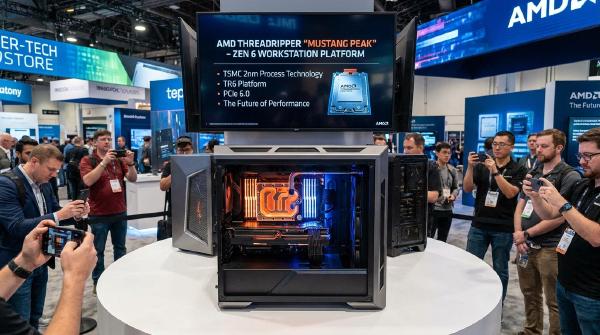
Unlike the specific performance and core-count rumors, AMD has officially identified Zen 6 as part of its next-generation CPU roadmap. At its 2025 Financial Analyst Day, the company presented Zen 6 as the successor to Zen 5 and identified TSMC’s 2nm process in its manufacturing plans.
AMD’s roadmap also includes Zen 6C, a variant aimed at more energy-efficient, high-density computing. The architecture family is intended to span both Ryzen client processors and EPYC server products, although specific configurations and launch schedules may differ across product segments.
The roadmap provides a credible basis for discussing Zen 6’s general direction, but it does not validate every leaked specification circulating online.
What Moving to TSMC 2nm Could Mean #
Manufacturing process technology affects transistor density, power characteristics, achievable operating frequencies, and the physical design constraints that architects must consider. A transition to a more advanced process can provide opportunities to improve performance per watt or increase the amount of logic integrated into a given area.
However, process-node names are not direct measurements of transistor size, and a newer node does not guarantee a fixed performance improvement. The final outcome depends on the specific process technology, circuit design, voltage requirements, manufacturing characteristics, and product-level operating limits.
For Zen 6, the planned use of TSMC’s 2nm technology could give AMD additional flexibility in balancing performance, energy efficiency, and silicon area. The company could use those opportunities to refine existing designs or introduce architectural features that would be more difficult to implement under different manufacturing constraints.
The reported 13% IPC gain, however, cannot be attributed to the process node alone. IPC is primarily a measure of how efficiently the architecture executes instructions, while manufacturing technology influences the physical implementation and operating characteristics of that architecture.
A complete performance evaluation will need to separate architectural gains from improvements caused by frequency, cache behavior, memory performance, and other platform changes.
Zen 6 and Zen 6C Serve Different Design Goals #
AMD’s roadmap distinguishes between Zen 6 and Zen 6C. Although both belong to the same broader architecture family, they target different priorities.
The high-performance Zen 6 design is intended for products that emphasize strong per-core performance alongside multithreaded capability. This makes it relevant to desktop Ryzen processors and server configurations that require high performance across a broad range of workloads.
Zen 6C is designed with energy efficiency and core density in mind. Such designs can be useful in server environments where fitting more processing capacity within a power or space budget is important.
The presence of Zen 6C on the roadmap does not establish that desktop Ryzen processors will use the same core configuration as EPYC server CPUs. Client and server products have different requirements for power limits, memory channels, I/O, platform features, and workload behavior.
Specific product configurations will need to be confirmed by AMD as individual processors are announced.
AI and Other Architectural Improvements #
AMD has also indicated that Zen 6 will include improvements beyond conventional CPU performance. Its roadmap references expanded support for AI data types and new AI pipelines, suggesting that the company intends to improve the architecture’s capabilities for relevant computational workloads.
AI-related performance depends on more than a single feature. Supported data types, execution resources, software libraries, compiler behavior, memory movement, and workload characteristics all influence how effectively a processor handles AI tasks.
AMD has not disclosed enough detail in the roadmap to quantify the performance impact of these changes or determine how they will compare with dedicated accelerators. The final benefits will depend on the specific processor implementation and the software ecosystem available at launch.
These features nevertheless indicate that Zen 6’s development is intended to address a wider set of computing demands rather than focusing exclusively on conventional desktop benchmark performance.
📅 AMD Zen 6 Release Date: Is 2027 Realistic? #
Current market rumors point to a possible 2027 launch window for desktop Zen 6 Ryzen processors. This timeframe remains speculative and should not be treated as an official release date.
AMD’s public roadmap confirms that Zen 6 is under development, but roadmap placement alone does not establish the launch date of a specific desktop CPU. Server and client products can arrive on different schedules because they target different platforms, customers, and validation requirements.
Why the Release Timeline Remains Uncertain #
Bringing a new CPU architecture to market involves multiple stages, including architecture development, silicon validation, manufacturing qualification, platform integration, firmware development, and product-level testing.
The transition to a new manufacturing process adds further dependencies. Production readiness, manufacturing capacity, yield, product segmentation, and market conditions can all influence when processors reach customers.
AMD may also stagger launches across product families. Even if one Zen 6-based product appears first, that would not necessarily establish the availability date for every desktop Ryzen or EPYC processor in the architecture family.
Until AMD announces specific products and launch windows, estimates based on leaks should be treated as provisional.
What Prospective Buyers Should Consider #
Users planning a new desktop build should base their decisions on available products and current requirements rather than relying entirely on an unconfirmed future launch.
If an existing system already provides sufficient performance, waiting for official Zen 6 information may help buyers make a more informed comparison. Conversely, users who need a workstation or gaming PC immediately should weigh the cost of delaying a purchase against the benefits of hardware that is already available.
For current Ryzen owners, the eventual upgrade decision will depend on motherboard compatibility, total platform cost, processor performance, and the value of any new features. A new architecture does not automatically make every previous-generation processor obsolete, especially when existing hardware already meets the user’s needs.
📈 What Zen 6 Could Mean for Desktop and Server CPUs #
If the current rumors prove accurate, Zen 6 could improve performance through several complementary changes: higher IPC, increased operating frequencies, more cores per CCD, revised cache resources, and a more capable memory and interconnect subsystem.
The relative importance of these changes will differ between desktop and server workloads.
Desktop Ryzen Processors #
For desktop users, the most relevant factors are likely to include single-threaded performance, gaming behavior, multi-core throughput, power consumption, and platform compatibility.
Higher IPC could improve performance in lightly threaded applications, while additional cores could benefit software that scales well across multiple threads. Cache and memory improvements may provide additional gains in games and other latency-sensitive applications.
However, the actual result will depend on the final Ryzen product lineup. Different models may use different core counts, cache configurations, power limits, and clock targets, so results from one CPU should not be generalized to the entire generation.
EPYC Server Processors #
Server processors face a different set of priorities. Core density, performance per watt, memory capacity and bandwidth, I/O capability, reliability, and virtualization performance can be especially important in data-center environments.
A higher core count per CCD could provide additional multithreaded capacity, while improvements to manufacturing efficiency and interconnects could help AMD balance compute density against power and thermal constraints.
The value of these changes will vary by server workload. Cloud infrastructure, databases, virtualization, scientific computing, and AI-related applications place different demands on CPU cores, memory, and I/O resources.
The existence of Zen 6C also suggests that AMD is considering designs optimized for density and energy efficiency alongside higher-performance cores. Nevertheless, final EPYC specifications and product positioning will need to be evaluated independently from desktop Ryzen products.
🔎 How to Evaluate Zen 6 Once Independent Testing Is Available #
When AMD releases retail Zen 6 processors, independent testing will be essential for determining whether the rumored architectural improvements translate into practical performance gains.
A useful evaluation should examine several dimensions rather than rely on a single benchmark score.
Single-Threaded and Multi-Threaded Performance #
Single-threaded tests can help reveal improvements in per-core performance, although the result still reflects both IPC and operating frequency. Multi-threaded tests show how effectively a processor uses its available cores and whether additional cores deliver meaningful throughput gains.
Comparisons should use consistent software versions, comparable power settings, and clearly documented test conditions. Otherwise, differences in configuration may distort the apparent generational improvement.
Gaming and Application Benchmarks #
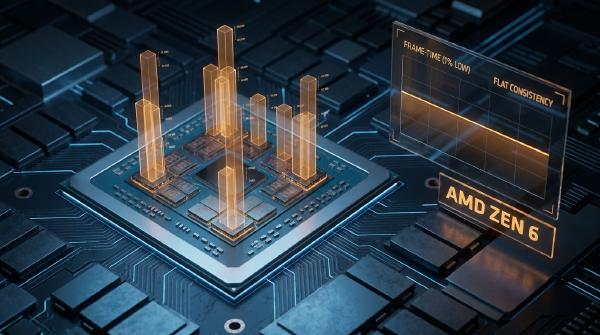
Gaming tests should cover a range of titles and settings, including CPU-limited scenarios and conditions where the graphics card becomes the primary bottleneck. Average frame rates and frame-time consistency can provide complementary information about real-world performance.
Productivity tests should include applications relevant to the intended user, such as compilation, rendering, data processing, and content creation. Results from a single workload should not be assumed to represent the performance of every application.
Power Consumption and Efficiency #
Performance per watt will be important for determining whether Zen 6 offers a meaningful efficiency improvement. Testing should distinguish between peak power, sustained workload consumption, and energy used to complete a fixed amount of work.
This distinction is particularly relevant when comparing CPUs with different core counts or boost behavior. A processor that completes a task more quickly may use less total energy even if its peak power consumption is higher.
Memory, Cache, and Latency Testing #
Dedicated tests should evaluate memory bandwidth, memory latency, cache capacity and behavior, and communication overhead where relevant. These measurements can help explain why certain applications improve more than others.
Ultimately, a combination of architectural analysis, synthetic benchmarks, application testing, and power measurements will provide a more reliable picture of Zen 6 than early leaks alone.
📝 Conclusion: Zen 6 Has Promise, but the Details Still Matter #
AMD’s Zen 6 architecture is officially part of the company’s next-generation roadmap, with TSMC’s 2nm process identified in its manufacturing plans. AMD has also outlined goals involving higher IPC, improved energy efficiency, expanded AI data-type support, and new AI pipelines across its future CPU architecture family.
The more specific performance claims remain unconfirmed. Current leaks suggest an approximately 13% IPC improvement over Zen 5, potentially higher clock speeds, 12-core CCDs, increased L3 cache capacity, and improvements to memory and interconnect technology. If these features are implemented successfully, they could contribute to gains in gaming, productivity, software development, and server workloads.
However, IPC figures cannot be translated directly into universal application performance, and additional cores do not guarantee proportional gains. Manufacturing technology, power limits, cache behavior, memory latency, software optimization, and product positioning will all influence the final result.
A desktop launch in 2027 remains a market rumor rather than a confirmed date. The most reliable approach is to distinguish AMD’s published roadmap from leaked specifications and wait for official product announcements and independent benchmarks before drawing conclusions about performance or value.
For now, Zen 6 represents a potentially important evolution of AMD’s chiplet-based CPU strategy. Whether it delivers the rumored generational leap will ultimately depend on the processors AMD ships, their real-world performance, and how competitively they are priced.
For related hardware and technology articles, visit KAD8 or PUDN.