Apple Expands Foundry Strategy with Intel 18A-P While Keeping A20 on TSMC 2nm
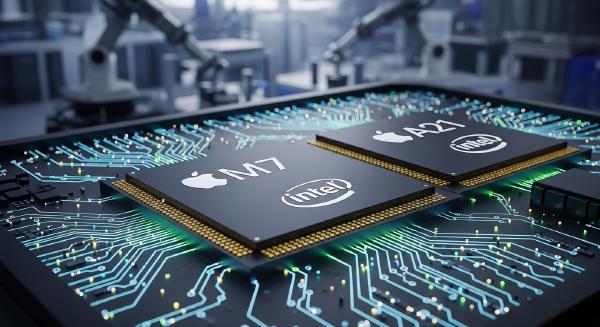
Apple is reshaping its semiconductor manufacturing strategy by adding Intel Foundry as a secondary production partner while continuing to rely on TSMC for its flagship processors. Industry reports indicate the company has begun validating Intel’s enhanced 18A-P process node for selected products, marking Apple’s first meaningful foundry diversification in nearly a decade.
Despite widespread speculation that future flagship iPhone processors would move away from TSMC, current evidence points to a more measured approach. The upcoming A20 and A20 Pro chips remain firmly tied to TSMC’s 2nm manufacturing process, while Intel’s role is focused on lower-tier and legacy silicon.
Apple Is Splitting Production Between Two Foundries #
Rather than replacing TSMC, Apple appears to be creating a dual-foundry strategy that balances manufacturing capacity, pricing leverage, and supply chain resilience.
TSMC Continues to Produce Flagship Chips #
TSMC remains Apple’s exclusive manufacturing partner for premium processors, including:
- A20
- A20 Pro
Reports indicate Apple has reserved more than half of TSMC’s initial 2nm production capacity to ensure stable launches for its highest-volume flagship devices.
Intel 18A-P Targets Entry-Level and Legacy Silicon #
Intel’s 18A-P node is reportedly being evaluated for products with lower manufacturing risk, including:
- Standard iPhone application processors
- Legacy Apple silicon
- Entry-level Mac processors
- Budget-oriented iPad chips
Current industry estimates suggest approximately 80% of Apple’s initial Intel wafer allocation will support iPhone-related silicon, reflecting the company’s overall product shipment mix.
Multi-Year Rollout Strategy #
Apple’s reported engagement with Intel follows a gradual adoption timeline designed to reduce manufacturing risk while validating a new supply chain partner.
| Year | Expected Milestone |
|---|---|
| 2026 | Process validation and engineering testing |
| 2027 | Initial production ramp |
| 2028 | Expanded commercial deployment |
| 2029 | Transition toward Intel’s 14A process |
This measured schedule gives Apple time to qualify Intel’s manufacturing technology before committing larger production volumes.
Why Apple Wants a Second Foundry #
The move extends beyond manufacturing technology.
As demand for advanced semiconductor capacity grows—particularly from AI infrastructure providers—access to leading-edge wafers has become increasingly competitive. By developing Intel as a secondary supplier, Apple gains several strategic advantages:
- Reduced dependence on a single foundry
- Greater negotiating leverage during capacity discussions
- Improved supply chain resilience
- Additional manufacturing flexibility for mature product lines
Rather than shifting flagship production immediately, Apple appears to be building long-term optionality.
Intel 18A-P: An Enhanced Version of 18A #
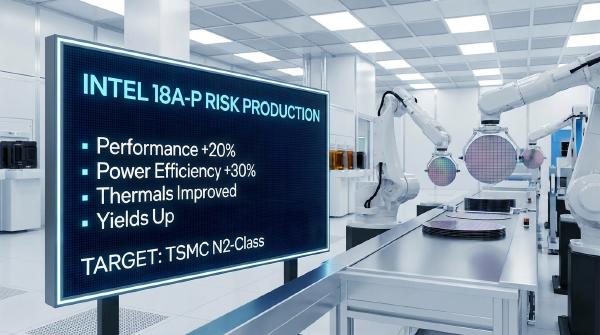
Intel 18A-P is positioned as a performance-optimized evolution of the company’s standard 18A manufacturing process.
According to available information, the node offers:
- Approximately 9% higher transistor performance at the same power level
- Roughly 18% lower power consumption at equivalent operating frequencies
These improvements make the process particularly attractive for power-sensitive mobile devices.
RibbonFET Gate-All-Around Transistors #
One of Intel’s major architectural changes is RibbonFET, its implementation of gate-all-around transistor technology.
Compared with traditional FinFET designs, RibbonFET provides:
- Better electrostatic control
- Lower leakage current
- Improved scaling for advanced process nodes
- Higher performance-per-watt
PowerVia Backside Power Delivery #
Intel also introduces PowerVia, a backside power delivery architecture that separates power routing from signal routing.
Potential benefits include:
- Reduced voltage drop
- Improved power delivery efficiency
- Additional routing resources for signal interconnects
- Better frequency scaling opportunities
Together, RibbonFET and PowerVia represent two of the most significant architectural transitions in Intel’s modern manufacturing roadmap.
Production Capacity Continues to Improve #
Intel has spent much of 2026 ramping production and improving yields across its advanced manufacturing facilities.
Current Manufacturing Sites #
Early 18A production is currently centered around two major fabs:
- D1X (Hillsboro, Oregon): Research, development, and risk production
- Fab 52 (Phoenix, Arizona): Initial high-volume manufacturing equipped with ASML EUV lithography systems
Manufacturing Progress #
Industry reports suggest several encouraging production milestones:
- Monthly output has reached approximately 30,000 wafers per month
- Manufacturing yields continue to improve steadily
- Intel’s commercial target is to achieve sustained yields exceeding 50–60% ahead of larger customer deployments in 2027
The company’s internal Panther Lake processors are expected to play a key role in driving manufacturing maturity before external customers increase production volumes.
Looking Beyond 18A-P #
Intel’s long-term roadmap extends beyond the current generation.
Future plans include:
- Migration of high-volume external customer production to Fab 62
- Preservation of D1X as a primary research facility
- Risk production for Intel 14A beginning in 2028
- Commercial 14A manufacturing targeted for 2029
Industry analysts also report that Apple has begun reviewing early process design kits (PDKs) for Intel’s 14A technology, although any future flagship products manufactured on that node remain speculative.
Outlook #
Apple’s reported adoption of Intel 18A-P represents a strategic diversification effort rather than a wholesale manufacturing transition.
TSMC continues to dominate Apple’s flagship silicon roadmap with the A20 family, while Intel is positioned to manufacture selected lower-risk products that help Apple reduce dependence on a single supplier.
If Intel successfully delivers competitive yields and stable production over the next several years, Apple could gain meaningful supply chain flexibility while fostering greater competition in the advanced foundry market. Whether that eventually expands to flagship processors will depend on Intel’s execution, manufacturing maturity, and the performance of future process nodes beyond 18A-P.