Gigabyte Confirms Future Intel CPU Support for Z790 and DDR4 Boards
Gigabyte has expanded its announced support for upcoming Intel desktop processors across its entire Z790, B760, and H610 motherboard lineups, including models equipped with both DDR4 and DDR5 memory. Announced on October 13, 2026, the update extends Gigabyte’s earlier compatibility plans beyond its mainstream and entry-level motherboards to include its enthusiast-oriented Z790 series.
The update targets Intel’s existing LGA1700 platform, potentially giving users another opportunity to upgrade their processors without replacing their motherboards or memory. For owners of DDR4-based systems, this could be particularly valuable because a CPU upgrade may avoid the additional cost of purchasing a new motherboard and DDR5 memory kit.
Gigabyte says the latest BIOS versions are available through its official website. However, the company has not identified the specific future processors covered by the announcement, and Intel has not officially disclosed their product names, specifications, or launch schedule.
The rumored Intel “Raptor Lake Next” family is one possible explanation, but that identification remains unconfirmed. The immediate takeaway is that Gigabyte is preparing its existing LGA1700 ecosystem for additional processor compatibility, potentially extending the useful life of current desktop systems.
🔧 Gigabyte Expands Future CPU Support Across Z790, B760, and H610 #
Gigabyte’s October 13 announcement broadens its previously reported plans for supporting upcoming LGA1700 processors. The latest statement explicitly includes its Z790, B760, and H610 motherboard families, covering both DDR4 and DDR5 variants.
The manufacturer says the expanded compatibility is available through BIOS updates and describes its coverage as extending across every model in the three chipset lineups.
The complete announcement is available in Gigabyte’s official newsroom.
Z790 joins the planned compatibility expansion #
The addition of Z790 is significant because it covers Gigabyte’s enthusiast and high-performance desktop motherboard segment.
Launched in 2022 alongside Intel’s 13th-generation Core processors, Z790 supports the LGA1700 platform and has also been used with compatible 12th- and 14th-generation Intel desktop CPUs.
The new announcement potentially extends that investment beyond the processors currently supported. Users who purchased a Z790 motherboard for a high-performance desktop system may have another CPU upgrade opportunity without rebuilding the platform.
B760 and H610 are also included in the announced support expansion.
| Chipset family | Market positioning | Memory configurations covered by the announcement |
|---|---|---|
| Z790 | Enthusiast and high-performance desktops | DDR4 and DDR5 models |
| B760 | Mainstream desktop systems | DDR4 and DDR5 models |
| H610 | Entry-level desktop systems | DDR4 and DDR5 models |
These are chipset-level categories, not a guarantee that every existing processor or future CPU works with every motherboard revision under every BIOS version. Users should consult the specific board’s CPU support list and firmware requirements before upgrading.
Why the announcement matters #
Motherboard compatibility can influence the total cost of a CPU upgrade as much as the processor’s purchase price.
When a new CPU requires a different socket or platform, users may have to replace the motherboard and, depending on the new platform, their memory as well. Those additional components can turn a relatively simple processor upgrade into a complete system rebuild.
By expanding support within LGA1700, Gigabyte could allow existing customers to retain more of their current hardware.
For enthusiasts, this may offer another way to improve CPU performance without replacing a functioning motherboard. For system builders and retailers, a broader compatibility roadmap may also help simplify inventory planning.
💾 DDR4 Compatibility Could Reduce Upgrade Costs #
One of the most notable elements of Gigabyte’s announcement is that it explicitly covers DDR4 as well as DDR5 motherboards.
Intel’s LGA1700 ecosystem includes motherboard models designed for either memory standard. This flexibility has allowed users to build systems around existing DDR4 memory while still using compatible modern Intel processors.
The new compatibility expansion could preserve that advantage for users whose motherboards receive the required BIOS updates.
Retaining an existing motherboard and memory kit #
For a user with a compatible DDR4-based LGA1700 system, a processor-only upgrade could avoid several additional expenses:
- Motherboard replacement: The existing board may remain usable if its exact model and BIOS support the target CPU.
- Memory replacement: A DDR4 motherboard will continue to require compatible DDR4 memory rather than DDR5.
- System migration: Existing storage, expansion cards, and other components may remain in place if they meet the requirements of the new configuration.
- Reinstallation work: Retaining the platform can reduce the number of hardware and software changes involved in an upgrade.
These potential savings are particularly relevant to users who already have sufficient memory capacity and do not need the features of a newer platform.
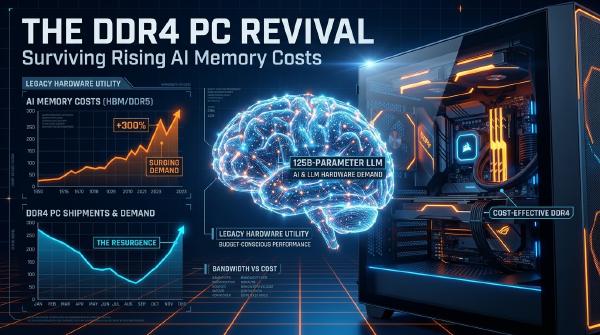
For additional context on the economics of retaining older memory configurations, see KAD’s analysis of why DDR4 is regaining relevance as PC hardware costs rise.
DDR4 and DDR5 remain platform-specific #
Although Gigabyte supports both memory types across the announced motherboard families, DDR4 and DDR5 are not interchangeable.
A motherboard designed for DDR4 cannot accept DDR5 DIMMs, and the reverse is also true. The memory controller configuration, motherboard layout, and firmware support must match the selected hardware.
The future CPU itself must also support the relevant memory configuration. Gigabyte’s announcement indicates broader processor compatibility across its DDR4 and DDR5 board lineups, but it does not provide complete specifications for the upcoming processors.
Consequently, buyers should not assume that any future Intel CPU will work with every LGA1700 motherboard simply because the board uses the correct socket.
The exact CPU support list and required BIOS version remain the decisive references.
⚙️ How to Prepare a Gigabyte Motherboard for a Future CPU #
Gigabyte says users can enable the announced compatibility through BIOS updates. Before replacing a processor, however, it is important to verify the requirements for the exact board.
Check the motherboard model and revision #
Start by identifying the complete motherboard model and its hardware revision.
Boards with similar product names may have different revisions, firmware packages, or processor support lists. Selecting the wrong BIOS can cause installation problems or leave the system unable to boot.
Users should check the manufacturer’s official support page rather than rely exclusively on a chipset name or a third-party compatibility list.
Install the required BIOS before changing CPUs #
If the motherboard requires a newer BIOS for the future processor, install that version while the existing supported CPU is still available.
The general procedure is:
- Open Gigabyte’s official support page for the exact motherboard model and hardware revision.
- Review the CPU support list and identify the required BIOS version once the target processor appears.
- Read the BIOS release notes and follow Gigabyte’s recommended update procedure.
- Complete the update using the supported method and allow the system to restart.
- Shut down the system and install the processor after compatibility has been confirmed.
The steps and available recovery features vary by motherboard. Users should follow the instructions for their specific model rather than assume every board supports the same update procedure.
It is also prudent to keep a copy of the currently working BIOS and understand the board’s recovery options before performing a firmware update.
Verify power delivery and cooling requirements #
Even when a motherboard supports a processor at the firmware level, the complete configuration must still meet its electrical and thermal requirements.
Users should check CPU power limits, motherboard VRM capability, cooler compatibility, and the recommended operating configuration for the final processor.
These considerations are particularly important for entry-level motherboards and systems with limited cooling capacity.
📰 Is This Intel’s Rumored Raptor Lake Next Lineup? #
Gigabyte’s announcement has attracted attention because it points toward additional processors for the LGA1700 platform, despite Intel’s transition toward newer desktop platforms.
The company has not named the processors in its October 13 statement. Intel has also not officially confirmed a product family called “Raptor Lake Next” in connection with this announcement.
The rumor is nevertheless plausible enough to warrant attention because reports of additional LGA1700 processors have circulated ahead of Gigabyte’s BIOS announcements.
What the rumors suggest #
Some reports associate the upcoming processors with an extended Raptor Lake product family intended to serve mainstream and entry-level desktop markets.
If that information proves accurate, continued support for the existing socket could give Intel another way to address users who prefer a lower-cost processor upgrade rather than a full platform migration.
The strategy could also be attractive to manufacturers because it extends the value of existing motherboard designs and provides an upgrade option for installed systems.
However, the available information does not establish the new processors’ final branding, core counts, clock speeds, cache capacities, power specifications, pricing, or performance.
KAD has previously examined the possibility in its report on the rumored Intel Raptor Lake Next lineup and LGA1700 compatibility.
The release date remains uncertain #
Gigabyte’s separate October 9 announcement covering B760 and H610 processors said the upcoming CPUs were expected in early 2027. The October 13 announcement subsequently expanded its coverage to Z790 but did not repeat a release timeframe.
Intel has not provided an official launch date for the unnamed processors in connection with the compatibility announcement.
The earlier reference to early 2027 is therefore useful context, but it should not be treated as a confirmed retail launch schedule.
The BIOS announcement establishes Gigabyte’s preparation for future processor support. It does not independently confirm Intel’s release timing.
📊 Is a Future LGA1700 CPU Upgrade Worth Waiting For? #
For existing LGA1700 users, the announcement introduces another potential upgrade path. Whether it is worth waiting for depends on the current system, the user’s workload, and the specifications of the eventual processors.
Potential benefits for existing users #
The most obvious advantage is retaining compatible hardware.
A user whose current CPU is limiting gaming performance, application responsiveness, or multithreaded workloads may benefit from a newer supported processor without replacing the motherboard. DDR4 users may also avoid the cost of switching memory standards.
The practical gains will depend on the processor’s architecture, core configuration, clock speeds, power limits, and price.
BIOS compatibility alone does not establish that the new processors will offer substantial performance improvements over existing 12th-, 13th-, or 14th-generation Core CPUs.
When a platform upgrade may still make more sense #
A new CPU may not solve every system limitation.
Users who need more memory bandwidth, newer connectivity, additional I/O, or other platform features may still benefit from moving to a newer motherboard and processor generation.
Likewise, a future LGA1700 processor may offer poor value if its performance improvement is small relative to its price.
A sensible purchase decision should compare the total cost of a compatible CPU upgrade with the cost of moving to a newer platform, including motherboard, memory, cooling, and other required components.
Until Intel discloses official specifications and independent performance testing becomes available, there is insufficient evidence to determine which option will deliver the best value.
✅ Conclusion: Gigabyte Extends the LGA1700 Upgrade Path #
Gigabyte’s October 13 announcement expands its planned future Intel CPU support across Z790, B760, and H610 motherboards, including both DDR4 and DDR5 models. The company says updated BIOS versions are available, potentially allowing compatible systems to adopt additional processors without replacing their existing motherboards or memory.
For users with DDR4-based LGA1700 systems, this is especially relevant because preserving the motherboard and memory may reduce the total cost of upgrading.
However, the processors themselves remain unidentified in the latest announcement. Their final specifications, branding, performance, pricing, and release schedule have not been officially confirmed by Intel. The rumored Raptor Lake Next family is one possible explanation, not an established product designation.
For now, existing motherboard owners should monitor Gigabyte’s model-specific CPU support lists and BIOS release notes. The upgrade opportunity will become clearer once Intel announces the processors and Gigabyte publishes definitive compatibility information for each supported board.
If the announced support translates into competitive retail processors, LGA1700 users could gain another practical way to extend the life of their systems without committing to a complete platform replacement.