Intel Wildcat Lake Core 7 350 Beats Apple A19 Pro in Multi-Core
For years, Apple’s custom ARM silicon has dominated the ultra-low-power performance narrative. The A-series and M-series chips established a reputation for exceptional single-thread efficiency, industry-leading battery life, and remarkably low thermal output. Many analysts believed this momentum would steadily push x86 architectures out of entry-level laptops and compact PCs entirely.
But newly surfaced May 2026 PassMark benchmarks suggest the competitive landscape is beginning to shift.
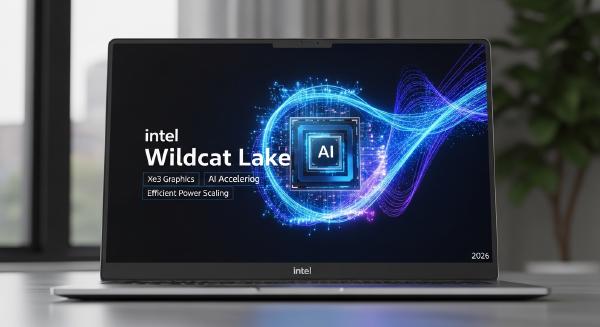
Intel’s new Core 7 350, powered by the low-power Wildcat Lake architecture, has demonstrated that modern x86 designs can still compete aggressively against ARM-based mobile silicon—especially in multi-threaded workloads constrained within a tight 15W power envelope.
⚙️ Wildcat Lake: Intel’s Low-Power Reboot #
Rather than pursuing massive core counts or high-wattage turbo behavior, Wildcat Lake focuses on streamlined efficiency and intelligent workload scheduling for thin-and-light systems.
Intel Core 7 350 Specifications #
| Specification | Details |
|---|---|
| Architecture | Wildcat Lake |
| Process Node | Intel 18A |
| Core Configuration | 6 Cores / 6 Threads |
| P-Cores | 2x Cougar Cove |
| LP-E Cores | 4x Darkmont |
| L3 Cache | 6MB Intel Smart Cache |
| Base TDP | 15W |
| Scalable Power Range | 10W–35W |
One of the most interesting aspects of the Core 7 350 is Intel’s shift toward LP-E (Low-Power Efficient) cores rather than traditional E-cores. These Darkmont LP-E cores are optimized for:
- Lower operating voltage
- Better idle efficiency
- Reduced thermal density
- Sustained background task execution
This design aligns closely with the realities of modern lightweight laptops, where:
- Battery life matters more than peak clocks
- Multitasking dominates typical workloads
- Thermal headroom is extremely limited
📊 PassMark Results: Intel Strikes Back #
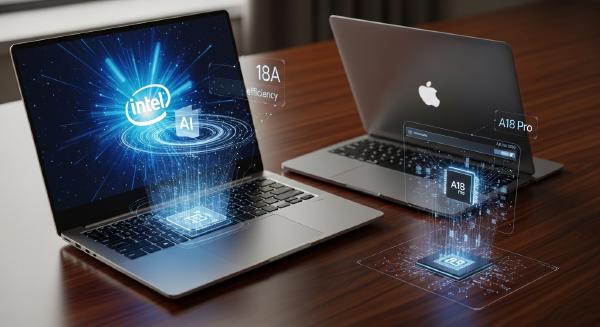
The PassMark scores reveal a fascinating split between Apple and Intel’s design philosophies.
| Metric | Intel Core 7 350 | Apple A19 Pro | Winner |
|---|---|---|---|
| Single-Thread Score | 4,228 | 5,172 | Apple (+18%) |
| Multi-Thread Score | 16,237 | 14,836 | Intel (+9%) |
🧠 Why Apple Still Dominates Single-Core #
Apple continues to lead in isolated thread performance because its architecture prioritizes:
- Extremely wide execution pipelines
- Aggressive branch prediction
- High IPC (Instructions Per Clock)
- Tight hardware/software integration
This strategy excels in:
- UI responsiveness
- App launch speed
- Short burst workloads
- Mobile-first interaction models
For lightweight everyday usage, Apple’s ARM approach remains exceptionally refined.
🚀 Why Intel Wins Multi-Core #
Intel’s advantage comes from a different optimization philosophy.
The Core 7 350 leans heavily on:
- Parallel task scaling
- Thread Director scheduling
- Background task distribution
- Sustained all-core utilization
Under workloads such as:
- Multi-tab web browsing
- Office multitasking
- Light video editing
- Background synchronization
- File compression
…the processor can engage all six cores simultaneously while staying inside its 15W thermal envelope.
This allows Intel to outperform Apple in scenarios where sustained concurrent workloads matter more than instantaneous burst performance.
🪟 The x86 Compatibility Advantage #
Performance is only part of the story.
One of x86’s biggest remaining advantages is still software compatibility.
While ARM-based Windows systems continue improving, many users still encounter:
- Translation overhead
- Driver inconsistencies
- Legacy software limitations
- Enterprise compatibility issues
Wildcat Lake systems avoid these friction points entirely.
For businesses, students, and mainstream users dependent on legacy Windows software stacks, x86 remains the safer and more frictionless platform.
💰 The Bigger Shock: Pricing #
Perhaps the most disruptive aspect of Wildcat Lake is not performance—but pricing.
The first major launch platform, the Honor X14, reportedly enters the market below $600.
That places it directly against Apple’s aggressively priced entry-level MacBook Neo.
The Competitive Difference #
| Product | Starting Price | Key Hardware Focus |
|---|---|---|
| Honor X14 (Wildcat Lake) | Under $600 | Higher RAM + larger battery |
| MacBook Neo | $599 | Ecosystem integration + efficiency |
Intel OEM partners are increasingly competing through:
- Higher memory capacities
- Larger SSDs
- Bigger batteries
- More ports
- Lower overall pricing
This creates a strong value proposition for budget-conscious buyers.
🔋 The New Low-Power CPU Reality #
The significance of Wildcat Lake goes beyond one benchmark.
For years, the industry narrative framed ARM as:
“The inevitable future of low-power computing.”
But the Core 7 350 demonstrates that:
- Modern x86 can still scale efficiently
- Intel’s 18A node is materially improving efficiency
- Multi-core optimization remains highly relevant
- Budget laptops still heavily favor compatibility and flexibility
Instead of outright replacing x86, ARM may simply force x86 vendors into becoming dramatically more power efficient.
And that competition is benefiting consumers directly.
🛒 Which Platform Should You Choose? #
Choose Apple ARM Systems If: #
- You are deeply invested in macOS and iOS
- You prioritize fanless operation
- Your workload is mostly light and single-threaded
- Battery life is your highest priority
Choose Wildcat Lake x86 Systems If: #
- You multitask heavily
- You rely on Windows legacy applications
- You want maximum RAM/storage per dollar
- You need strong compatibility with existing peripherals and software
📌 Final Thoughts #
The Core 7 350 does not dethrone Apple in raw single-core elegance or ecosystem integration. But it proves something many had begun to doubt:
x86 is still very capable of competing in ultra-low-power computing.
By combining:
- Intel 18A manufacturing
- LP-E core architectures
- Smarter scheduling
- Aggressive OEM pricing
Wildcat Lake reopens the low-cost thin-and-light market as a genuinely competitive battlefield.
The result is not the death of ARM dominance—but the return of meaningful balance in low-power computing.