Intel Xeon 600 + Arc Pro B70: Workstation AI & HPC Breakthrough
As of April 2026, Intel is formalizing its workstation strategy with a tightly integrated “I+I” platform—pairing Xeon 600 series CPUs with Arc Pro B-series GPUs. This combination targets both high-performance computing (HPC) and generative AI, two domains that increasingly overlap in real-world workloads.
The key shift is architectural: instead of forcing a choice between compute precision, memory capacity, and AI acceleration, Intel is converging them into a unified platform optimized for professional creators, researchers, and enterprise inference.
⚙️ Xeon 600: Converging HPC and AI in a Single CPU #
The Xeon 600 series redefines CPU roles by integrating both high-precision scientific compute and AI acceleration directly into the core architecture.
Native AI Acceleration with AMX #
- AMX (Advanced Matrix Extensions) embedded in core design
- No reliance on external accelerators for inference workloads
- Efficient switching between FP64 (HPC) and INT8/FP16 (AI) operations
This eliminates the traditional trade-off between scientific accuracy and AI throughput.
MRDIMM: Solving Memory Bandwidth Bottlenecks #
- Multiplexed Rank DIMM (MRDIMM) introduces dual-path memory access
- Significantly increases effective memory bandwidth
- Reduces data starvation in high-core-count scenarios
This is particularly impactful for matrix-heavy workloads such as simulation and transformer inference.
High-Capacity Memory Advantage #
- Up to 4TB memory per CPU
- Enables execution of ultra-large models and datasets in-memory
This is critical for workloads like protein folding simulations or large-scale graph processing, where GPU VRAM limits are restrictive.
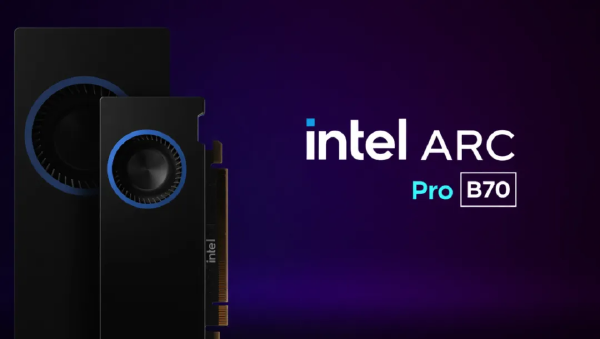
🎮 Arc Pro B70: A VRAM-Centric GPU Strategy #
The Arc Pro B-series shifts focus from raw compute throughput to memory capacity and cost efficiency, addressing a key limitation in modern AI workloads.
32GB VRAM as the New Baseline #
- Arc Pro B70 features 32GB GDDR6 VRAM
- Optimized for large model inference and long-context workloads
- Strong price-to-memory ratio compared to competing solutions
Strategic SKU Design (B65 vs B70) #
- B65 retains full 32GB VRAM with reduced compute cores
- Targets cost-sensitive deployments requiring large memory footprints
- Enables broader accessibility for AI practitioners
Multi-GPU Scaling for Edge AI #
Intel promotes a 4× B70 configuration:
- Total VRAM: 128GB
- Suitable for ~100B parameter models
- Leaves significant headroom for KV cache and concurrent requests
This architecture is particularly effective for enterprise edge inference, where memory capacity directly impacts throughput and latency.
🖥️ Compact Workstation Design: From Server Room to Desktop #
Intel is driving a shift toward localized AI workstations with aggressive form factor and acoustic targets.
Reference Design Goals #
- Single GPU: <8L chassis, <35dB noise
- Dual GPU: <14L chassis, <40dB noise
- Quad GPU: <35L chassis
These configurations bring data center-class capabilities into office or lab environments without traditional server infrastructure.
🔓 Breaking the CUDA Lock-In #
A major barrier to GPU competition has been software ecosystem lock-in. Intel addresses this through a layered compatibility strategy.
Framework-Level Integration #
- Native support for PyTorch and vLLM
- Support for modern inference techniques such as paged attention
- Minimal code changes required for migration
Language-Level Portability #
- Adoption of Triton as a cross-platform kernel language
- Enables compilation across Intel and NVIDIA architectures
- Reduces dependency on CUDA-specific tooling
Creator-Focused Tooling #
- Native support for ComfyUI
- Plug-and-play experience for generative media workflows
- Lower barrier for creators adopting Intel GPUs
🧭 Future Direction: Toward Disaggregated GPUs #
Intel has previewed its next-generation GPU architecture, Crescent Island, expected to extend this strategy further.
Expected Trends #
- Larger VRAM capacities
- Chiplet-based GPU designs
- Improved cost scalability and yield efficiency
This indicates a long-term commitment to competing not just on performance, but on system-level economics.
📊 Platform Summary #
| Feature | Xeon 600 Series | Arc Pro B70 |
|---|---|---|
| Core Strength | Massive system memory (up to 4TB) | High VRAM capacity (32GB) |
| Key Technologies | AMX, MRDIMM | Multi-GPU scaling |
| Primary Workloads | HPC, large-scale AI models | AIGC, inference, edge deployment |
| Ecosystem | oneAPI, OpenVINO | PyTorch, Triton, ComfyUI |
📌 Conclusion #
Intel’s Xeon 600 and Arc Pro B70 pairing represents a deliberate shift toward balanced, memory-centric compute platforms. By addressing both CPU and GPU limitations—bandwidth, capacity, and software portability—Intel is building a viable alternative to traditional HPC and AI stacks.
For professionals working with large datasets, generative models, or hybrid HPC-AI pipelines, this “I+I” platform offers a compelling combination of scalability, flexibility, and cost efficiency.