The 2026 CPU Shortage Explained: AI Demand Is Breaking the Market
As of mid-April 2026, the PC hardware industry is facing its most severe disruption since the pandemic era. What began as GPU scarcity has now evolved into something far more systemic—the CPU market itself is under pressure.
At the center of it all is a phenomenon many are calling the “AI Siphon Effect.” Instead of a true silicon shortage, we’re witnessing a massive reallocation of manufacturing capacity toward AI infrastructure.
Here’s what’s actually happening—and how it affects your next build.
⚠️ The AI Siphon: Where Did All the CPUs Go? #
The issue isn’t that fabs can’t produce chips—it’s that they’re choosing which chips to produce.
Major foundries like TSMC, Intel Foundry, and Samsung Electronics are shifting capacity toward high-margin silicon.
-
Explosive AI Demand
Companies like OpenAI and Google have reportedly increased processor orders by 300% year-over-year, driven by hyperscale AI deployments. -
Consumer CPUs Deprioritized
Wafer allocation is increasingly dominated by:- AI accelerators
- Data center CPUs
- Custom silicon for cloud providers
This leaves mainstream desktop CPUs in short supply.
-
The Intel 18A Gamble
Intel’s 18A process entered high-volume manufacturing in early 2026.
However, yields are estimated at ~60%, meaning supply is improving—but not fast enough to stabilize pricing.
💰 Price Surge: The “Scarcity Tax” Is Real #
Even when CPUs are available, pricing has detached from MSRP.
-
AMD Ryzen 9 9950X3D2 (Dual Edition)
- MSRP: $899
- Street Price: $999–$1,099
- Cause: limited allocation + automated scalping
-
Intel Core Ultra 200S Plus (Arrow Lake Refresh)
- MSRP: $299–$349
- Market Increase: ~15% in weeks
Retail channels are struggling to maintain inventory, and bots are exacerbating the problem.
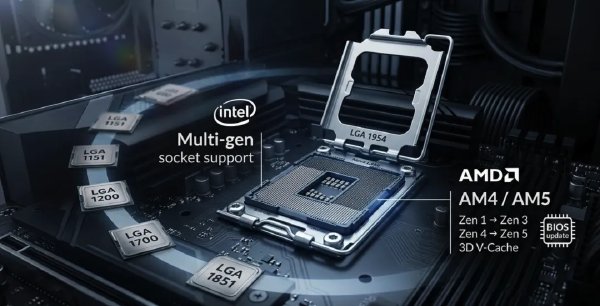
🔄 The Comeback Play: AM4’s Unexpected Return #
In the middle of this chaos, AMD made a calculated move—reviving a proven platform.
-
AMD Ryzen 7 5800X3D (10th Anniversary Edition)
Positioned as a stable, cost-effective alternative, this re-release targets users unwilling to enter the expensive DDR5 ecosystem. -
Why It Works
- Massive installed base of AM4 users
- DDR4 memory remains affordable and widely available
- Gaming performance still competitive due to 3D V-Cache
-
Price Positioning
- Estimated: $200–$220
- Delivers near high-end gaming performance without platform migration
Rather than chasing bleeding-edge tech, AMD is monetizing stability and compatibility.
🧩 Intel’s Dilemma: Raptor Lake Gets Squeezed #
Ironically, older mainstream CPUs are among the hardest hit.
-
Intel Raptor Lake (13th/14th Gen)
Once the backbone of budget and office PCs, these chips are now scarce. -
Why?
- Older nodes are being phased out or deprioritized
- Capacity is shifting to Intel 3 and 18A
- Foundry focus favors future architectures
-
Real-World Impact System integrators are increasingly forced to deploy newer (and more expensive) platforms like Arrow Lake, even for entry-level builds.
📊 2026 CPU Market Snapshot #
| Segment | Status | Recommended Action |
|---|---|---|
| High-End (AI/Content) | Severe Shortage | Wait for 18A yield improvements (Q4 2026). |
| Enthusiast Gaming | High Scalping | Consider 5800X3D if already on AM4. |
| Budget/Office | Unstable Supply | Pre-builts often have better allocation. |
| Laptop/Mobile | Gradual Recovery | OEM supply prioritized over retail. |
🔮 Final Take: A Market Redefined by AI #
This isn’t a temporary disruption—it’s a structural shift.
AI workloads are now the primary driver of semiconductor economics, and consumer hardware is no longer the top priority. The result is a market where:
- Availability matters more than innovation
- Older platforms regain relevance
- Upgrade strategies shift toward cost efficiency over future-proofing
For builders in 2026, the smartest move isn’t chasing the newest CPU—it’s navigating scarcity intelligently.