Meta’s AI data center network is built around a carefully engineered philosophy: vendor diversity at scale. Rather than depending on a single networking silicon provider, Meta’s Disaggregated Scheduled Fabric (DSF) intentionally mixes merchant silicon, custom ASICs, and in-house designs to optimize cost, performance, and long-term supply resilience.
At hyperscale, the network itself becomes a programmable system. DSF reflects that reality.
🔮 What DSF Is Solving #
Large-scale AI training workloads generate traffic patterns that traditional Ethernet fabrics struggle with:
- Extreme east-west bandwidth
- Microburst congestion from collective operations
- Sensitivity to tail latency during synchronization
DSF addresses this by separating scheduling intelligence from packet forwarding, enabling predictable performance even at tens of thousands of GPUs.
🔀 Switch ASICs: The Core Fabric #
Meta uses different switch silicon for different layers of its leaf-spine topology, matching each ASIC’s strengths to a specific role.
Broadcom: The DSF Backbone #
Broadcom remains the dominant supplier in Meta’s scheduled fabric.
- Jericho3-AI
Deployed in the Arista 7700R4 as the DSF Leaf Switch.
Designed for AI traffic with:- Very deep buffers
- Zero-packet-loss behavior
- Deterministic congestion handling

- Ramon3
Used in the Arista 7720R4 as the DSF Spine Switch.
Ramon3 aggregates multiple Jericho3-AI devices into a single, massive non-blocking fabric domain.

- Tomahawk5 (TH5)
Powers Meta’s self-designed Minipack3 switch.- 51.2 Tbps switching capacity
- Optimized for power efficiency per bit
- Ideal for dense fabric deployments

Cisco: Competitive Merchant Silicon #
- Silicon One G200
Used in the Cisco 8501 platform.- Direct competitor to Tomahawk5
- 51.2 Tbps throughput
- Runs Meta’s internal network OS, FBOSS, demonstrating full software portability across vendors

NVIDIA: Expanding Beyond Scheduled Fabrics #
- Spectrum-4
Deployed in Minipack3N systems within Meta’s Non-Scheduled Fabric (NSF).- 51.2 Tbps Ethernet switching
- Used where deterministic scheduling is less critical than raw throughput
🧩 Network Interface Controllers: The Edge of the Fabric #
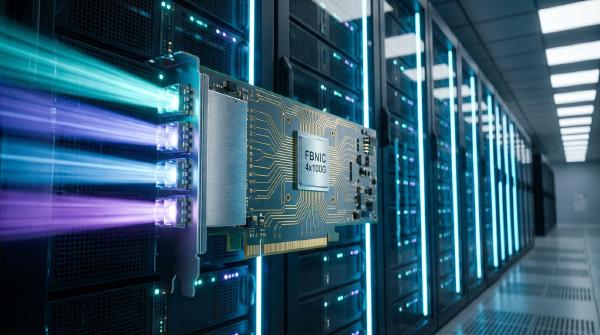
At the server boundary, Meta has moved away from generic NICs toward semi-custom designs.
Marvell + Meta: FBNIC #
- Custom 5nm ASIC (FBNIC)
Co-developed with Marvell- Multi-host NIC supporting up to four independent hosts
- PCIe Gen5 connectivity
- Up to 4×100GE network interfaces
- Hardware offloads optimized for AI collectives and low-latency messaging
FBNIC is foundational to Meta’s goal of making the network a first-class accelerator rather than a passive transport.

🤖 AI Accelerators with Native Networking #
MTIA: Meta’s In-House AI Chip #
- Meta Training and Inference Accelerator (MTIA)
Integrates networking directly on the accelerator die.- Native RoCE (RDMA over Converged Ethernet) support
- Direct participation in the Ethernet-based DSF
- Reduced CPU involvement and lower end-to-end latency
This tight coupling of compute and networking is critical for scaling training clusters efficiently.
📊 Meta AI Network Silicon Overview #
| Platform | Network Role | Supplier | Chip |
|---|---|---|---|
| Arista 7700R4 | DSF Leaf | Broadcom | Jericho3-AI |
| Arista 7720R4 | DSF Spine | Broadcom | Ramon3 |
| Minipack3 | Fabric Switch | Broadcom | Tomahawk5 |
| Cisco 8501 | Fabric Switch | Cisco | Silicon One G200 |
| Minipack3N | Fabric Switch (NSF) | NVIDIA | Spectrum-4 |
| FBNIC | Multi-host NIC | Marvell & Meta | Custom 5nm ASIC |
🧭 Why This Matters #
Meta’s DSF architecture demonstrates a clear trend in hyperscale AI infrastructure:
- No single vendor dependency
- Ethernet as the unifying fabric
- Custom silicon where differentiation matters
- Merchant silicon where scale and economics dominate
Rather than chasing a monolithic “perfect” solution, Meta is assembling a networked system of systems—one where flexibility, supply chain resilience, and software control are as important as raw bandwidth.