OpenRDMA Explained: A GPU-Native Multipath RDMA Architecture
In an AI supercluster containing tens of thousands of GPUs, computation is only half the problem. Every accelerator must continuously exchange gradients, activations, parameters, and synchronization data with other GPUs. As model sizes increase, these transfers can consume a significant portion of each training iteration.
The problem is not always insufficient network bandwidth. Sometimes the bottleneck is the software interface used to access that bandwidth.
Before a GPU can initiate an RDMA transfer, the system needs to establish where the data resides, which remote memory region is accessible, what permissions apply, and how much data should move. Traditional RDMA interfaces expose much of this work through queue management and software-generated descriptors.
That creates an awkward situation: the GPU has plenty of parallel compute capacity, but it must spend resources preparing network instructions before the NIC can do its job.
The OpenRDMA research paper proposes a different division of responsibilities. Instead of making the GPU construct complete network work requests, it gives the GPU a minimal interface for expressing communication intent. The NIC handles descriptor construction, transport state, packet delivery, reliability, and memory-visibility coordination.
Its central design principle is simple: the GPU submits an 8-byte doorbell, while the NIC manages the transport machinery behind it.
The result is a GPU-native RDMA architecture built around simplified submission, packet-level multipath routing, selective retransmission, and NIC-managed completion semantics.
🧩 Why Traditional RDMA Interfaces Are Awkward for GPUs #
Understanding OpenRDMA starts with the interface it wants to replace.
How conventional RDMA works #
RDMA allows a network interface card (NIC) to transfer data directly between registered memory regions without requiring the CPU to handle every byte.
A typical RDMA endpoint uses a Queue Pair (QP), which contains a Send Queue and a Receive Queue. A Completion Queue (CQ) records the results of completed operations.
Software submits work through a Work Queue Element (WQE). A WQE describes the operation, including its opcode, memory address, transfer length, and memory key.
The normal submission sequence looks like this:
- Software constructs a WQE containing the operation details.
- It writes the WQE into the appropriate queue.
- It updates the producer pointer.
- It rings the NIC’s doorbell.
- The NIC fetches the WQE, validates the operation, and performs the transfer.
- The NIC posts a Completion Queue Element (CQE) when the operation finishes.
- Software processes the completion and reclaims the queue entry.
This design works well for CPU-driven networking. Software threads can maintain queue pointers, construct descriptors, inspect completion records, and handle errors.
GPUs have a different execution model.
Their compute resources are organized around highly parallel execution, with thousands of threads operating through Streaming Multiprocessors (SMs). Maintaining a conventional software-oriented queue state machine is not a natural fit.
GPUDirect RDMA still leaves a control-path problem #
GPUDirect RDMA allows the NIC to access GPU memory directly rather than copying data through host RAM.
That removes an important data-movement bottleneck, but it does not automatically eliminate CPU involvement in communication submission.
In a conventional CPU-managed implementation, the GPU signals the CPU when it wants to transfer data. The CPU prepares the necessary work request and rings the NIC’s doorbell.
The CPU therefore remains in the control path, even though it no longer needs to handle the payload itself.
This creates additional latency and consumes CPU cycles for operations that may occur extremely frequently during distributed training.
GPU-initiated communication moves the problem elsewhere #
IBGDA takes a different approach. It allows the GPU to submit communication requests directly to the NIC, avoiding the CPU-mediated submission path.
However, the GPU must now construct WQEs and manage the associated queue state itself.
That is a meaningful trade-off. The CPU disappears from the per-operation path, but GPU SMs must spend time building network descriptors, updating queue pointers, and tracking submission state.
Those resources would otherwise be available for model computation.
The underlying mismatch is one of interface granularity:
- GPUs execute large numbers of parallel operations across warps.
- Traditional RDMA queues expose a software-thread-oriented state machine.
- Network descriptors contain more information than the GPU needs to provide for every repeated transfer.
OpenRDMA attempts to remove this mismatch rather than simply moving the existing queue implementation from the CPU to the GPU.
💡 The Core Idea: Doorbell In, Flag Out #
OpenRDMA starts with a straightforward observation: most of the information required to perform a transfer is already known before the GPU submits it.
The destination, memory key, connection, permissions, and maximum transfer length can all be registered during initialization.
There is little reason to reconstruct that information for every individual send.
Instead, OpenRDMA uses a doorbell-in, flag-out interface.
The GPU submits a small request telling the NIC which connection and preconfigured operation to execute. The NIC retrieves the remaining metadata from its own tables and constructs the internal work order.
On the receiving side, the GPU does not need to process a conventional completion queue. It polls a designated memory location and checks whether the NIC has written the expected completion flag.
The interface reduces to two operations:
- Write a doorbell to initiate communication.
- Read a flag to determine when the corresponding data is safe to consume.
The doorbell occupies just 8 bytes.
Five requirements behind the simplified interface #
Removing conventional queues from the GPU-facing interface does not mean removing transport reliability.
The NIC must still handle several conditions correctly:
- Submission must be bounded so that a GPU cannot overwhelm the NIC with unlimited outstanding requests.
- Packets must be allowed to arrive out of order because different network paths have different latencies.
- Reliability must preserve packets that have already arrived instead of discarding them whenever a sequence gap appears.
- Packet arrival and GPU-readable completion must be treated as separate events.
- Hardware state must remain bounded, with higher-level policy decisions delegated to software where appropriate.
These requirements drive most of OpenRDMA’s architecture.
The CPU still participates in initialization, connection configuration, and exception recovery. It simply leaves the high-frequency communication path once normal traffic begins.
⚙️ Inside the 8-Byte Doorbell #
The most interesting part of the interface is how little information the GPU actually needs to submit.
The doorbell contains no explicit memory address, memory key, or peer identifier. Those details are stored in NIC-side metadata.
Instead, the request identifies a connection, selects a preconfigured operation, and provides a value associated with that operation.
Encoding the doorbell #
OpenRDMA embeds the connection identifier in the doorbell’s write address.
The NIC calculates the connection ID from the address:
doorbell_address = doorbell_base + connection_id * 8
Writing to a particular address therefore identifies the connection associated with that request.
The remaining 64 bits are divided into five fields:
| Field | Width | Purpose |
|---|---|---|
| Debug sequence number | 4 bits | Producer-visible debugging information |
| Opcode | 2 bits | Identifies the requested operation |
| Slot index | 18 bits | Selects a registered operation template |
| Length or flag value | 32 bits | Specifies transfer length or flag contents |
| Reserved | 8 bits | Reserved for future expansion; must be zero |
The 18-bit slot index provides access to as many as \(2^{18}\), or 262,144, pre-registered operation templates.
Pre-registered operation templates #
During initialization, the CPU creates the operation records and registers them with the NIC.
Each record contains the information required to execute an operation, including:
- The operation type.
- Source and destination memory information.
- The relevant memory key.
- Maximum permitted transfer length.
- The destination peer.
- Connection-specific metadata.
The NIC stores these records in a global table.
Once registration is complete, the GPU only needs a doorbell address and a slot index to identify the operation. It supplies the transfer length or flag value and submits one 8-byte write.
This is a substantial reduction in GPU-side bookkeeping.
NIC-side validation and work-order construction #
The NIC performs the work that the GPU no longer needs to handle.
Its processing includes:
- Extracting and validating the connection ID from the write address.
- Unpacking the doorbell fields.
- Checking reserved bits and supported opcodes.
- Confirming that the selected slot exists and is valid.
- Verifying the operation type.
- Checking memory permissions and keys.
- Validating the requested transfer length.
- Combining the connection metadata and operation template into an internal work order.
The NIC then handles packet numbering and transmission.
The GPU does not need to understand the complete transport descriptor.
Three supported command types #
OpenRDMA defines three basic commands:
| Command | Behavior | Resource usage |
|---|---|---|
| Plain write | Sends payload data and permits out-of-order delivery | Does not reserve a peer flag-wait slot |
| Flag-only | Sends a completion flag indicating that earlier data has arrived | Reserves one ordered slot |
| Combined write and flag | Sends payload data and a completion flag through one doorbell | Reserves one ordered slot |
The distinction matters because the receiving side must maintain bounded storage for flags that arrive before the data they protect.
Credit-based submission control #
OpenRDMA replaces GPU-managed queue occupancy with hardware-managed credits.
It uses two credit types:
- Doorbell credits limit the number of outstanding submissions.
- Ordered credits limit the number of pending completion flags per connection.
Before submitting a doorbell, the GPU atomically claims a credit.
The NIC maintains a monotonically increasing grant watermark as previously occupied slots become available.
Because the watermark only moves forward, duplicate or out-of-order observations cannot create additional credits. Atomic claiming also prevents multiple GPUs from accidentally consuming the same available credit.
This keeps the submission interface simple without allowing unbounded outstanding work.
Doorbell processing latency #
The paper estimates a fixed processing budget of 19 clock cycles from doorbell unpacking to the first data-read request.
The breakdown is:
| Operation | Clock cycles |
|---|---|
| Slot, memory-region, connection, and page-table lookups | 12 |
| Synchronization | 3 |
| Sorting and ordering | 3 |
| Handshake | 1 |
| Total | 19 |
At a target frequency of 400 MHz, 19 cycles correspond to approximately 47.5 ns.
The paper separately describes a roughly 75 ns fixed-path figure in its timing discussion. These figures should not be treated as interchangeable without clarifying the measurement boundary and included pipeline stages.
The broader performance benefit comes from eliminating several operations entirely: GPU-side WQE construction, queue-pointer management, doorbell logging, and the NIC’s additional WQE-fetch operation.
🌐 Why Multipath Networking Matters for GPU Clusters #
Simplifying submission solves only one part of the problem.
Even with efficient doorbells, an RDMA transport can underutilize the network if it cannot distribute traffic across available links.
AI training workloads are particularly vulnerable to this problem.
Low flow entropy in collective communication #
Distributed training uses communication patterns such as:
- All-Reduce
- All-Gather
- Reduce-Scatter
Depending on the parallelization strategy, each GPU or NIC may communicate with only a relatively small number of fixed peers during a particular training phase.
Those connections often carry large transfers.
This produces low flow entropy: a small number of heavy flows dominate the network rather than thousands of independent short flows.
Traditional switches commonly use flow-based hashing to select an egress port. Once a flow is assigned to a path, its packets generally remain on that path.
When several large flows collide on the same uplink, congestion develops even though other links may have available capacity.
This is especially problematic for collective operations.
A collective cannot finish until its slowest participant completes the required communication. One congested connection can therefore delay an entire group of GPUs.
Moving load balancing from flows to packets #
OpenRDMA addresses this problem by allowing packets belonging to the same connection to travel through different network paths.
Instead of assigning one entire transfer to one route, the NIC distributes individual packets across multiple available paths.
This approach is known as packet-level multipath load balancing or packet spraying.
It can improve link utilization when the network offers sufficient path diversity.
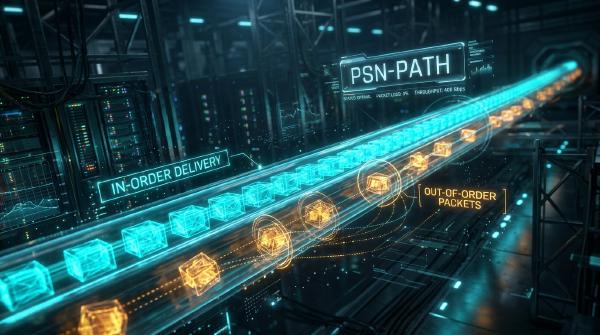
However, it introduces a transport problem: packets sent later may arrive before packets sent earlier.
OpenRDMA’s reliability and memory-placement mechanisms are designed around that behavior rather than assuming in-order delivery.
SRv6 and compressed routing identifiers #
OpenRDMA uses Segment Routing over IPv6 (SRv6) to encode routing information in the outer IPv6 destination address.
The address represents the selected route through the network. Intermediate switches follow their configured forwarding behavior without requiring the NIC to calculate an entirely new route for every packet.
The paper favors this approach because it can reuse existing IPv6 forwarding infrastructure without introducing a separate label stack.
It also uses micro-segment identifiers (uSID) to compress multi-hop route information into a compact address representation.
That matters for hardware pipelines where route selection must remain inexpensive.
Entropy Values select the path #
Looking up a complete route for every packet would add unnecessary work to the packet-processing pipeline.
OpenRDMA instead uses a compact identifier called an Entropy Value (EV).
Each EV maps to three pieces of information:
- A network route.
- A local NIC port.
- A send queue or channel.
The NIC selects among currently active EVs when transmitting packets.
The identifier can be carried in the UDP source port or IPv6 flow label. Route definitions and EV mappings are prepared by the control plane before normal traffic begins.
The data plane then needs only a table lookup to determine where a packet should go.
This allows consecutive packets from the same connection to use different paths without waiting for earlier packets to finish.
Direct placement without a reorder buffer #
Packet spraying creates out-of-order arrivals, but OpenRDMA does not require the receiver to reconstruct the original packet order before writing data into memory.
Each packet carries the information needed to identify its final destination and validate the relevant memory access.
Once verified, the NIC writes the packet directly to its designated GPU memory location.
Network arrival order and memory placement order are therefore separated.
This avoids the need for an additional payload reorder buffer and prevents an unnecessary copy through temporary storage.
EVs also provide path-health information. Feedback carrying an EV lets the sender associate congestion or packet loss with a particular route.
The sender can remove an unhealthy EV from the active set and replace it with a standby path.
🔄 Selective Reliability: Distinguishing Delayed Packets from Lost Packets #
Multipath transmission changes a basic assumption behind traditional reliable transports: packets no longer arrive in sequence order.
Consider a sender transmitting packets numbered 10 through 20.
The receiver may see packets 11 through 20 first because they traveled through faster paths. Packet 10 may still be moving through a congested route.
At this point, the receiver cannot conclude that packet 10 has been lost.
It may simply be late.
Why cumulative acknowledgments are insufficient #
A conventional cumulative acknowledgment reports the highest contiguous sequence number received.
In this example, the receiver can only acknowledge packet 9 until packet 10 arrives.
That acknowledgment says nothing about packets 11 through 20, even though they may already be stored in memory.
A transport that responds to every sequence gap with a retransmission risks confusing delayed packets with lost packets.
Go-back-N-style recovery makes this worse. Depending on the implementation, a gap can cause the sender to replay multiple packets that the receiver already has.
That wastes bandwidth and can create additional congestion.
Tracking individual sequence slots #
OpenRDMA uses a receive bitmap or table to track individual sequence numbers within the current receive window.
When packet 15 arrives before packet 10, the receiver records packet 15 rather than discarding it.
The cumulative acknowledgment advances only when a contiguous sequence of packets beginning at the lowest unacknowledged position becomes available.
Once the gap closes, the window can slide forward.
This preserves useful progress even when packet delivery is heavily reordered.
Adaptive acknowledgment detail #
OpenRDMA uses two levels of acknowledgment reporting.
When out-of-order delivery is limited, a simple cumulative ACK is sufficient.
When the receiver accumulates more out-of-order packets, it sends a detailed ACK containing individual slot status.
The trigger is based on the number of unacknowledged packets currently held, rather than simply calculating:
max_seq - cumulative_ack
This distinction matters when multiple receive channels deliver packets concurrently.
A single packet arriving far ahead can produce a large sequence-number distance even when the receiver is holding only a small number of out-of-order packets.
Counting actual buffered packets gives a better indication of the receiver’s state.
Determining whether a packet is actually lost #
An empty sequence slot does not automatically mean a packet has disappeared.
The receiver needs evidence that enough subsequent packets have arrived and been reported beyond the missing sequence number.
Only then can the sender distinguish a likely loss from ordinary path-induced delay.
OpenRDMA handles two error categories differently.
Explicitly identifiable errors
Some failures are visible directly to the receiver:
- Truncated packet headers.
- Checksum failures.
- Temporary receiver resource exhaustion.
When the receiver can identify the affected sequence number, it can immediately report the specific error without waiting for additional packets.
Silent drops
A packet dropped before its header reaches the receiver cannot be identified directly.
These losses rely on acknowledgment gaps, periodic feedback, or sender-side timeouts.
Shared retransmission timers #
Maintaining an independent timer for every outstanding packet would consume substantial state as connection counts and receive windows grow.
OpenRDMA instead shares one timer across a fixed-size contiguous block of sequence numbers.
When that timer expires, the sender checks the latest receive bitmap and retransmits only packets that remain missing.
It does not blindly replay the entire block.
Duplicate retransmissions are also controlled. The sender permits at most one pending retransmission per sequence number and checks the latest acknowledgment state again before transmitting.
A delayed ACK may have arrived while the retransmission was waiting in the queue.
The intended result is straightforward: one lost packet should require retransmitting one packet, not replaying an entire window.
In the paper’s experiments, each additional dropped packet introduces only 298 bytes of wire overhead.
🧠 Packet Arrival Is Not the Same as GPU Memory Visibility #
Reliable delivery answers whether a packet has arrived. It does not automatically answer whether the GPU can safely consume the corresponding data.
OpenRDMA separates three events:
- The NIC receives and records a packet.
- The payload is written into its target GPU memory location.
- The GPU observes the completed write.
These events cannot be treated as equivalent.
The receiver uses four DMA channels to write GPU memory in parallel. Consequently, packet arrival order at the NIC does not necessarily match the order in which memory writes complete.
A packet may be acknowledged before its payload has been committed to GPU memory.
Likewise, a completed DMA write does not automatically guarantee that a GPU compute unit will observe the new value through an ordinary cached load.
The four-stage completion pipeline #
OpenRDMA addresses this with a four-stage hardware pipeline.
Stage 1: Receipt
The NIC records the incoming packet and acknowledges its arrival without waiting for the GPU memory write to finish.
This keeps transport acknowledgment separate from the slower memory-commit process.
Stage 2: Global sequencing
The NIC assigns a unified sequence number across the parallel DMA channels.
This provides a consistent ordering reference even when multiple channels process incoming data concurrently.
Stage 3: Ordered commit
A hardware mechanism described as Call-Next examines the head of each DMA channel’s queue.
A write is committed only when the next expected sequence number is available at the appropriate queue head.
As writes become committed, the NIC advances a committed-data watermark.
Stage 4: Flag release
Each connection maintains a queue of pending completion flags.
A flag is released only after all payload data covered by that flag has passed the committed-data watermark.
The NIC then writes the flag to the designated memory location.
Why the completion flag is only four bytes #
The flag itself is small: 4 bytes.
Its value comes from the ordering guarantee it represents.
When the GPU observes the flag, it knows that the payload covered by that flag has already completed its NIC-side memory writes.
This resembles release-acquire synchronization:
- The producer publishes the flag only after the associated payload writes are complete.
- The consumer checks the flag before accessing the payload.
However, the ordering guarantee must be implemented correctly across the device and memory system.
Handling flags that arrive too early #
Packet spraying can also reorder completion flags.
A flag may reach the receiver before some of the payload packets it protects.
The receiver cannot publish that flag immediately.
OpenRDMA therefore stores early flags in a bounded per-connection wait queue.
Each entry contains only the information needed for later release:
- The sequence number covered by the flag.
- The target memory address.
- The memory key.
- The flag value.
The NIC can release the original packet-header buffers while waiting for the missing payload data.
Because this queue has finite capacity, pending flags consume ordered credits. This prevents the sender from submitting more flag operations than the receiver can safely retain.
GPU cache visibility remains a separate concern #
There is an important limitation here.
Writing the flag proves that the NIC has completed the relevant memory writes on the device side. It does not, by itself, prove that every GPU cache has observed the updated payload.
Runtime software still needs to use the platform’s specified cache-bypassing reads and appropriate memory barriers.
If the platform cannot guarantee those semantics, the driver must use CPU-managed completions rather than treating an ordinary cached GPU read as definitive proof of data arrival.
This is a distinction that matters in any GPU-native transport design: network completion, DMA completion, and application-level memory visibility are related but separate guarantees.
🏗️ Why OpenRDMA Splits Reliability Between Hardware and Software #
Putting every reliability mechanism inside the NIC sounds attractive, but it creates a hardware resource problem.
A fully hardware-managed implementation would need several structures:
- Original request metadata.
- A bitmap tracking received sequence numbers.
- A retransmission queue.
- Timer state for detecting missing packets.
These structures grow with the number of active connections and the depth of their receive windows.
For an FPGA-based NIC, that can become expensive.
OpenRDMA instead separates high-frequency packet processing from lower-frequency recovery decisions.
Keep the fast path in hardware #
Operations that happen continuously must remain on the NIC:
- Doorbell processing.
- Descriptor construction.
- Address translation.
- Permission checking.
- Packet generation.
- Normal packet forwarding.
These operations sit directly on the communication critical path.
Adding CPU involvement to every send would undermine the architecture’s main objective.
Delegate retransmission decisions to the CPU #
Packet loss is comparatively infrequent in the target deployment model.
OpenRDMA therefore allows the NIC to report reliability events to the CPU instead of maintaining every retransmission decision entirely in hardware.
When an acknowledgment arrives, the NIC decodes its contents, including cumulative progress, bitmap information, and specific error indices.
It then retrieves the corresponding original request metadata from its internal ledger and sends a report to host memory using a PCIe write.
The CPU processes that report and determines which packets should be retransmitted.
It builds retransmission commands using the original destination, length, and memory-key information, then passes those commands back to the NIC.
The NIC validates the commands against the latest connection state, window limits, credits, and congestion conditions before transmitting.
It also checks whether a late acknowledgment has already covered the requested sequence number.
Why this hybrid approach matters #
This arrangement reduces the amount of on-chip state required for reliability.
It also keeps normal send progress independent of retransmission processing.
New doorbells and sequence numbers can continue advancing while the CPU handles recovery in the background.
The trade-off is additional PCIe reporting traffic and CPU processing latency.
For workloads that do not require strict in-order delivery at the upper layer, that cost can be acceptable compared with dedicating large amounts of FPGA memory to retransmission state.
The wire protocol remains consistent across both configurations. Packet numbering, acknowledgment formats, and receiver deduplication do not change.
Deployments can therefore choose between software-assisted retransmission for resource-constrained hardware and fully hardware-managed recovery when minimum recovery latency justifies the additional chip resources.
🚦 Congestion Control: Reroute Before Reducing the Send Rate #
Traditional congestion control often responds to congestion by reducing the sender’s transmission rate or shrinking its sending window.
OpenRDMA takes a different approach.
When sufficient alternative paths exist, it prefers to move traffic away from a congested route rather than immediately slowing down the entire connection.
The rationale is that reducing the sending rate sacrifices throughput even when other network links remain available.
Rerouting can preserve throughput by distributing traffic across unused capacity.
Hardware backpressure already limits transmission #
OpenRDMA relies on two existing mechanisms to regulate traffic:
- Full egress buffers apply backpressure to upstream queues.
- Exhausted submission credits prevent the GPU from issuing additional doorbells.
Together, these mechanisms provide an end-to-end hardware feedback loop.
When congestion fills downstream buffers, the send engine stops pulling new work. Backpressure propagates upstream, credits stop returning, and the GPU eventually stops submitting additional requests.
The transport does not need to calculate a separate per-round sending allowance to maintain this basic flow control.
Removing congested paths from the active set #
When a receiver detects a congestion mark while processing a packet header, it includes that information in feedback carrying the associated EV.
The sender then:
- Removes the affected EV from its active path set.
- Promotes a standby EV.
- Moves unacknowledged packets from the congested path to the replacement path.
The same recovery mechanism handles congestion and genuine packet loss.
This avoids maintaining two independent recovery systems with separate state and corner cases.
Recovering an evicted path #
An evicted path is not permanently disabled.
The sender periodically probes the same route to determine whether it has recovered.
After three consecutive successful probes, the path can return to the active set.
Persistent failures can instead trigger diagnostics to investigate the physical link.
Probing is rate-limited to at most once per millisecond for each evicted path.
This keeps the monitoring overhead small.
Retransmissions take priority #
When the NIC has both new packets and retransmissions waiting to be sent, OpenRDMA gives retransmissions higher priority.
There is a practical reason.
A missing packet can prevent receiver progress and cause buffers to remain occupied. If recovery takes too long, a timeout may trigger additional retransmissions and create more network traffic.
Sending the missing packet promptly can therefore prevent a much larger recovery event.
The approach has one major dependency: path diversity.
Rerouting works best in fabrics with many alternative routes, potentially hundreds. In heavily oversubscribed or poorly redundant networks, there may be few usable alternatives.
In those environments, path eviction alone cannot replace conventional rate-based congestion control.
📊 Evaluation Results and Scheduling Trade-Offs #
The paper evaluates OpenRDMA using hardware and network co-simulation.
The sender and receiver RTL designs run in Verilator, while ns-3 models network serialization, queueing, and propagation delay.
The two environments exchange timestamped advancement messages for individual frames.
The test configuration includes:
| Parameter | Configuration |
|---|---|
| Queue Pairs | 4 |
| Receive channels | 4 |
| Independent links | 4 |
| Link bandwidth | 100 Gb/s each |
| Per-path latency | 200 ns |
| Network queue depth | 100 packets |
| Receive window per QP | 16 packets |
| Ordered queue entries per QP | 4 |
One result highlights an important limitation of simplistic packet-level load balancing.
With four QPs and 4 KiB messages, fixed-path routing achieved 211.8 Gb/s, while per-packet spraying achieved 164.2 Gb/s.
At first glance, that seems counterintuitive. Packet spraying is supposed to improve link utilization.
The explanation is in the packet segmentation.
Each 4 KiB message was divided into a 4,068-byte main packet and a 28-byte tail packet.
A round-robin scheduler that distributes packets evenly across paths is balancing packet counts, not payload bytes.
Because the packets have very different sizes, equal packet distribution does not necessarily produce equal bandwidth utilization.
This is a useful reminder for multipath transport design: packet-level scheduling needs to account for message segmentation, packet size, path characteristics, and receiver buffering capacity.
The best routing policy is not necessarily the one that distributes the highest number of packets evenly.
🔍 OpenRDMA and the Direction of AI Network Transport #
OpenRDMA reflects a broader shift in the way large AI fabrics approach reliable communication.
Traditional RDMA implementations were built around queue-based interfaces and relatively stable transport paths. Modern GPU clusters increasingly need to support packet-level multipath delivery, out-of-order arrivals, selective recovery, and hardware-managed synchronization.
The industry is moving in the same direction.
The Open Compute Project (OCP) published its Multi-Path Reliable Connection (MRC) specification in March 2026, with contributions from AMD, Broadcom, Intel, Microsoft, NVIDIA, and OpenAI.
The Ultra Ethernet Consortium (UEC) also finalized its 1.0 specification family in 2026.
These efforts put multipath routing, selective acknowledgments, and out-of-order packet delivery at the center of next-generation AI networking.
For additional background, see KAD’s coverage of OpenAI MRC and multipath networking for 100,000-GPU AI superclusters.
The underlying network architecture also matters. KAD’s introduction to AI cluster networks explains how GPU backend fabrics, RDMA-enabled NICs, and network rails fit into large distributed training systems.
OpenRDMA’s contribution is more specific: it translates these transport requirements into a concrete hardware interface that reduces GPU-side control overhead while preserving reliability.
Its architecture divides responsibilities across three layers:
| Component | Primary responsibility |
|---|---|
| GPU | Express communication intent through minimal doorbell writes and consume completion flags |
| NIC | Construct work orders, manage packet delivery, select paths, track memory commits, and enforce transport semantics |
| CPU | Initialize connections, configure operation templates, and handle low-frequency recovery decisions |
This division matches the strengths of each component. GPUs focus on parallel computation, NICs handle high-frequency data-path operations, and CPUs retain the flexibility needed for configuration and exceptional conditions.
Several engineering questions remain open.
First, will NIC vendors move descriptor construction and more of the transport control path away from conventional host software interfaces?
Second, how much does software-assisted retransmission cost under production workloads, particularly when PCIe reporting, host polling, and CPU scheduling are included?
Finally, how well does reroute-first congestion handling perform in networks with higher oversubscription and fewer redundant paths?
Those questions will determine how practical GPU-native, multipath reliable transport becomes as AI clusters continue to scale.