Dell 2026 Technology Summit: Enterprise AI Agents Scale Up
At the 2026 Dell Technology Summit in Shanghai, Dell emphasized a major shift in enterprise AI: companies are moving beyond experimental pilots toward large-scale deployment, workflow integration, and measurable business value.
Rather than treating AI as an isolated software initiative, Dell presented it as a continuous infrastructure transformation spanning client devices, private data centers, edge environments, cloud infrastructure, storage, and cybersecurity.
The strategy reflects a growing reality for enterprise AI: deploying capable models is only one part of the challenge. Organizations also need the compute, data pipelines, storage, networking, management, and security infrastructure required to operate AI Agents reliably at scale.
🤖 Enterprise AI Moves From Pilots to Production #
Dell’s 2026 Modern Enterprise Readiness Survey indicates that more than 50% of Chinese organizations plan to build AI capabilities within the next 24 months, while 45% are already embedding AI into core business workflows.
This shift changes the infrastructure requirements considerably.
Early AI experiments can often rely on cloud APIs and small proof-of-concept environments. Production AI Agents, however, need persistent access to enterprise data, predictable performance, security controls, and integration with existing business systems.
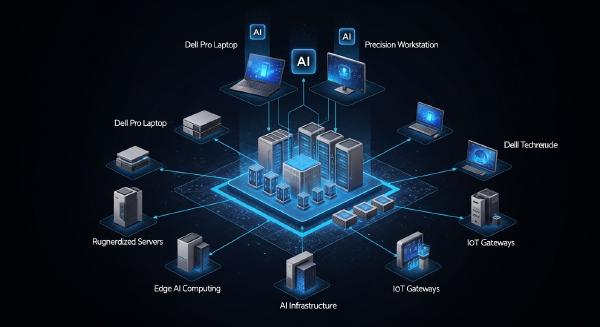
Dell’s approach divides the AI infrastructure stack into four major layers:
- Client: AI PCs and commercial systems capable of running AI workloads locally
- Data Center: Private cloud, compute, storage, and AI data infrastructure
- Edge & Cloud: Distributed infrastructure for geographically dispersed workloads
- Cyber Resilience: Integrated security, detection, recovery, and protection
Together, these layers form Dell’s vision of a systemic AI infrastructure rather than a collection of disconnected AI products.
💻 AI Moves Onto the Client Device #
At the client layer, Dell is positioning its AI PC portfolio as an important component of enterprise Agent deployment.
Local AI processing can reduce dependence on cloud inference for selected workloads, potentially lowering latency, bandwidth consumption, and recurring inference costs. It can also provide organizations with greater control over sensitive information that does not need to leave the endpoint.
The company highlighted its Dell Pro commercial systems alongside products such as the Dell XPS 13.
The XPS 13 is positioned as an ultraportable AI PC, with a roughly 1 kg chassis, 12.7 mm thickness, a 2.5K touchscreen, dual Thunderbolt 4 connectivity, and claimed battery life of up to 17 hours.
The broader implication is that enterprise AI is increasingly expected to operate across a spectrum of devices rather than exclusively inside centralized GPU clusters.
🏢 Private Cloud Becomes the Enterprise AI Foundation #
At the data-center layer, Dell is combining Dell Private Cloud (DPC), PowerStore Elite, and the Dell AI Data Platform (AIDP).
This reflects an important principle of enterprise AI: models are only as useful as the data infrastructure surrounding them.
Enterprise Agents may need to continuously retrieve information from databases, documents, applications, storage systems, and internal knowledge repositories. Preparing this information for AI workloads therefore becomes a core infrastructure task.
Dell’s PowerStore Elite is positioned as a high-performance storage platform for these environments, with claimed features including:
- 6:1 data-reduction guarantee
- Up to 3× higher IOPS performance
- Non-disruptive system upgrades
The combination of AI compute and AI-ready storage is increasingly important as enterprises move toward retrieval-augmented generation, multimodal workloads, and persistent Agent memory.
🌐 Distributed Infrastructure Extends AI to the Edge #
Not every enterprise AI workload can or should run inside a centralized data center.
Factories, retail locations, branch offices, healthcare environments, and other distributed operations may require local processing because of latency, bandwidth, privacy, or availability requirements.
Dell’s Distributed Private Cloud (DDPC) extends private-cloud management principles into edge and mid-market environments.
This creates a more distributed architecture in which AI workloads can move between centralized infrastructure and local computing resources depending on operational requirements.
For AI Agents, this could enable a workflow where local systems perform immediate perception or decision-making while centralized infrastructure handles larger models, historical data, and computationally intensive tasks.
🛡️ Cyber Resilience Becomes Part of the AI Stack #
As AI becomes embedded deeper into business processes, cybersecurity can no longer be treated as a separate layer added after deployment.
Dell is therefore incorporating cyber resilience across the infrastructure stack, combining protection, threat detection, and automated recovery.
This is particularly important for enterprise Agents because an Agent can potentially interact with files, applications, databases, APIs, and operational systems.
A compromised Agent or underlying infrastructure could therefore have a much broader impact than a conventional standalone application.
Building recovery and security mechanisms directly into the infrastructure is consequently becoming a prerequisite for trustworthy enterprise AI deployment.
🖥️ New Hardware Extends the AI Ecosystem #
The summit also highlighted several new Dell and Alienware products across professional computing, displays, and enterprise infrastructure.
The Alienware 39 5K OLED (AW3926QW) features a 38.9-inch curved 5K WUHD display with a 1500R curvature, 4th-generation Tandem OLED technology, and dual operating modes of 5120×2160 at 165Hz or 2560×1080 at 330Hz.
For commercial environments, the Dell UltraSharp 52 (U5226KW) offers a 51.5-inch curved 6K 21:9 IPS Black display with a 6144×2560 resolution and 129 PPI density.
Dell also highlighted the Alienware 16 Area-51 and 16X Aurora laptops, which introduce anti-glare OLED displays designed to reduce reflections in brightly lit environments.
While these products are not all directly related to enterprise AI infrastructure, they demonstrate Dell’s broader strategy of treating AI-enabled computing as an ecosystem spanning individual users, professional workstations, data centers, and distributed infrastructure.
🧠 The Real Challenge Is the Full AI System #
The most important message from Dell’s 2026 Technology Summit is not a single product launch.
It is the company’s argument that enterprise AI has entered an infrastructure phase.
The first generation of AI adoption focused heavily on model selection and experimentation. The next phase requires organizations to solve a much broader set of problems:
- Where should AI inference run?
- How should enterprise data be prepared and accessed?
- How can Agents operate across distributed environments?
- How can AI workloads remain secure and recoverable?
- How can infrastructure scale as AI becomes embedded into everyday workflows?
Dell’s client-to-cloud strategy attempts to address these questions with an integrated infrastructure stack.
🚀 Enterprise Agents Could Drive the Next Infrastructure Cycle #
AI Agents are fundamentally different from traditional chatbot deployments because they can continuously observe, reason, retrieve information, invoke tools, and execute tasks.
That creates demand for infrastructure capable of supporting persistent workloads rather than occasional model queries.
Dell’s strategy therefore points toward a future in which AI infrastructure is distributed across AI PCs, private clouds, enterprise storage, edge systems, and centralized data centers, with cybersecurity and management integrated throughout.
The transition from AI experimentation to production will ultimately depend less on whether enterprises can access powerful models and more on whether they can build the infrastructure needed to operate those models reliably, securely, and economically at scale.
Dell’s 2026 strategy is built around exactly that transition: turning enterprise AI from an experimental technology into a continuously operating infrastructure layer.