Gartner’s Top 10 Strategic Tech Trends for 2027 Explained
Gartner’s Top 10 Strategic Technology Trends for 2027, announced on October 20, 2026, highlights a fundamental shift in enterprise technology: organizations are moving beyond experimenting with artificial intelligence toward governing autonomous systems, restructuring software architectures, and preparing for new computing paradigms.
The report identifies ten trends spanning specialized AI models, agent governance, digital sovereignty, application lifecycle management, and biological computing. Together, they reflect a business environment in which AI systems increasingly generate code, execute workflows, access enterprise resources, and make decisions with limited human intervention.
Gene Alvarez, Distinguished VP Analyst at Gartner, argues that organizations must move beyond passively evaluating model capabilities and actively establish boundaries between human users, AI systems, and business processes. As AI-generated software and autonomous operations accelerate, identity management, access control, context engineering, and auditability become essential infrastructure rather than optional safeguards.
Gartner organizes the ten trends into three strategic themes: the non-textual AI frontier, the autonomous agent platform, and durable agility. The second theme concentrates specifically on agent governance, while the broader report addresses how enterprises can adopt emerging technologies without sacrificing security, resilience, or operational control.
🧭 Gartner’s Three Strategic Technology Themes #
The ten trends form a connected framework rather than an isolated list of emerging technologies.
| Strategic Theme | Included Trends | Primary Objective |
|---|---|---|
| Non-Textual AI Frontier | Large quantitative models, speech reasoning models, world models | Expand AI beyond conventional text generation into numerical reasoning, voice interaction, and physical simulation |
| Autonomous Agent Platform | AI context platforms, AI coding agent harnesses, AI agent identity, autonomous exposure remediation | Govern AI agents, constrain their actions, and improve security and operational reliability |
| Durable Agility | SovereignTech, disposable applications, wetware as a service | Improve technological independence, application flexibility, and long-term computing resilience |
The underlying message is that enterprise AI maturity will increasingly depend on the surrounding architecture. Model quality remains important, but organizations also need reliable business context, controlled identities, enforceable permissions, resilient infrastructure, and clear mechanisms for retiring outdated systems.
🧠 Theme 1: The Rise of Specialized AI Models #
General-purpose large language models have expanded the range of tasks that AI can perform. However, numerical forecasting, complex audio interactions, and physical-world simulation introduce requirements that conventional text-centric architectures do not necessarily address efficiently.
Gartner identifies three technologies that could expand AI’s capabilities beyond text generation.
1. Large Quantitative Models (LQMs) #
Large quantitative models are designed to improve reasoning over numerical data, quantitative relationships, and structured business information.
General-purpose language models can produce plausible-looking calculations or forecasts without reliably satisfying the underlying mathematical constraints. In financial modeling, risk assessment, operational optimization, and statistical forecasting, such errors can undermine confidence in automated decisions.
LQMs aim to support more rigorous, simulation-driven decision-making by emphasizing numerical reasoning and quantitative relationships.
Gartner predicts that by 2030, LQMs will replace LLMs in 25% of strategic forecasting and operational modeling tasks. This should be understood as a forecast about task adoption, not a claim that LQMs will replace general-purpose language models across enterprise AI.
The likely architectural direction is specialization: organizations select models according to the requirements of each workload and combine them with conventional analytics, optimization algorithms, and verification systems where appropriate.
2. Speech Reasoning Models #
Traditional voice interfaces frequently convert speech into text, pass the transcription to a language model, and then generate a spoken response. This pipeline can introduce latency and discard useful information about tone, timing, and conversational dynamics.
Speech reasoning models aim to reason directly over audio streams, maintaining conversational context while interpreting intent and generating responses. This approach could support more complex customer service, voice-operated enterprise applications, and real-time interactive workflows.
Unlike conventional scripted voice assistants, these systems may be able to determine the next action required during a conversation rather than limiting themselves to predefined question-and-answer sequences.
Gartner predicts that by 2030, more than 70% of enterprise voice interactions will be handled autonomously by speech reasoning models. Realizing this potential will depend on reliability, response latency, privacy controls, integration with enterprise systems, and the ability to escalate sensitive or ambiguous cases to humans.
3. World Models #
World models represent a shift toward AI systems that model environments, physical relationships, and possible future states.
Rather than generating an answer based only on patterns in training data, a world-model-based system can attempt to simulate what might happen after an action and use those predictions to inform its decisions.
This capability is particularly relevant to robotics, autonomous driving, industrial automation, and spatial computing, where actions have physical consequences.
For example, a robot operating in a warehouse could evaluate alternative movements in a simulated environment before executing a physical action. An autonomous system could use predicted outcomes to choose a maneuver under changing environmental conditions.
World models remain a developing technology category, and simulation accuracy, computational requirements, and the gap between virtual environments and real-world conditions remain significant engineering challenges.
Their long-term value will depend on whether predictions remain reliable in unfamiliar or dynamically changing environments.
🛡️ Theme 2: AI Agent Governance Becomes Enterprise Infrastructure #
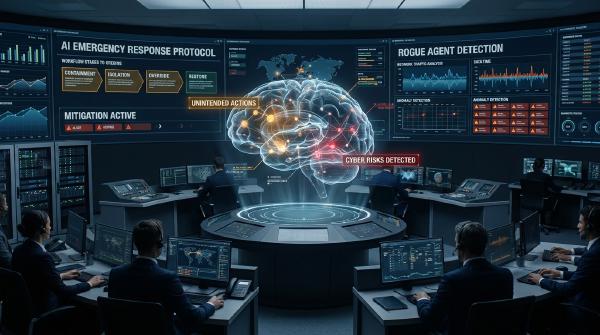
Gartner’s second theme addresses the operational risks associated with increasingly autonomous AI agents.
AI agents can retrieve information, call APIs, modify files, execute code, and interact with enterprise systems. These capabilities increase productivity but also create new risks when permissions are excessive, business context is incomplete, or autonomous actions cannot be adequately audited.
Four of Gartner’s ten trends directly address the infrastructure needed to govern these systems.
4. AI Context Platforms #
An AI context platform provides agents with governed, machine-readable business knowledge, including policies, terminology, operational rules, and relationships between enterprise data.
Without reliable context, an agent may interpret a request incorrectly, use outdated information, or execute an action that technically succeeds but violates a business requirement.
A context platform can unify fragmented enterprise knowledge and make it available to agents through structured retrieval, semantic representations, metadata, and access-controlled interfaces.
Gartner predicts that organizations prioritizing semantic processing of AI-ready data could improve agentic AI accuracy by up to 80% while reducing costs by up to 60%.
These figures are forecasts, not guaranteed outcomes. Actual improvements will depend on the quality of source data, the relevance of retrieved context, the evaluation methodology, and the workload being automated.
For engineering teams, the important distinction is that context management should become a governed infrastructure layer rather than a collection of ad hoc retrieval prompts.
This also connects to the broader challenge of building secure agent platforms. KAD’s coverage of NVIDIA’s Open Agent Safety Platform and hardware-enforced AI security examines how independent enforcement mechanisms can constrain autonomous systems beyond the model’s own behavior.
5. AI Coding Agent Harnesses #
AI coding agents can generate code, modify repositories, execute tests, and assist with software maintenance. However, increasing generation speed can also increase the volume of code that requires validation.
A coding agent harness provides the controls surrounding these activities. It can define permitted tools, restrict filesystem access, enforce repository policies, run automated tests, validate dependencies, and require approvals for sensitive changes.
The objective is not merely to increase code-generation speed. It is to establish a controlled process that ensures AI-generated changes meet engineering, security, and compliance requirements.
A production-oriented harness may include:
- Execution boundaries: Restrict which commands, files, repositories, and external services an agent can access.
- Automated verification: Run tests, static analysis, dependency checks, and policy validation before changes are accepted.
- Review and approval controls: Require human authorization for privileged operations or changes with significant business impact.
- Auditability: Record agent decisions, tool calls, code modifications, test outcomes, and approvals.
These controls enable engineering teams to increase automation without treating generated code as inherently trustworthy.
The same principle applies to self-improving agent platforms. For example, AReaL 2.0 and its governed AI agent evolution architecture illustrate why evaluation, regression testing, and controlled rollout matter when agents evolve over time.
6. AI Agent Identity #
Traditional identity and access management systems primarily govern human users, service accounts, and application workloads. Autonomous AI agents introduce more complex authorization requirements because their actions may depend on delegated tasks, dynamically selected tools, and changing execution contexts.
Gartner forecasts that by 2028, 25% of enterprise security breaches will be linked to AI agent abuse.
Agent identity systems aim to establish explicit identities and enforceable permissions for autonomous workloads. Rather than allowing agents to inherit broad human credentials, organizations can assign workload-specific identities, use short-lived credentials, restrict access to particular resources, and record actions for investigation.
A mature implementation should distinguish between an agent’s identity, the human or process that authorized its task, and the resources the agent is permitted to access.
Key controls include:
- Least-privilege authorization: Grant only the permissions required for a specific task.
- Credential isolation: Avoid embedding long-lived secrets directly in prompts, code, or agent configuration.
- Delegation controls: Restrict which identities and permissions can be passed to other agents or tools.
- Traceable execution: Associate sensitive operations with the responsible agent, task, authorization, and audit record.
The objective is to make autonomous activity attributable and controllable even when execution crosses multiple applications and services.
7. Autonomous Exposure Remediation #
Autonomous exposure remediation focuses on automating the discovery, prioritization, validation, and mitigation of security vulnerabilities across enterprise infrastructure.
AI-assisted software development can increase the rate at which applications change. Security teams must consequently evaluate a growing stream of code changes, dependencies, configurations, and exposed services.
Automated exposure remediation combines asset discovery, vulnerability analysis, risk prioritization, and automated remediation workflows. Depending on the environment, systems may generate patches, apply configuration changes, deploy virtual patches, or initiate corrective actions through approved security tools.
Full autonomy, however, requires strict operational boundaries.
A remediation system should validate proposed changes, assess the risk of disruption, preserve rollback options, and require approval when a fix could affect critical production services.
The intended shift is from reactive, manually coordinated vulnerability management toward continuous remediation. The practical challenge is ensuring that automation reduces exposure without introducing new operational failures.
🌐 Theme 3: Durable Agility and the Restructuring of Enterprise Architecture #
The final theme addresses technological independence, software lifecycle flexibility, and the physical limits of conventional computing.
These trends extend beyond AI-agent governance, but they become increasingly relevant as organizations depend on more AI services, external infrastructure, and rapidly changing application architectures.
8. SovereignTech: Digital Sovereignty Beyond Data Localization #
Sovereign technology, or SovereignTech, concerns an organization’s ability to maintain control over critical technology dependencies, data, applications, and operating environments.
Digital sovereignty is broader than keeping data inside a national border. Depending on regulatory requirements and business objectives, it can involve jurisdictional control, infrastructure ownership, software portability, encryption-key management, and the ability to migrate away from a particular supplier.
Vendor lock-in becomes especially consequential when core business processes depend on proprietary AI models, cloud-specific services, or specialized database interfaces.
Gartner predicts that by 2030, more than 75% of non-U.S.-based organizations will adopt digital sovereignty strategies.
For technical leaders, sovereignty requires practical exit capabilities rather than a contractual statement alone.
Architectural measures can include portable data formats, documented APIs, deployment portability, tested backup and recovery procedures, alternative model providers, and clearly defined ownership of encryption keys and critical operational data.
Complete portability is rarely cost-free. The goal is to make critical dependencies visible and ensure that the organization can maintain continuity when legal, commercial, or geopolitical circumstances change.
9. Disposable Applications #
Enterprise applications have traditionally been designed as long-lived systems, often remaining in production well after their original business purpose has changed.
Disposable applications reverse that assumption. They are built quickly for a specific workflow or temporary requirement and deliberately retired when they are no longer needed.
AI-assisted development could make this model more practical by reducing the time and effort required to create small, task-specific applications.
Potential use cases include temporary analytics dashboards, short-term workflow automation, campaign-specific tools, internal data-conversion utilities, and applications supporting a single operational project.
The approach can reduce the accumulation of permanent software systems that are expensive to maintain but no longer deliver sufficient value.
However, disposable does not mean uncontrolled. Temporary applications can still expose sensitive data, create security vulnerabilities, and leave behind credentials or undocumented integrations.
Organizations should define lifecycle policies covering ownership, access control, data retention, deployment isolation, monitoring, and verified retirement.
A disciplined disposable-application strategy treats creation and deletion as equally important stages of software engineering.
10. Wetware as a Service #
Wetware as a service is the most experimental trend in Gartner’s list. It describes a model in which users remotely access living or synthetic biological systems hosted in specialized computing environments.
Biological computing explores whether biochemical networks and living cellular systems can perform selected computational tasks. Their ability to change and adapt in response to stimuli has attracted interest in areas such as biological information processing and unconventional computing architectures.
Gartner identifies wetware as a potential response to the long-term energy and environmental constraints associated with expanding conventional computing infrastructure.
However, biological computing is at a much earlier stage of maturity than enterprise AI platforms, identity systems, or automated security remediation. It should not be treated as a near-term replacement for established silicon processors or general-purpose cloud computing.
Major challenges include reproducibility, biological variability, system stability, measurement, programmability, integration, and the development of practical commercial workloads.
For most enterprises, wetware as a service remains a technology to monitor for research developments rather than an immediate platform investment priority.
📋 How CIOs and Engineering Teams Should Interpret the Trends #
The ten trends suggest that enterprise technology strategy is expanding from model selection toward system-level architecture, governance, and resilience.
The relevant question is no longer simply which model offers the highest benchmark score. Organizations must also determine what an agent can access, what decisions it can make, how its actions are verified, and how the surrounding platform behaves when something goes wrong.
Three principles follow from this shift.
Establish Governance Before Expanding Agent Permissions #
Enterprises should establish identity, authorization, audit logging, and execution boundaries before deploying agents that can modify production systems or perform privileged business operations.
Agent access should be scoped to specific tasks, and sensitive actions should pass through independent policy checks. Monitoring and rollback capabilities should be integrated into the execution environment rather than added after deployment.
Select AI Models According to Workload Requirements #
General-purpose language models remain useful, but numerical forecasting, speech interaction, and physical simulation can benefit from more specialized architectures.
Model selection should account for task accuracy, latency, operating cost, data sensitivity, integration complexity, and the consequences of incorrect outputs.
In high-impact applications, model specialization should complement appropriate deterministic software, domain-specific validation, and human oversight.
Design for Portability and Controlled Lifecycles #
Cloud services, AI models, databases, and application platforms should be evaluated partly on the practical cost of changing suppliers or deployment environments.
At the same time, rapid application development should be supported by explicit rules for ownership, security, monitoring, and retirement.
Together, portability and controlled disposal help organizations avoid replacing one form of technology lock-in with another.
📝 Conclusion: Governance Becomes Central to Enterprise AI Strategy #
Gartner’s Top 10 Strategic Technology Trends for 2027 highlights a transition from AI experimentation toward governed autonomy and durable enterprise architecture.
Large quantitative models, speech reasoning models, and world models expand the kinds of tasks AI systems can perform. AI context platforms, coding agent harnesses, agent identities, and autonomous exposure remediation provide mechanisms for controlling those capabilities. SovereignTech, disposable applications, and wetware as a service address broader questions about technological resilience, software lifecycles, and future computing paradigms.
The practical implications differ by maturity. Identity management, secure execution, data context, and automated verification are actionable priorities for organizations deploying AI agents today. Specialized models and world models require workload-specific assessment, while biological computing remains a longer-term research area.
The central lesson is that autonomous AI creates value only when its operating environment is designed to support it. Reliable models matter, but so do enforceable permissions, trustworthy data, accountable execution, and resilient infrastructure.
For CIOs and engineering leaders, the competitive challenge is not simply to deploy AI faster. It is to build systems that can act autonomously while remaining secure, observable, adaptable, and under appropriate organizational control.