Google Reportedly Invests $12.2 Billion in Marvell AI Chip Deal
Google is reportedly preparing a major strategic agreement with Marvell Technology that could reshape the company’s approach to custom AI silicon and infrastructure. The deal would cover multiple chip technologies designed to complement Google’s Tensor Processing Units (TPUs), while also giving Google a substantial potential equity position in Marvell.
Under the reported agreement, Google would receive a warrant to purchase up to 58.97 million Marvell shares at $206.58 per share. If exercised in full, the position would be worth approximately $12.2 billion and could make Google Marvell’s fifth-largest shareholder.
The agreement also reportedly ties Marvell’s future revenue opportunities to performance milestones. If those milestones are achieved, the partnership could generate approximately $120 billion in revenue for Marvell through fiscal year 2033.
🚀 Google and Marvell Expand Their AI Silicon Partnership #
Foreign media reported on August 19 that Google is set to reach an agreement with US semiconductor company Marvell Technology.
The partnership is expected to encompass multiple technologies that can work alongside Google’s TPU accelerators, including processors and supporting silicon used for AI workloads, data storage, and high-speed networking.
Rather than representing a single accelerator design, the reported agreement points toward a broader AI infrastructure relationship covering multiple components of the compute stack.
$12.2 billion warrant could make Google a major Marvell shareholder #
A central component of the deal is a warrant granting Google the right to purchase up to 58.97 million Marvell shares at $206.58 per share.
If Google exercises the warrant completely, the resulting equity position would be valued at approximately $12.2 billion, potentially making Google Marvell’s fifth-largest shareholder.
The structure also aligns Google’s financial interests with Marvell’s long-term execution. The warrant is reportedly connected to performance milestones, creating an incentive for both companies to meet specific technical and commercial objectives.
📈 Marvell Shares Jump Nearly 10% After the Report #
Marvell shares reacted strongly to the reported agreement.
As of the close of trading on August 19 in local US time, Marvell’s stock had risen as much as 13.54% during the session before finishing 9.85% higher.
Alphabet, Google’s parent company, also moved higher, gaining as much as 0.51% before closing up 0.12%.
The market reaction reflects the strategic significance investors attach to Google’s involvement. A long-term commitment from one of the world’s largest cloud providers could provide Marvell with substantial visibility into future AI infrastructure demand.
Potential revenue opportunity could reach $120 billion #
Foreign media reports indicate that, if Google satisfies the performance milestones associated with the equity option, the agreement could generate approximately $120 billion in revenue for Marvell through fiscal year 2033.
That figure would make the relationship significantly more important than a conventional semiconductor supply agreement. It would instead represent a long-term alignment between a hyperscale cloud provider and a major infrastructure silicon supplier.
🧠 Marvell Adds Google as a Major Custom Silicon Customer #
Google has historically relied heavily on Broadcom as its primary custom chip partner. The reported Marvell agreement therefore raises questions about whether Google is shifting its semiconductor strategy.
Morningstar analyst William Kerwin reportedly views the deal differently. While considering the agreement a major win for Marvell, Kerwin believes Google is primarily adding another compute supplier rather than replacing Broadcom through direct competition.
This interpretation is consistent with the increasing complexity of AI infrastructure.
Modern AI data centers require far more than GPUs or AI accelerators. Compute platforms also depend on networking silicon, storage controllers, interconnect technologies, custom processors, and other specialized components. A hyperscaler can therefore work with multiple suppliers while optimizing different parts of its infrastructure.
Google can diversify its custom silicon supply chain #
Adding Marvell to the ecosystem could give Google greater flexibility when developing and deploying specialized silicon.
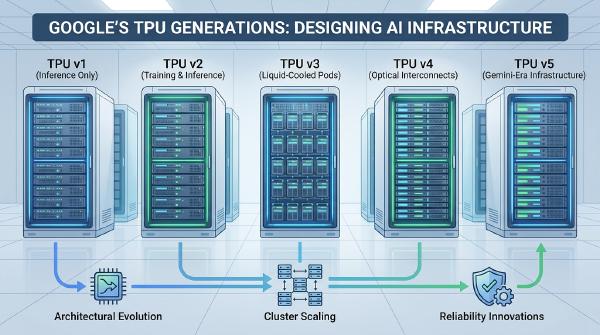
Google’s TPU architecture is designed specifically for machine-learning workloads, but the surrounding infrastructure must also provide high-bandwidth data movement, storage access, networking, and general-purpose processing.
A broader supplier base can potentially help Google optimize cost, performance, capacity, and supply-chain resilience across these components.
⚡ AI Inference Is Driving Demand for Custom Chips #
The reported Google-Marvell agreement comes as technology companies increasingly search for alternatives to Nvidia’s GPU-dominated AI infrastructure.
Training large language models remains extremely compute-intensive, but inference is becoming an increasingly important workload as AI services move into large-scale production.
Inference workloads can have different performance, latency, power-efficiency, and cost requirements from model training. This creates opportunities for application-specific processors and custom accelerators that are optimized for particular workloads.
Google’s TPU program is one of the most prominent examples of this strategy.
Hyperscalers are building increasingly specialized AI infrastructure #
Cloud providers have strong incentives to develop or commission custom silicon because AI workloads are becoming a larger component of their infrastructure costs.
Instead of relying exclusively on merchant GPUs, hyperscalers can combine proprietary accelerators with specialized networking and data-processing silicon to optimize complete systems.
This approach also allows cloud companies to differentiate their infrastructure and potentially reduce dependence on a small number of external semiconductor suppliers.
☁️ Google’s AI Reorganization Raises the Importance of Infrastructure #
Google recently reorganized its AI operations, giving executives closely aligned with Google Cloud greater decision-making authority.
The organizational change has increased attention on custom silicon and AI infrastructure as strategic components of Google’s cloud business.
For Google Cloud, AI infrastructure is not simply an engineering requirement. It is increasingly part of the competitive foundation of its cloud platform.
TPUs, networking infrastructure, data-center systems, and custom processors can all influence the economics of delivering AI services at hyperscale.
The reported Marvell agreement therefore fits into a broader strategy in which Google is attempting to control more of the underlying technology stack supporting AI workloads.
🔗 AI Companies and Chipmakers Are Deepening Their Financial Ties #
The Google-Marvell agreement is also part of a broader trend in the AI industry: major model developers, cloud companies, and semiconductor manufacturers are increasingly linking their commercial interests through large financial commitments.
These arrangements can include equity purchases, stock warrants, capacity agreements, and credit guarantees.
Nvidia and OpenAI #
On August 16, The Information reported that Nvidia was finalizing a credit guarantee agreement worth approximately $100 billion with OpenAI.
The reported arrangement would provide credit support for OpenAI’s plans to rent a large data center in Ohio, further illustrating the enormous financial requirements associated with scaling AI compute infrastructure.
AMD and OpenAI #
AMD also announced a partnership with OpenAI in October under which OpenAI plans to deploy a total of 6 GW of AMD GPU compute capacity.
As part of that arrangement, AMD agreed to issue OpenAI up to 160 million warrants.
The structure gives OpenAI a potential financial interest in AMD while simultaneously creating a long-term demand commitment for AMD’s AI accelerators.
🌐 AI Infrastructure Is Becoming an Interconnected Financial Ecosystem #
The emerging relationships between Google and Marvell, Nvidia and OpenAI, and AMD and OpenAI demonstrate how the economics of AI infrastructure are evolving.
Large model developers need enormous amounts of compute capacity. Cloud providers need competitive and cost-efficient infrastructure. Semiconductor companies need long-term demand and capital visibility.
These incentives increasingly overlap.
Large-scale warrants, equity arrangements, capacity commitments, and credit guarantees can align the interests of companies across multiple layers of the AI supply chain. At the same time, these structures make the relationships between model developers, hyperscalers, and semiconductor manufacturers significantly more intertwined.
For Google, the reported Marvell agreement appears to be less about replacing an existing supplier and more about expanding its custom silicon ecosystem. For Marvell, however, securing a potentially multibillion-dollar strategic relationship with one of the world’s largest AI infrastructure operators could become a defining growth opportunity through the end of the decade.