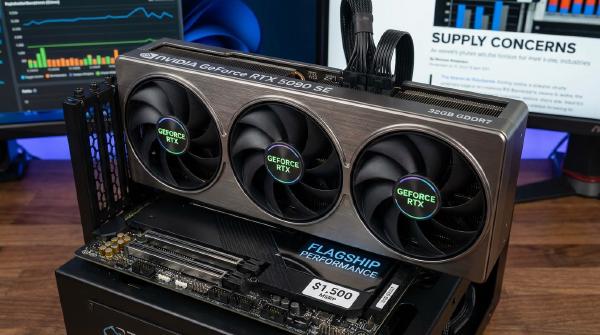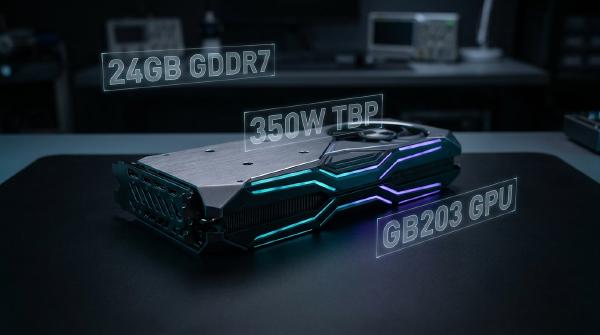
NVIDIA RTX 50 Super Series Delayed as 3GB GDDR7 Prices Triple
NVIDIA has reportedly postponed the launch of its GeForce RTX 50 Super graphics card lineup due to unexpectedly high pricing for 3GB GDDR7 memory chips. While board partners have already received production-ready GPUs, the escalating cost of next-generation memory has forced the company to suspend launch plans for both the desktop Super family and the rumored GeForce RTX 5050 9GB.
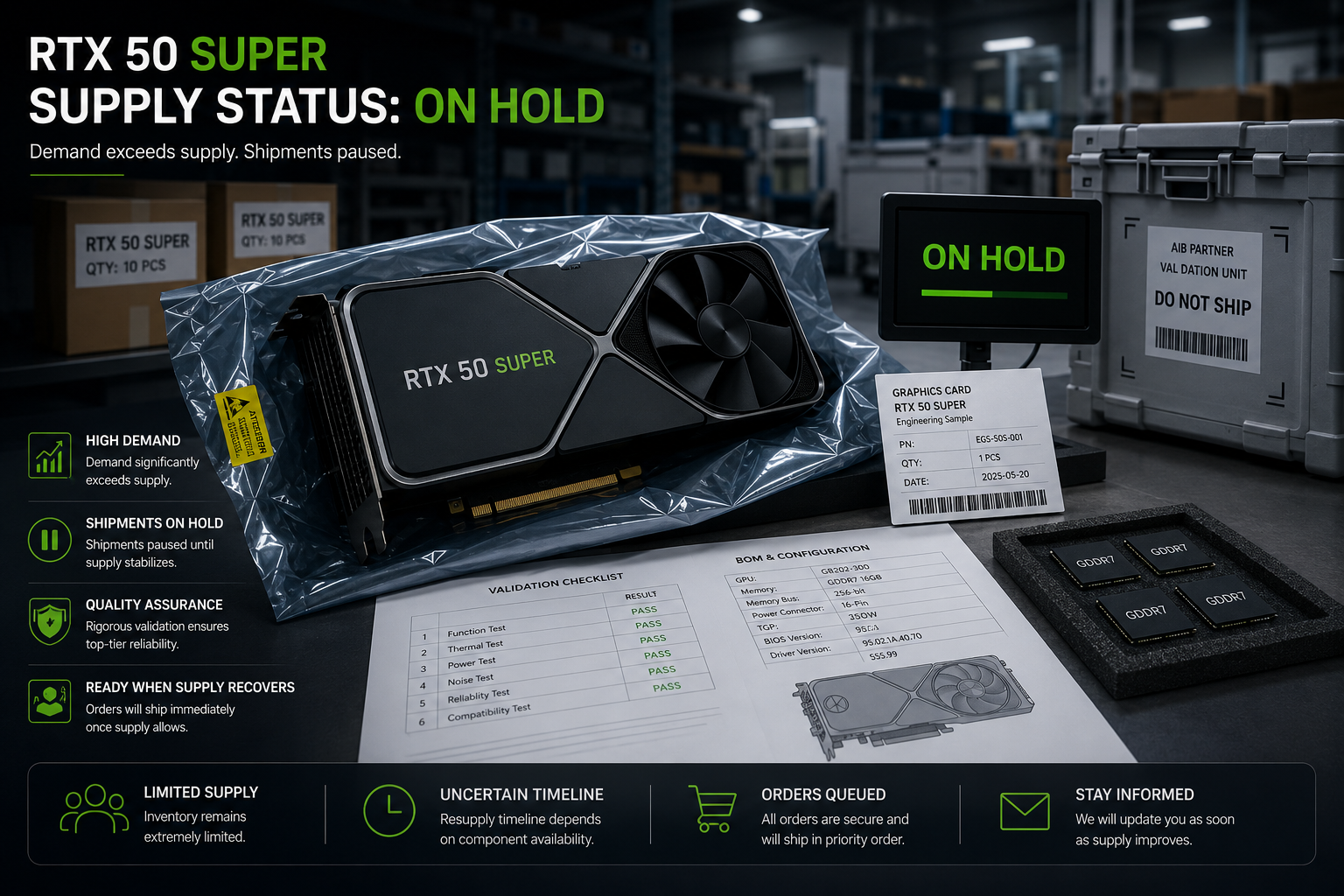
Although the delay disrupts NVIDIA’s expected product roadmap, current reports suggest the lineup has been postponed rather than canceled. Once memory pricing stabilizes or manufacturing costs improve, the Super series is still expected to reach the market.
🚀 Launch Plans Paused Despite Hardware Readiness #
According to supply chain reports, NVIDIA has instructed its add-in board (AIB) partners to halt all launch preparations for the RTX 50 Super family.
Notably, at least one major board partner has already received production silicon, indicating that hardware development is essentially complete. The delay appears to be driven by commercial considerations rather than engineering challenges.
For consumers, this means:
- Product specifications are believed to be finalized.
- Manufacturing is technically ready to proceed.
- Retail availability has been postponed indefinitely.
- No revised launch schedule has been announced.
The postponement also affects the rumored GeForce RTX 5050 9GB, which relies on the same high-cost memory configuration.
RTX 5050 Memory Configuration #
The reported design differences illustrate why the lower-end model faces the same challenge.
| Model | Memory Configuration | Total Capacity |
|---|---|---|
| RTX 5050 | 4 × 2GB GDDR7 | 8GB |
| RTX 5050 9GB | 3 × 3GB GDDR7 | 9GB |
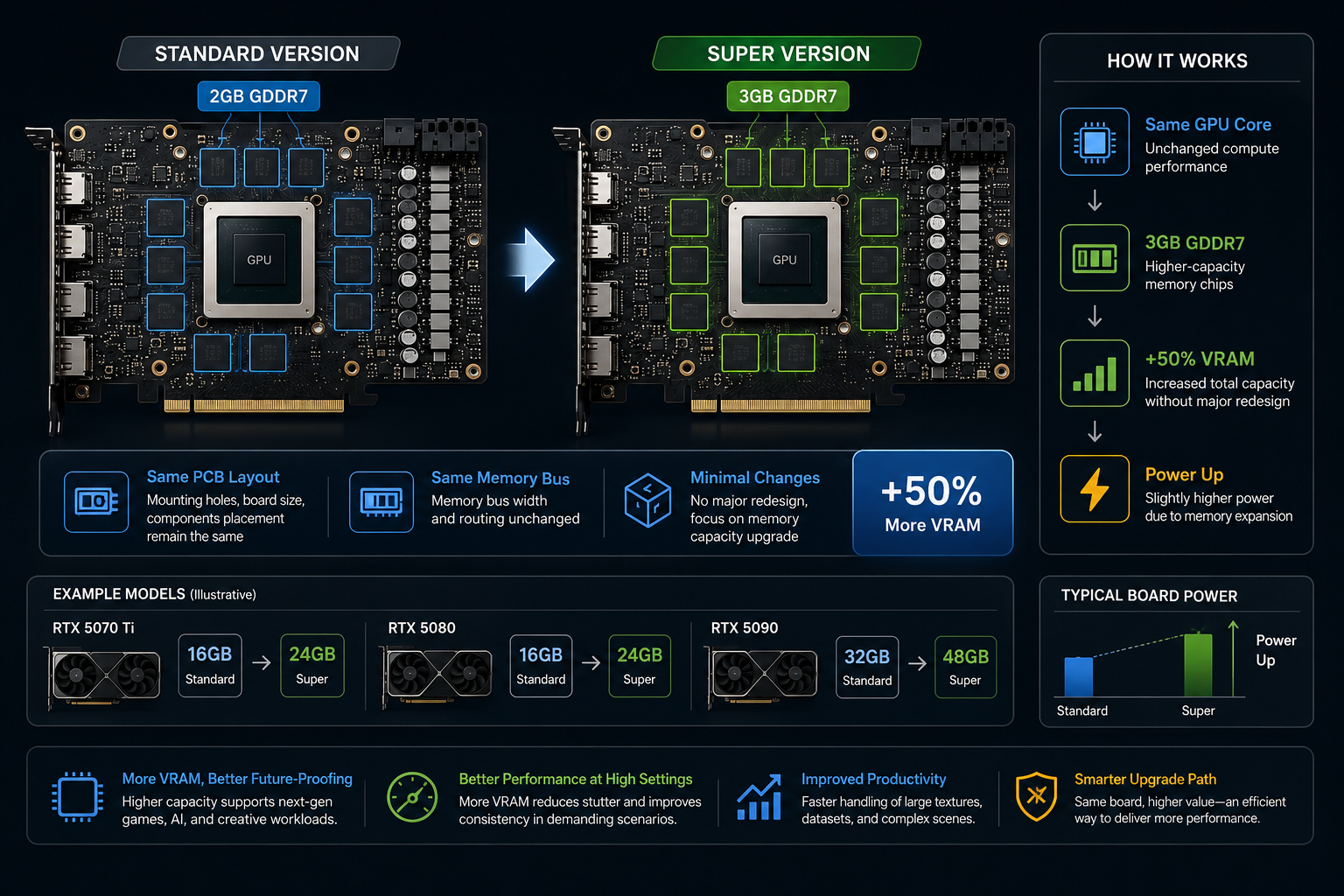
Although the 9GB model reduces the number of memory packages, it depends entirely on the much more expensive 3GB GDDR7 chips.
💾 3GB GDDR7 Has Become the Primary Bottleneck #
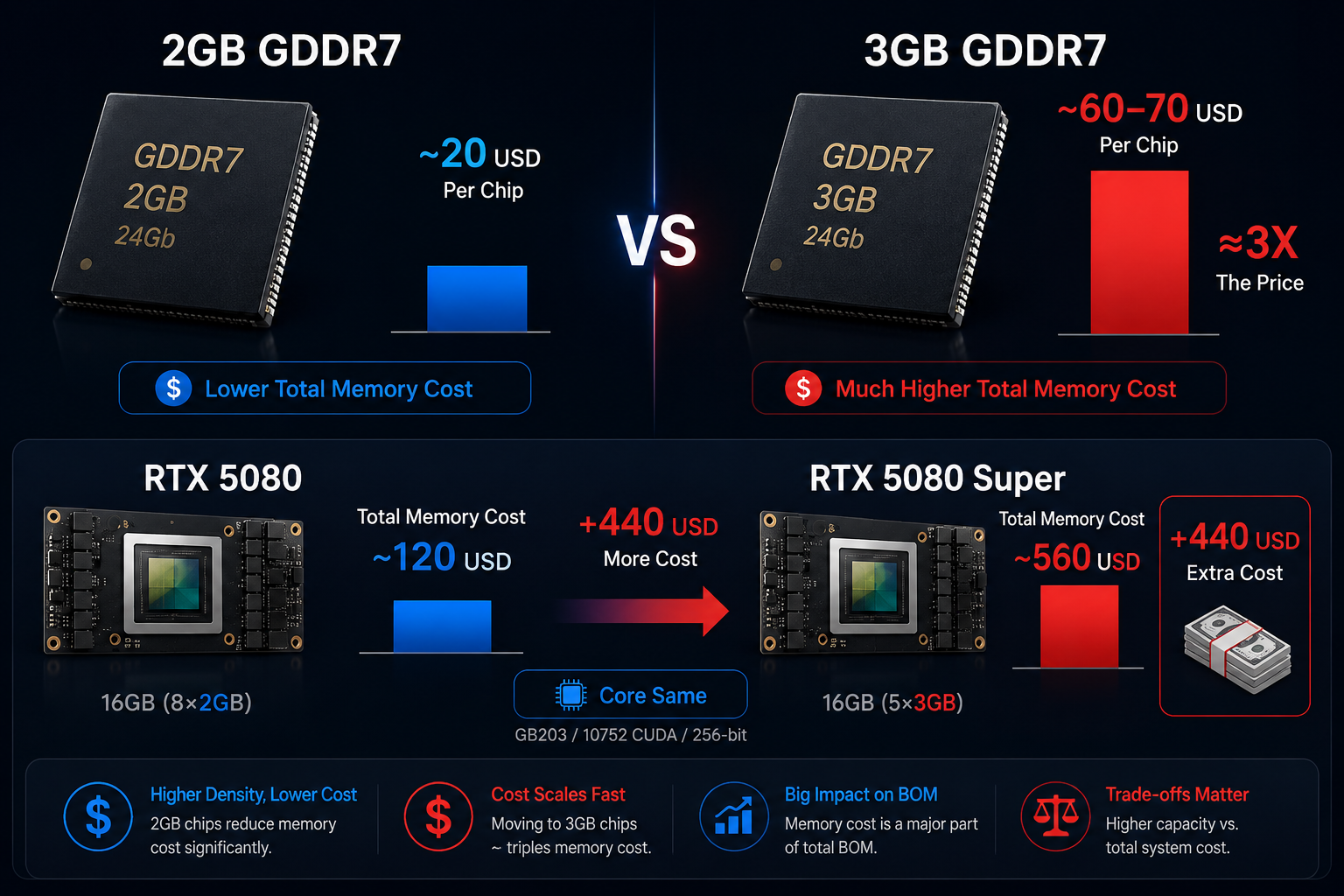
The biggest obstacle facing NVIDIA’s launch strategy is the dramatic price disparity between current GDDR7 memory densities.
Current supply chain estimates indicate:
| Memory Type | Estimated Price per Chip |
|---|---|
| 2GB GDDR7 | ~$20 |
| 3GB GDDR7 | ~$60–70 |
This represents an increase of roughly three times the cost for only 50% more memory capacity per package.
From a manufacturing perspective, the economics become difficult to justify.
For example:
- Four 2GB chips provide 8GB of VRAM.
- Three 3GB chips provide 9GB of VRAM.
- Despite using fewer chips, the total memory cost is dramatically higher.
Approximate memory procurement costs illustrate the issue:
| Configuration | Approximate Memory Cost |
|---|---|
| 4 × 2GB | ~$80 |
| 3 × 3GB | ~$180–210 |
In other words, manufacturers may pay well over twice as much for only 1GB of additional VRAM.
This creates an unfavorable bill of materials (BOM) for graphics card vendors and significantly complicates retail pricing.
📈 Rising Memory Costs Pressure the Entire Product Stack #
Unlike GPU silicon, whose pricing is generally established well before launch, memory prices remain highly sensitive to supply conditions.
Several industry factors continue to drive GDDR7 costs upward:
- Limited production capacity for high-density GDDR7 packages.
- Strong demand from AI accelerators and data center hardware.
- Ongoing DRAM supply constraints.
- Higher manufacturing complexity for newer memory densities.
As a result, GPU vendors must carefully balance component costs against consumer pricing expectations.
Launching products built around expensive memory chips could force:
- Higher MSRPs.
- Reduced profit margins.
- Lower sales volumes.
- More aggressive discounting later in the product lifecycle.
Postponing the launch may therefore be the more commercially viable strategy.
🏭 Board Partners Face an Uncertain Timeline #
The delay creates an unusual situation for NVIDIA’s ecosystem partners.
Although hardware appears ready for production, AIB manufacturers are now left holding inventory while waiting for revised launch guidance.
This uncertainty affects several areas:
- Inventory planning.
- Manufacturing schedules.
- Marketing campaigns.
- Retail distribution.
- Product positioning for the holiday sales season.
Until NVIDIA provides updated guidance, partners are unlikely to commit additional resources toward volume production.
🎮 What This Means for Consumers #
For prospective GPU buyers, the postponement has several practical implications.
Those considering an RTX 50 Super upgrade should expect:
- Longer wait times before launch.
- No confirmed release date.
- Potentially higher retail pricing if memory costs remain elevated.
- Continued availability of existing RTX 50-series models.
Likewise, gamers waiting specifically for the RTX 5050 9GB should recognize that its release depends on the same memory market dynamics.
Unless GDDR7 pricing improves, NVIDIA may continue prioritizing existing products that rely on more economical memory configurations.
📌 Final Thoughts #
The reported delay of the GeForce RTX 50 Super lineup highlights how increasingly influential memory pricing has become in modern GPU development.
Unlike previous generations, where GPU silicon largely dictated production costs, today’s graphics cards are heavily affected by fluctuations in advanced memory technologies. In this case, the unusually high cost of 3GB GDDR7 appears significant enough to outweigh the benefits of launching refreshed products on schedule.
With hardware reportedly complete and board partners already in possession of production units, the RTX 50 Super family appears to be waiting for more favorable component economics rather than further engineering work. Unless supply conditions improve, NVIDIA’s next wave of desktop GPUs may remain on hold while the industry waits for GDDR7 pricing to normalize.