RTX 50 Super Rumors Resurface with Bigger VRAM and Possible 2026 Launch
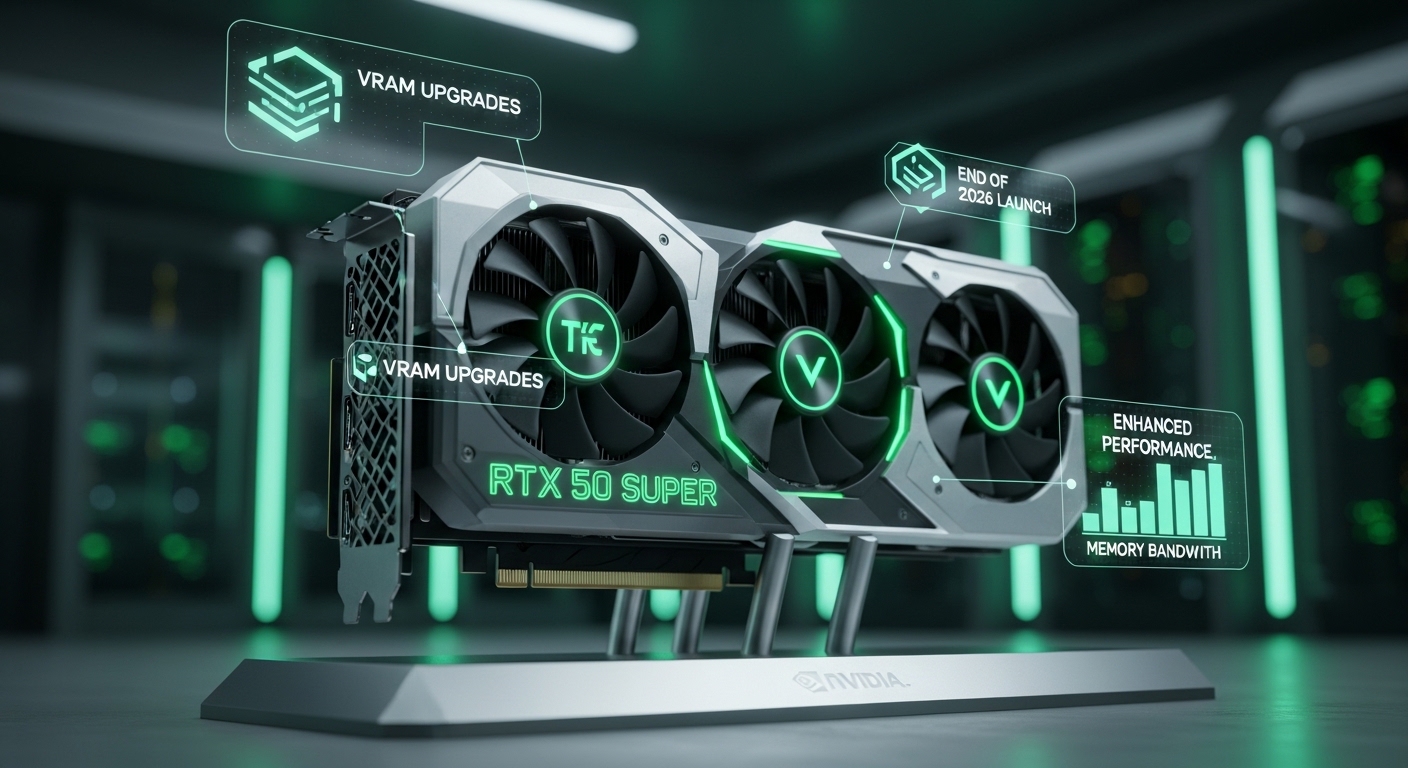
Reports that NVIDIA had canceled its RTX 50 Super refresh may have been premature. New leaks indicate that the RTX 50 Super family has returned to active development, potentially bringing significantly larger memory capacities across the product stack and arriving before the end of 2026.
While none of the specifications have been officially confirmed by NVIDIA, the latest information suggests that the company could be preparing a substantial mid-generation refresh aimed at addressing one of the most common criticisms of the current RTX 50 series: limited VRAM capacity.
🔄 Cancellation Rumors Give Way to New Development Claims #
Earlier supply-chain rumors suggested NVIDIA had shelved the RTX 50 Super lineup due to shortages of higher-capacity GDDR7 memory chips. Those reports led many prospective buyers to assume that the standard RTX 50 series would remain NVIDIA’s primary offering until the next-generation architecture arrived.
However, new information from hardware industry sources indicates that development of the RTX 50 Super family is continuing. Additional speculation gained traction after references to RTX 50 Super models reportedly appeared in online power-supply compatibility databases, suggesting that product planning may have remained active despite previous cancellation reports.
Although the latest leak carries a moderate confidence level rather than definitive confirmation, it aligns with growing expectations that NVIDIA will introduce a refresh to strengthen its position in both gaming and AI workloads.
💾 VRAM Appears to Be the Primary Focus #
The most significant rumored change involves memory capacity.
The standard RTX 50 series primarily relies on 2GB GDDR7 memory modules across much of the lineup. The refreshed Super models are expected to transition to 3GB GDDR7 modules, enabling substantial increases in total VRAM without requiring major architectural changes.
If accurate, the resulting specifications could look like this:
| Model | Current VRAM | Rumored Super VRAM |
|---|---|---|
| RTX 5060 | 8GB | 12GB |
| RTX 5070 | 12GB | 18GB |
| RTX 5070 Ti | 16GB | 24GB |
| RTX 5080 | 16GB | 24GB |
| RTX 5090 | Unchanged | Largely Unchanged |
The increase represents roughly a 50% memory boost across most of the product family.
For many users, the most important upgrade would be the move from 8GB to 12GB on the RTX 5060-class product. Modern games, ray tracing workloads, AI image generation applications, and local large language model inference increasingly benefit from larger memory pools, making VRAM capacity a key purchasing consideration.
🎮 Why More VRAM Matters #
VRAM capacity has become one of the most debated topics in the GPU market.
While raw shader performance remains important, memory limitations can increasingly become the bottleneck in several scenarios:
- High-resolution gaming with ray tracing enabled
- AI image generation workloads
- Local AI assistant and LLM deployments
- Professional content creation applications
- Future game releases with larger texture requirements
Many reviewers and enthusiasts criticized lower-tier RTX 50 models for retaining relatively modest VRAM capacities despite rising software demands. A Super refresh focused on memory expansion would directly address those concerns without requiring a completely new GPU architecture.
⚡ GDDR7 Supply May Have Improved #
One of the primary explanations for the earlier cancellation rumors was limited availability of 3GB GDDR7 memory modules.
According to current reports, manufacturing capacity for these chips may be improving, allowing NVIDIA to move forward with products that were previously delayed or reconsidered.
If memory supply constraints continue to ease throughout 2026, a late-year launch window becomes increasingly plausible.
📅 Potential Launch Window #
No official release date has been announced.
Current rumors point toward a launch sometime between the second half of 2026 and the end of the year. NVIDIA has historically used Super refreshes to strengthen competitiveness between major architectural generations, making a late-cycle RTX 50 update strategically sensible.
Whether the products arrive in Q3, Q4, or later remains uncertain.
💰 Expect Higher Prices #
The larger memory configurations are unlikely to come cheaply.
GDDR7 remains significantly more expensive than previous-generation memory technologies, and moving from 2GB to 3GB modules across an entire product stack would increase manufacturing costs considerably.
As a result, RTX 50 Super cards are widely expected to launch at higher prices than their non-Super counterparts.
Potential buyers may therefore face a trade-off:
- Buy now and secure an existing RTX 50 card at current pricing.
- Wait for the Super refresh and gain substantially more VRAM, potentially at a premium price.
🚀 Should Buyers Wait? #
The answer largely depends on workload requirements.
Users primarily focused on current-generation 1080p gaming may find existing RTX 50 models perfectly adequate. However, users planning to run AI workloads, create content, use high-resolution textures, or keep a graphics card for many years could benefit significantly from the rumored memory upgrades.
If the leaks prove accurate, the RTX 50 Super lineup may become one of NVIDIA’s most practical mid-generation refreshes in recent years—not because of major compute improvements, but because it addresses a growing industry reality: memory capacity increasingly matters as much as raw GPU performance.