AI Computing Infrastructure Is Shifting from Expansion to Efficiency
The global AI infrastructure market is undergoing a significant transformation. Within just a few weeks, several high-profile developments challenged the prevailing assumption that AI infrastructure investment would continue growing without restraint.
Meta announced plans to commercialize excess AI computing capacity by offering cloud infrastructure services to external customers. Shortly afterward, SoftBank launched SB Neo, a new company dedicated to AI cloud services in the United States. Meanwhile, Blackstone unexpectedly abandoned what was expected to become the world’s largest data center campus, while Microsoft reportedly withdrew from a multibillion-dollar cloud infrastructure agreement with Oracle over security compliance concerns.
At first glance, these events appear contradictory. Technology companies are expanding into GPU leasing while several large-scale infrastructure projects are being delayed or cancelled. This has fueled speculation that AI computing capacity is becoming oversupplied and that the infrastructure investment boom may be nearing its end.
However, a closer examination of the semiconductor industry suggests a different conclusion. Rather than signaling a collapse in demand, these developments represent a transition from rapid capacity expansion toward capital efficiency, utilization optimization, and sustainable infrastructure investment.
📈 AI Giants Are Turning Computing Power into Revenue #
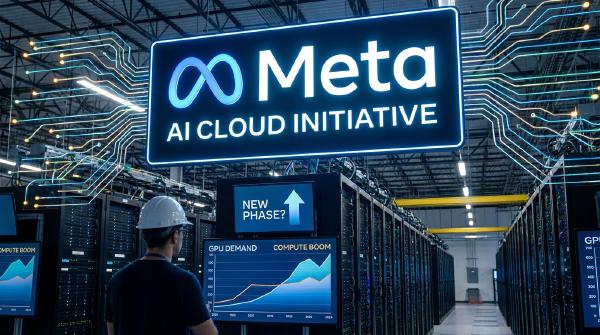
One of the most significant developments occurred when Meta announced plans to launch cloud infrastructure services that provide external customers with access to AI computing resources and foundation models.
The announcement immediately boosted investor confidence, with Meta adding more than $120 billion in market value in a single trading session. At the same time, companies specializing in GPU leasing experienced sharp declines as investors questioned whether hyperscalers would become direct competitors.
The market interpreted Meta’s decision as evidence that GPU supply had exceeded demand. That conclusion, however, oversimplifies the economics of AI infrastructure.
GPU Clusters Are Becoming Revenue-Generating Assets #
Meta continues to aggressively invest in AI infrastructure.
Its 2026 capital expenditure guidance ranges between $125 billion and $145 billion, with most spending allocated to AI data centers and GPU deployments. Cumulative AI infrastructure investment has already exceeded $180 billion.
Unlike traditional cloud providers, Meta derives nearly all of its revenue from advertising rather than AI cloud services. As a result, enormous GPU clusters represent substantial capital expenditures without directly generating proportional revenue.
Offering unused or previous-generation GPU capacity to external customers enables Meta to:
- Improve GPU utilization
- Offset depreciation expenses
- Generate recurring infrastructure revenue
- Increase return on invested capital (ROIC)
Industry estimates suggest that leasing approximately 250 MW of AI computing capacity could generate roughly $10 billion in annual revenue.
Rather than indicating weakening AI demand, the strategy reflects more sophisticated infrastructure asset management.
Meta Is Following an Emerging Industry Trend #
Meta is not alone.
Several hyperscale AI operators have already demonstrated that GPU infrastructure can become a profitable business independent of their own AI workloads.
For example:
- xAI reportedly leased the entire capacity of its Colossus supercomputer to Anthropic under a multiyear agreement.
- Google has reportedly leased large-scale computing resources to compensate for delays in its own data center construction.
- These agreements collectively generate billions of dollars in recurring infrastructure revenue.
Such transactions demonstrate that AI infrastructure is evolving beyond an internal operating expense into a monetizable platform asset.
SoftBank Expands into AI Cloud Infrastructure #
SoftBank further reinforced this trend by establishing SB Neo, a new cloud infrastructure company targeting enterprise AI workloads in the United States.
Its long-term strategy includes:
- Building up to 10 GW of AI data center capacity
- Launching enterprise AI cloud services beginning in fiscal year 2027
- Deploying an initial 800 MW facility in Ohio
- Leveraging NVIDIA’s latest GPU platforms
To finance the expansion, SoftBank is reportedly securing approximately $10 billion in funding backed by its OpenAI holdings.
The entrance of another global technology investor illustrates growing confidence in AI infrastructure as a long-term service business rather than merely a hardware procurement race.
The Neocloud Market Continues to Expand #
The emergence of GPU leasing has accelerated the growth of so-called Neocloud providers.
Unlike traditional hyperscale cloud vendors, these companies specialize in AI-focused GPU infrastructure and high-performance computing services.
Industry research indicates:
- Neocloud revenue exceeded $25 billion in 2025.
- Annual growth surpassed 200%.
- By 2030, Neocloud providers could account for approximately 20% of the AI cloud market.
Nevertheless, analysts also caution that GPU leasing may gradually become commoditized as hardware availability improves. Competitive differentiation will increasingly depend on software ecosystems, networking, operational efficiency, and customer services rather than GPU ownership alone.
🏗️ Data Center Expansion Faces Real-World Constraints #
While demand for AI infrastructure remains robust, deploying new data centers has become considerably more difficult.
Several flagship projects have recently been delayed or cancelled despite strong market demand.
Blackstone Halts a Historic Data Center Project #
Blackstone’s subsidiary QTS suspended development of the Digital Gateway campus in Virginia.
Originally planned as:
- 2,100 acres
- 37 data center buildings
- More than $100 billion in investment
the project would have become the world’s largest data center campus.
However, years of legal disputes, zoning challenges, community opposition, and partner withdrawals ultimately forced Blackstone to abandon the project.
Shortly beforehand, Blackstone also sold several mature Virginia data centers, signaling a more selective investment strategy.
Other Large Projects Are Also Slowing #
Infrastructure developer Crusoe similarly paused construction of a 1.8 GW AI data center in Wyoming after reportedly receiving concerns from its primary customer.
The project highlights a broader industry reality:
Securing GPU hardware is no longer the only challenge. Power infrastructure, land availability, and regulatory approvals increasingly determine whether projects can move forward.
⚡ Power Infrastructure Has Become the Primary Bottleneck #
The limiting factor for AI infrastructure has shifted dramatically.
During the previous AI investment cycle, semiconductor availability constrained expansion.
Today, electrical infrastructure has become the dominant challenge.
Data centers already account for a meaningful share of electricity consumption in many regions.
Industry forecasts suggest:
- Data centers currently consume roughly 5% of total US electricity.
- Electricity demand from AI infrastructure could triple by 2035.
- In Northern Virginia, data centers already consume more than 25% of regional electricity.
As AI clusters become larger and denser, electrical grid expansion struggles to keep pace.
Industry estimates indicate that many projects scheduled for completion over the next several years have yet to begin construction because sufficient power capacity is unavailable.
🏘️ Community Opposition Is Increasing #
Infrastructure developers must also contend with growing public resistance.
Residents increasingly express concerns regarding:
- Electricity consumption
- Water usage
- Noise pollution
- Land development
- Rising local housing costs
Opposition groups targeting new AI data centers have expanded rapidly across the United States.
As a result, permitting timelines continue to lengthen, delaying infrastructure deployment even when financing and customer demand remain available.
🔒 Compliance Is Becoming a Competitive Advantage #
Another emerging constraint is regulatory compliance.
Microsoft’s reported decision to terminate a multibillion-dollar cloud agreement with Oracle illustrates how security certification can outweigh hardware availability.
For enterprise and government customers, infrastructure providers increasingly compete on:
- Security certifications
- Regulatory compliance
- Operational reliability
- Data sovereignty
As computing resources become more abundant, these operational requirements become stronger differentiators than raw GPU capacity alone.
💻 High-End AI Chips Remain in Short Supply #
Despite concerns regarding infrastructure investment, semiconductor demand remains exceptionally strong.
The current market exhibits a structural imbalance rather than an overall surplus.
Structural Supply Mismatch #
Industry analysis indicates two distinct markets:
- General-purpose computing resources are becoming increasingly available.
- High-performance AI accelerators for large language model training remain supply constrained.
The shortage primarily affects:
- Advanced GPUs
- High-bandwidth memory (HBM)
- Advanced packaging technologies
- Leading-edge semiconductor manufacturing capacity
NVIDIA Continues to Benefit #
NVIDIA’s financial performance illustrates this imbalance.
Its data center business continues to generate the overwhelming majority of corporate revenue, supported by sustained demand for AI training and inference hardware.
Meanwhile, manufacturing partners continue expanding advanced packaging and leading-edge fabrication capacity to accommodate future AI accelerator production.
🔮 HBM Memory Remains a Critical Bottleneck #
Memory suppliers continue to experience intense demand for High Bandwidth Memory (HBM).
Leading manufacturers are accelerating production schedules for next-generation HBM4, reflecting expectations that AI workloads will continue driving substantial memory requirements.
HBM has become one of the most strategically important technologies within the AI semiconductor ecosystem because GPU performance increasingly depends on memory bandwidth rather than compute capability alone.
🔄 GPU Leasing Is Reshaping Hardware Procurement #
The growing popularity of GPU leasing is also changing how organizations consume AI infrastructure.
Instead of purchasing expensive hardware outright, many startups and mid-sized AI companies increasingly rent computing resources from hyperscalers or specialized cloud providers.
This model provides several advantages:
- Lower upfront capital investment
- Faster deployment
- Flexible capacity scaling
- Reduced infrastructure management complexity
As GPU prices remain elevated, leasing offers a practical alternative for organizations without hyperscale budgets.
For cloud providers, this also encourages greater emphasis on utilization rates and energy efficiency rather than simply maximizing hardware acquisitions.
⚙️ Custom AI Chips Are Becoming Strategic Assets #
The rapid growth of AI infrastructure costs has also accelerated investment in custom silicon.
Several leading AI companies are developing proprietary accelerators designed specifically for inference workloads.
Examples include:
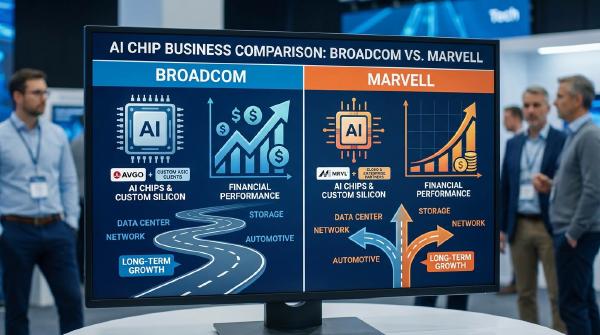
- OpenAI collaborating with Broadcom on custom AI processors.
- Anthropic exploring custom chip development partnerships.
- Meta advancing successive generations of internally designed AI accelerators.
The primary objective is reducing inference costs while decreasing long-term dependence on third-party GPU suppliers.
This trend creates new opportunities for semiconductor design firms while introducing greater competition within the AI accelerator ecosystem.
🔬 A More Mature Semiconductor Supply Chain #
The evolution of GPU leasing represents more than a new business model—it fundamentally changes the structure of AI infrastructure.
Previously, semiconductor supply chains followed a relatively straightforward path:
- Chip manufacturers produced AI accelerators.
- Cloud providers purchased and deployed the hardware.
- Enterprise customers consumed cloud services.
Today, hyperscalers occupy multiple roles simultaneously.
They are:
- The largest semiconductor customers
- Infrastructure operators
- AI service providers
- GPU leasing platforms
This dual identity significantly improves overall computing resource utilization while reducing idle infrastructure.
For semiconductor manufacturers and equipment suppliers, procurement behavior is becoming increasingly disciplined. Rather than purchasing hardware aggressively to secure future capacity, infrastructure operators are placing greater emphasis on utilization rates, return on investment, operational efficiency, and long-term profitability.
Although this transition may moderate procurement cycles in the short term, it ultimately supports a healthier and more sustainable AI infrastructure ecosystem. The industry is moving beyond the initial phase of capacity expansion toward one defined by efficient resource allocation, optimized capital deployment, and balanced long-term growth.