AI Infrastructure to Push Global Semiconductor Market Beyond $1 Trillion in 2026
The global semiconductor industry is entering a new phase of structural expansion. According to the latest market forecasts, annual semiconductor revenue is expected to surpass the $1 trillion threshold in 2026—well ahead of earlier projections—as artificial intelligence infrastructure becomes the industry’s primary growth engine.
Worldwide semiconductor revenue is projected to reach $1.29 trillion in 2026, representing a remarkable 52.8% year-over-year increase from $842.8 billion in 2025. Unlike previous semiconductor cycles driven by consumer electronics, this expansion is fueled primarily by hyperscale AI infrastructure, advanced memory technologies, and accelerating investments in cloud computing.
Among all semiconductor segments, memory is experiencing the most dramatic transformation. DRAM revenue alone is forecast to climb to $418.6 billion in 2026, supported by unprecedented demand for High Bandwidth Memory (HBM) and next-generation DDR products. Meanwhile, non-memory semiconductors continue to expand steadily, with revenue expected to reach $693.5 billion.
This shift marks more than another market upcycle—it represents a structural redefinition of semiconductor demand, where AI infrastructure increasingly determines investment priorities across the entire industry.
🚀 AI Infrastructure Becomes the Industry’s Growth Engine #
The emergence of AI infrastructure has fundamentally changed semiconductor demand dynamics.
What initially appeared to be a temporary increase in cloud spending has evolved into a long-term investment cycle driven by hyperscalers, sovereign AI initiatives, and enterprise AI deployment.
Major cloud providers continue expanding data center capacity at an unprecedented pace.
Key industry projections include:
- Hyperscale capital expenditure surpassed $100 billion during Q3 2025.
- The four largest hyperscale cloud providers are expected to increase capital spending by approximately 70% year over year.
- Combined AI infrastructure investment could approach $600 billion in 2026.
IDC projects data center semiconductor revenue to reach $477.1 billion in 2026.
Looking further ahead, data center silicon is expected to generate $843.2 billion annually by 2030—nearly half of the projected global semiconductor market.
“The semiconductor industry has crossed a structural threshold. AI is no longer a demand catalyst—it is the demand foundation. The race to build out AI infrastructure is consuming silicon at a pace the industry has never seen, with profound implications for memory, logic, and packaging technologies.”
— Jeff Janukowicz, VP, Semiconductor & Semiconductor Manufacturing, IDC
AI Computing Drives Silicon Demand #
Within the data center market, AI computing has become the largest identifiable semiconductor category.
The approximately $281 billion intelligent data center segment encompasses:
- CPUs
- AI accelerators
- GPUs
- Custom ASICs
- High-speed networking silicon
Demand is increasingly concentrated among hyperscale cloud providers while expanding into government-backed sovereign AI initiatives that are securing long-term supply agreements with leading semiconductor manufacturers.
Several structural trends continue reinforcing this growth.
Higher Compute Density #
Modern generative AI models require significantly greater computational density than traditional cloud workloads.
As GPU clusters become larger and more densely packed, semiconductor consumption per rack continues to increase.
Rapid Growth in AI Inference #
Training is no longer the only driver of semiconductor demand.
Each successive generation of large language models creates additional inference workloads, requiring ongoing hardware upgrades and expanding accelerator deployments.
AI Expands Beyond the Data Center #
AI processing is steadily moving toward enterprise infrastructure, industrial edge computing, personal computers, and mobile devices.
This broader deployment diversifies semiconductor demand while creating new opportunities across multiple product categories.
💾 Memory Evolves into a Strategic Resource #
Among all semiconductor segments, memory has undergone the most profound transformation.
Rather than following its traditional boom-and-bust cycle, the memory market is increasingly constrained by structural demand generated by AI infrastructure.
Total memory revenue is forecast to increase from:
- $226 billion in 2025
- $594.7 billion in 2026
- $790.4 billion in 2027
These projections reflect not merely cyclical recovery but a fundamental repricing of advanced memory technologies.
DRAM Experiences Structural Repricing #
DRAM is at the center of this transition.
IDC forecasts $418.6 billion in DRAM revenue during 2026, representing approximately 177% year-over-year growth.
Unlike previous demand cycles dominated by consumer electronics, today’s premium memory demand originates primarily from hyperscale AI infrastructure.
Cloud providers are purchasing significantly more expensive memory technologies—including HBM—and are willing to secure long-term supply agreements despite elevated pricing.
At the same time, manufacturing HBM consumes considerably more silicon area than conventional DRAM, reducing available production capacity for standard memory products.
“The memory market is at an unprecedented inflection point where demand has structurally outstripped supply. For an industry long characterized by boom-and-bust cycles, this time is different. The rapid expansion of AI infrastructure and workloads is placing immense stress on the memory ecosystem.”
— Jeff Janukowicz, VP, Semiconductor & Semiconductor Manufacturing, IDC
📦 HBM Emerges as the AI Supply Chain Bottleneck #
High Bandwidth Memory has become one of the most constrained components in AI hardware manufacturing.
Production capacity across leading suppliers is largely committed through 2026, with many allocation agreements already extending into 2027.
HBM demand is concentrated across:
- NVIDIA AI accelerators
- AMD Instinct platforms
- Custom AI processors developed by hyperscalers
Unlike conventional DRAM, HBM manufacturing requires advanced packaging technologies including:
- TSV interconnects
- Die stacking
- Silicon interposers
- Complex thermal integration
These manufacturing processes significantly increase production costs while limiting near-term capacity expansion.
Although suppliers continue investing aggressively, meaningful additional production is unlikely before late 2026 due to the technical complexity and capital requirements involved.
💽 NAND Flash Benefits from AI Storage Growth #
The impact of AI infrastructure extends beyond DRAM.
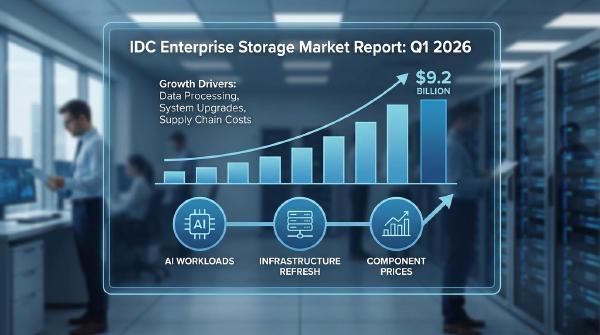
NAND Flash revenue is forecast to reach $174.1 billion in 2026, representing approximately 138.5% growth compared with 2025.
Demand is being driven by:
- AI training datasets
- Model checkpoint storage
- High-performance inference clusters
- Enterprise SSD deployments
Unlike earlier enterprise storage cycles, today’s pricing environment reflects sustained hyperscale procurement rather than temporary inventory fluctuations.
As cloud providers continue securing NAND supply, enterprise SSD pricing has increased while inventory remains constrained across consumer and OEM channels.
🌍 Other Semiconductor Markets Face a More Complex Environment #
While AI dominates industry growth, other semiconductor segments continue operating under different market conditions.
IDC projects non-memory, non-data-center semiconductor revenue to reach approximately $406.3 billion in 2026.
Each market faces distinct opportunities and challenges.
Mobile Devices #
Mobile semiconductor revenue is expected to decline to approximately $89.8 billion during 2026.
This weakness does not necessarily indicate declining consumer interest in smartphones.
Instead, manufacturers are increasingly challenged by rising component costs, particularly advanced memory.
As HBM and premium DRAM command higher prices, smartphone vendors must carefully balance:
- Product pricing
- Hardware specifications
- Profit margins
Automotive #
The automotive semiconductor market remains influenced primarily by macroeconomic conditions rather than AI adoption.
Factors affecting demand include:
- Interest rates
- Tariffs
- Energy prices
- Consumer spending
Although software-defined vehicles and autonomous driving continue supporting long-term semiconductor demand, 2026 is expected to represent a period of slower near-term growth.
Internet of Things #
The IoT semiconductor market is forecast to reach approximately $136.6 billion.
Although inventory normalization continues weighing on traditional IoT deployments, Edge AI is beginning to create an entirely new class of higher-value semiconductor demand.
As AI inference becomes increasingly distributed, edge devices are expected to become a more important growth segment over the remainder of the decade.
📈 Outlook: A Path Toward a $1.75 Trillion Industry #
IDC’s long-term forecast projects global semiconductor revenue reaching approximately $1.75 trillion by 2030.
Several trends are expected to shape this expansion.
Memory Prices Will Remain Structurally Higher #
Although pricing is likely to moderate over time, memory products—particularly HBM—are expected to remain significantly more valuable than during previous semiconductor cycles.
AI Will Expand Across More Industries #
AI adoption is steadily moving beyond hyperscale cloud infrastructure into enterprise systems, industrial automation, autonomous vehicles, edge computing, and consumer electronics.
This diversification broadens semiconductor demand while reducing reliance on traditional PC and smartphone refresh cycles.
Geopolitical Risks Remain Important #
Trade restrictions, supply chain localization, export controls, and macroeconomic uncertainty will continue influencing investment decisions throughout the semiconductor ecosystem.
Despite these challenges, long-term growth expectations remain firmly supported by AI infrastructure spending.
“The data shows that the semiconductor market has permanently expanded its addressable opportunity. AI infrastructure has redefined the demand baseline, memory has been structurally repriced as a strategic asset, and the industry’s growth trajectory to 2030 is no longer dependent on consumer refresh cycles.”
— Nina Turner, Research Director, Semiconductors, IDC
🔮 Conclusion #
The semiconductor industry has entered a fundamentally different era.
Rather than relying on cyclical consumer electronics demand, future growth will increasingly be driven by AI infrastructure, hyperscale computing, advanced memory technologies, and intelligent edge systems.
HBM has emerged as one of the industry’s most strategically valuable components, while DRAM and NAND markets are being reshaped by persistent demand from AI deployments. At the same time, data center silicon has become the dominant semiconductor category, supported by unprecedented levels of capital investment from cloud providers worldwide.
Although macroeconomic and geopolitical risks remain, the industry’s long-term trajectory appears increasingly defined by artificial intelligence. Crossing the $1 trillion revenue milestone in 2026 is therefore more than a symbolic achievement—it signals the beginning of a new semiconductor supercycle built on AI as the industry’s enduring foundation.