NVIDIA Vera CPU and RTX Spark Challenge Intel and AMD
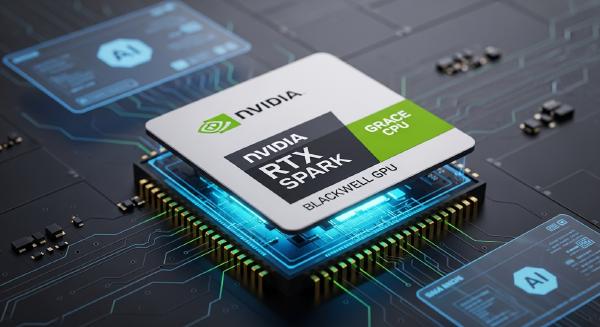
At GTC Taipei, NVIDIA CEO Jensen Huang unveiled one of the company’s most ambitious product launches to date. Beyond introducing the RTX Spark superchip for AI-native Windows PCs, NVIDIA also revealed the Vera CPU, a custom Arm-based processor designed specifically for AI agent workloads.
Together, these products signal NVIDIA’s intention to expand far beyond GPUs and compete directly in markets historically dominated by Intel and AMD. More importantly, they represent NVIDIA’s vision for an AI-first computing era where personal computers, workstations, and data centers are built around autonomous AI agents rather than traditional software applications.
🚀 RTX Spark: Reinventing the Personal Computer #
According to Huang, the PC industry is undergoing its first major transformation in four decades.
NVIDIA and Microsoft have collaborated to create a new category of AI-native Windows systems powered by the RTX Spark superchip. Rather than serving as conventional PCs, these systems are designed to function as platforms for personal AI agents capable of reasoning, planning, and executing tasks on behalf of users.
A Unified Architecture Built for AI #
Manufactured using TSMC’s 3nm process technology, RTX Spark integrates:
- 70 billion transistors
- A custom 20-core Grace CPU
- A Blackwell RTX GPU
- NVLink-C2C interconnect technology
- Up to 128GB of LPDDR5X unified memory
- Up to 1 petaflop of FP4 AI compute performance
The GPU portion includes:
- 6,144 CUDA cores
- Fifth-generation Tensor Cores
- Full RTX feature support
- Native CUDA compatibility
Unlike traditional PC architectures that separate CPU and GPU memory pools, RTX Spark operates as a unified computing platform optimized for AI workloads.
AI Workloads Previously Reserved for Data Centers #
NVIDIA claims RTX Spark enables laptops and compact desktops to perform tasks that previously required workstation-class hardware.
Examples include:
- Rendering 90GB+ 3D scenes with OptiX and DLSS
- Editing 12K 4:2:2 video content
- Running 120-billion-parameter language models locally
- Supporting context windows of up to one million tokens
- Delivering 100+ FPS gaming at 1440p with ray tracing enabled
The platform is intended to transform the PC from an application launcher into an intelligent assistant capable of carrying out complex tasks through natural language interaction.
💻 A New Windows Product Family #
NVIDIA and Microsoft are not simply introducing a new chip. They are launching an entirely new Windows hardware ecosystem optimized for AI agents.
The initial lineup includes:
- AI-powered laptops
- Compact desktop systems
- Desktop AI supercomputers
Thin-and-Light AI PCs #
Despite their computational capabilities, RTX Spark laptops remain highly portable.
Expected specifications include:
- Thickness as low as 14 mm
- Weight around 3 pounds (1.36 kg)
- Display sizes ranging from 14 to 16 inches
- Continuous local AI processing capabilities
Systems from major OEM partners are expected to launch later this year.
Adobe Optimizes for RTX Spark #
One of the most significant software developments is Adobe’s extensive optimization effort.
Adobe has reportedly redesigned major portions of:
- Photoshop
- Premiere Pro
The updated applications are designed to leverage:
- Unified memory
- Blackwell GPU acceleration
- TensorRT AI processing
- AI-assisted creative workflows
Adobe estimates performance improvements of up to 2× across editing, visual effects, color grading, and AI-enhanced creative tasks.
🔮 Vera CPU: NVIDIA’s Most Ambitious Processor Yet #
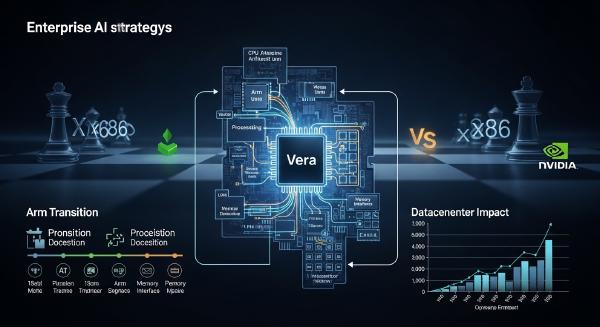
While RTX Spark targets AI PCs, the Vera CPU is aimed directly at AI infrastructure.
NVIDIA argues that traditional CPUs have become a bottleneck in modern AI systems. As AI agents increasingly depend on retrieval, tool calling, code execution, and orchestration, processor efficiency directly impacts latency and throughput.
The Vera CPU was designed specifically to address these challenges.
Technical Highlights #
Vera introduces several major architectural changes:
- 88 custom NVIDIA Arm Olympus cores
- LPDDR5X memory subsystem
- 1.2 TB/s memory bandwidth
- PCIe Gen6 support
- Multi-bit error correction without bandwidth penalties
- Monolithic mesh architecture
- NVLink-C2C integration
Unlike many modern processors that rely on chiplet designs, Vera employs a unified architecture that minimizes communication overhead and latency between cores.
Designed for AI Agent Workloads #
NVIDIA optimized Vera around four primary goals:
- Industry-leading IPC (Instructions Per Clock)
- High per-core bandwidth
- Maximum total system bandwidth
- Exceptional energy efficiency
According to NVIDIA, Vera can:
- Fetch, decode, and execute up to 10 instructions per cycle
- Deliver 50% higher IPC than Grace
- Provide up to 3× more bandwidth per core than comparable x86 systems
- Reduce peak memory latency by 40%
These characteristics are particularly important for:
- Python runtimes
- Agent orchestration
- Tool calling
- Retrieval-augmented generation
- Sandbox execution environments
Benchmark Results #
NVIDIA shared several performance claims for Vera:
- 1.8× higher performance in AI agent sandbox workloads
- 3× faster SQL execution in 1TB benchmark tests
- 6× acceleration in real-time stream processing applications
The processor has already entered mass production and is expected to become available through system partners later this year.
Early adopters reportedly include:
- OpenAI
- Anthropic
- SpaceX
🖥️ DGX Station Brings AI Supercomputing to Windows #
Alongside Vera and RTX Spark, NVIDIA introduced the latest DGX Station platform.
Developed in partnership with Microsoft, the new DGX Station extends NVIDIA’s AI infrastructure strategy to high-end desktop environments.
DGX Station Specifications #
The system is powered by the NVIDIA GB300 Grace Blackwell Ultra superchip and offers:
- Up to 748GB unified memory
- 20 petaflops of FP4 AI compute
- 800Gbps ConnectX-8 SuperNIC networking
- Full Windows compatibility
NVIDIA claims the system can:
- Run trillion-parameter AI models
- Support hundreds of concurrent AI agents
- Serve as a local AI development and deployment platform
The system is expected to launch during the fourth quarter.
🤖 NVIDIA Expands into Robotics #
NVIDIA also announced a new humanoid robotics reference design through a partnership with Unitree Robotics.
The platform combines:
- Unitree H2 Plus humanoid robot
- Sharpa Wave dexterous robotic hand
- NVIDIA Jetson Thor processor
The initiative is part of NVIDIA’s broader strategy to extend AI infrastructure beyond data centers and personal computing into physical AI systems.
🔬 Vera Rubin Enters Full Production #
Another major milestone announced at GTC Taipei was the transition of Vera Rubin into full-scale production.
NVIDIA describes Vera Rubin as its most ambitious engineering project to date.
A Distributed AI Agent Infrastructure #
The platform includes:
- Vera Rubin NVL72 systems
- Liquid-cooled Vera CPU racks
- BlueField-4 STX infrastructure
- Groq LPX inference systems
- Spectrum-X Ethernet Photonics networking
More than 150 supply-chain partners are reportedly involved in manufacturing and deployment.
According to NVIDIA, assembly efficiency has improved dramatically compared with Grace Blackwell systems, reducing rack assembly times from hours to minutes.
Networking and Security Innovations #
The platform introduces several key technologies:
Spectrum-X Ethernet Photonics #
Features include:
- Co-packaged optical networking
- 200Gb/s SerDes Ethernet switching
- Large-scale AI cluster connectivity
BlueField-4 STX #
Security enhancements include:
- Hardware-level threat detection
- Rack-scale AI data protection
- Accelerated infrastructure security
These capabilities are designed to support large-scale AI agent deployments across enterprise environments.
📈 NVIDIA’s Strategy: Becoming an AI Infrastructure Company #
Perhaps the most important message from Huang’s keynote was not about any individual product.
NVIDIA increasingly views itself as an AI infrastructure company rather than a GPU vendor.
Four Core Competitive Advantages #
Huang highlighted four key areas where NVIDIA believes it maintains leadership:
Faster Time-to-First-Token #
Reducing startup latency for:
- Model inference
- Training jobs
- Agent execution
Superior Performance Per Watt #
NVIDIA argues that AI economics increasingly depend on:
- Tokens per watt
- Throughput per watt
- Operational efficiency
Reliability at Scale #
Years of hyperscale deployment experience have enabled NVIDIA to build highly reliable infrastructure platforms.
Long-Term Software Value #
Because the AI ecosystem is deeply integrated with CUDA, NVIDIA believes its systems benefit from:
- Longer useful lifecycles
- Better software compatibility
- Lower total cost of ownership
🛣️ The Roadmap to 2030 #
NVIDIA also revealed a long-term roadmap for its AI computing platforms.
Current Generation #
- Grace CPU
- Blackwell GPU
Next Generation #
- Vera CPU
- Rubin GPU
- LPDDR6 memory
- ConnectX-9 networking
- 1600G bandwidth
Future Generation (2029–2030) #
- Rosa CPU architecture
- Feynman GPU architecture
- ConnectX-10 networking
- Next-generation memory technologies
The roadmap suggests a major architectural refresh approximately every two years.
🏁 Conclusion #
NVIDIA’s announcements at GTC Taipei demonstrate a company rapidly expanding beyond its GPU roots.
RTX Spark aims to redefine the personal computer around AI agents. Vera challenges traditional server CPUs by prioritizing AI orchestration workloads. DGX Station brings workstation-scale AI capabilities to desktop environments, while Vera Rubin establishes the foundation for next-generation AI infrastructure.
Whether NVIDIA can successfully challenge Intel and AMD in CPUs remains to be seen. However, one thing is increasingly clear: the company is no longer competing solely in graphics or acceleration hardware. It is building a vertically integrated AI computing stack that spans personal devices, workstations, data centers, networking, robotics, and software.
If NVIDIA’s vision proves correct, future computing platforms may be defined less by applications and operating systems and more by the AI agents that run on top of them.