AMD Ryzen AI Max 400 Pushes 192GB Unified Memory for AI
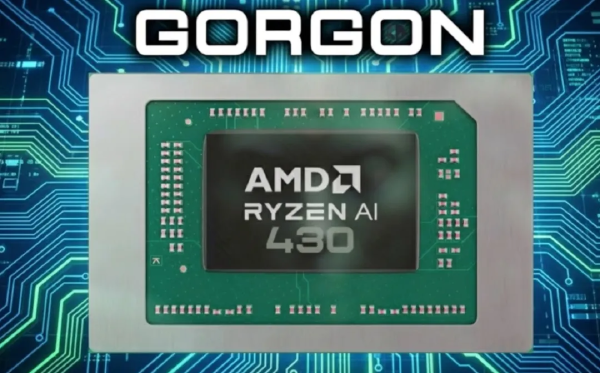
AMD has officially introduced its next-generation AI-focused client processor family: the Ryzen AI Max PRO 400 series, codenamed Gorgon Halo.
Alongside the silicon launch, AMD also unveiled the Ryzen AI Halo Developer Platform, a compact 1-liter workstation system specifically designed for local AI inference, agentic workflows, and large-scale machine learning experimentation.
The defining breakthrough of the platform is not raw CPU frequency or GPU scaling.
It is memory architecture.
For the first time on a mainstream-accessible x86 client platform, developers can configure up to:
- 192GB of LPDDR5X unified memory
- Up to 160GB reserved as dedicated VRAM
This dramatically expands the practical ceiling for local AI workloads, enabling systems to execute massive language models that previously required expensive multi-GPU server configurations.
🚀 Ryzen AI Max 400 vs. Ryzen AI Max 300 #
Gorgon Halo represents a mid-generation refinement of AMD’s earlier Ryzen AI Max 300 family, also known as Strix Halo.
The fundamental silicon design remains largely unchanged, but AMD significantly expanded memory capacity and improved bandwidth across the platform.
| Component | Ryzen AI Max 300 | Ryzen AI Max 400 | Key Improvement |
|---|---|---|---|
| CPU Architecture | Zen 5 | Zen 5 | Same core design |
| Peak CPU Boost | 5.1 GHz | 5.2 GHz | Minor frequency uplift |
| Graphics Architecture | RDNA 3.5 | RDNA 3.5 | Rebranded Radeon 8065S |
| GPU Clock | 2.9 GHz | 3.0 GHz | Slight raster uplift |
| NPU Performance | 50 TOPS | 55 TOPS | Firmware optimization gains |
| Unified Memory | 128GB LPDDR5X-8000 | 192GB LPDDR5X-8533 | Massive capacity increase |
| Maximum VRAM Allocation | 112GB | 160GB | Substantial AI workload expansion |
The most important upgrade is clearly the transition from 128GB to 192GB of unified memory.
That increase fundamentally changes the scale of AI models that can realistically operate on local hardware.
🧠 Why Unified Memory Matters for AI #
Traditional desktop AI systems typically rely on:
- Dedicated discrete GPUs
- Separate system memory pools
- PCIe transfers between CPU and GPU memory
These boundaries create bandwidth bottlenecks and memory fragmentation issues for extremely large models.
Gorgon Halo avoids those constraints through a shared memory architecture.
TRADITIONAL AI WORKSTATION

CPU Memory ─── PCIe ─── GPU VRAM


GORGON HALO UNIFIED MEMORY

CPU + GPU + NPU
        │
192GB Shared LPDDR5X Pool
By allowing the CPU, GPU, and NPU to operate inside the same unified memory space, AMD dramatically reduces transfer overhead and increases flexibility for large inferencing tasks.
📈 The Leap From 70B to 300B+ Models #
AMD positions the Ryzen AI Max 400 platform as the first x86 client-class architecture capable of running:
- 300B+ parameter large language models locally
without requiring external accelerator arrays.
LOCAL AI SCALING EVOLUTION

128GB Unified Memory
        │
        └──► ~70B Parameter Models


192GB Unified Memory
        │
        └──► 300B+ Parameter Models
This represents a major shift in local AI economics.
Previously, experimentation with extremely large open-source models often required:
- Enterprise GPUs
- Multi-GPU NVLink systems
- Cloud inference subscriptions
- Remote inference clusters
AMD is attempting to collapse that requirement stack into a single workstation-class client platform.
⚙️ Gorgon Halo Processor Lineup #
The Ryzen AI Max PRO 400 family launches with three primary SKUs.
RYZEN AI MAX 400 STACK

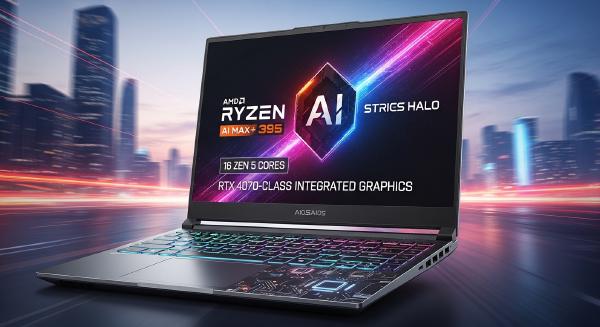
Ryzen AI Max+ PRO 495
• 16 Zen 5 Cores / 32 Threads
• Radeon 8065S (40 CUs)
• 55 TOPS NPU
• 80MB Cache

Ryzen AI Max PRO 490
• 12 Zen 5 Cores / 24 Threads
• Radeon 8050S (32 CUs)
• 50 TOPS NPU
• 76MB Cache

Ryzen AI Max PRO 485
• 8 Zen 5 Cores / 16 Threads
• Radeon 8050S (32 CUs)
• 50 TOPS NPU
• 40MB Cache
The flagship Ryzen AI Max+ PRO 495 is the only configuration that unlocks:
- The full 16-core Zen 5 configuration
- Full 40 Compute Units
- The maximum 3.0 GHz GPU clock target
AMD is clearly positioning the 495 as the primary workstation-tier AI development SKU.
🖥️ More Than an AI Platform #
Although AMD heavily markets Gorgon Halo toward AI developers, the hardware configuration also benefits traditional workstation workloads.
The combination of:
- Massive unified memory
- High-bandwidth LPDDR5X
- Large integrated GPU resources
- Zen 5 multi-core scaling
creates a versatile workstation-class platform.
🎬 Benefits for Creative Professionals #
Many creative workloads suffer from memory pressure rather than pure compute limitations.
The 192GB memory pool can significantly improve:
- 8K video editing
- Large timeline caching
- RAW asset handling
- 3D rendering pipelines
- Massive Photoshop compositions
- Multi-VM workflows
because more active datasets remain resident directly in memory.
Reduced Disk Swapping #
When workstation memory fills, systems typically fall back to storage paging.
That introduces enormous latency penalties.
With 192GB available, many professional workflows can remain fully memory-resident, dramatically improving responsiveness.
🤖 Benefits for Machine Learning Developers #
The AI-focused advantages are even more substantial.
Local Multi-Modal Workflows #
Developers can run:
- Vision-language models
- OCR systems
- Multi-agent pipelines
- Local inference engines
- Sandboxed coding assistants
without relying on remote cloud APIs.
Privacy and Data Sovereignty #
Keeping inference local eliminates:
- Cloud upload requirements
- API dependency costs
- External data exposure
- Network latency overhead
This is particularly valuable for:
- Enterprise AI deployments
- Research labs
- Financial institutions
- Government workloads
- Confidential development environments
🔒 Enterprise PRO Features #
Like previous AMD PRO platforms, Gorgon Halo includes enterprise management and security tooling.
Key enterprise capabilities include:
- Remote fleet management
- Enterprise deployment support
- Security virtualization features
- Commercial lifecycle guarantees
This positions the platform not just as a developer toy, but as a serious enterprise workstation architecture.
💻 Ryzen AI Halo Developer Platform #
To showcase the silicon ecosystem, AMD introduced the official:
- Ryzen AI Halo Developer Platform
a compact 1-liter mini workstation system.
Base Configuration #
The system launches with:
- 2TB PCIe 4.0 NVMe SSD
- Windows and Linux compatibility
- Ryzen AI Max 400 silicon
- Compact workstation chassis
Pricing #
Entry pricing starts at:
- $3,999
with pre-orders beginning in June 2026.
Although expensive for consumer desktops, the pricing is substantially lower than traditional enterprise AI server hardware capable of handling similarly large local models.
🏭 OEM Ecosystem Expansion #
AMD also confirmed that major manufacturers are preparing systems based on Gorgon Halo silicon.
Partners include:
- ASUS
- Lenovo
- HP
These vendors are expected to introduce:
- AI workstations
- Compact developer systems
- Mini PCs
- Mobile workstation platforms
throughout Q3 2026.
📊 AMD’s Larger AI Strategy #
Gorgon Halo reveals AMD’s broader strategic direction in AI computing.
Rather than competing exclusively in hyperscale GPU clusters, AMD is aggressively targeting:
- Edge AI
- Local inference
- Developer workstations
- Enterprise client AI
- Hybrid cloud-local workflows
The company appears to believe that future AI usage will increasingly move toward:
- Persistent local agents
- Privacy-sensitive inferencing
- Distributed AI execution
- On-device automation
rather than relying entirely on centralized cloud providers.
🎯 The Bottom Line #
Ryzen AI Max 400 is not simply a faster refresh of Strix Halo.
It is a statement about where client computing is heading.
By combining:
- 192GB unified memory
- Up to 160GB allocatable VRAM
- Zen 5 compute cores
- RDNA 3.5 graphics
- XDNA 2 AI acceleration
AMD is transforming x86 client systems into legitimate large-model AI workstations.
If AMD’s local 300B+ model claims prove practical in real-world deployments, Gorgon Halo could become one of the most important turning points in the evolution of edge AI and developer-focused client hardware.