AMD Surpasses 32% x86 CPU Share as EPYC and AI Demand Fuel Growth
Meta Description: AMD’s x86 CPU market share reaches a record 32.6%, driven by EPYC server growth, AI infrastructure demand, and the continued success of Ryzen X3D processors.
AMD has achieved another major milestone in the ongoing battle for CPU market share. According to the latest data from Mercury Research, the company captured 32.6% of the global x86 processor market during the first quarter of 2026, marking the highest share in its history.
The achievement reflects AMD’s continued momentum across server and mobile segments, while the rise of AI infrastructure is reshaping how enterprises evaluate processor performance and core counts.
📈 AMD Reaches a New Market Share Record #
Mercury Research’s latest report shows AMD’s overall x86 processor market share climbing from 27.1% in Q1 2025 to 32.6% in Q1 2026, representing nearly six percentage points of year-over-year growth.
Even when excluding game console SoCs—which remain a significant AMD strength—the company’s market share still reached 30%, up from:
- 24.4% one year ago
- 29.3% in the previous quarter
This demonstrates that AMD’s growth is not solely dependent on its dominant position in gaming consoles but is being driven by expanding adoption across traditional PC and server markets.
🖥️ EPYC Continues to Dominate the Server Battlefield #
The server segment remains AMD’s strongest growth engine.
EPYC processor shipment share reached 33.2%, up from:
- 30.0% in the previous quarter
- 27.2% in the same period last year
Even more impressive is AMD’s revenue share.
According to Mercury Research, EPYC processors now account for 46.2% of total server CPU revenue, indicating that AMD is not merely shipping more units—it is successfully competing in the premium segment where profit margins are highest.
Several factors are contributing to this growth:
- Continued expansion of AI data centers
- Strong adoption among cloud service providers
- Growing demand for high-core-count server processors
- Competitive performance-per-watt advantages
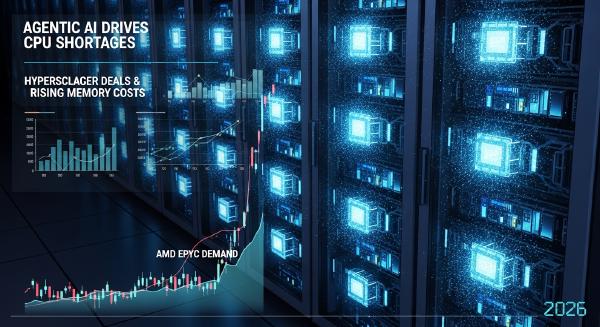
Overall server CPU shipments grew by more than 10% year-over-year, with much of that demand tied directly to AI infrastructure deployments.
🤖 AI Agents Are Changing CPU Requirements #
One of the most interesting trends emerging in 2026 is the evolving role of CPUs within AI infrastructure.
For years, CPUs largely played a supporting role to accelerators such as GPUs. However, the rise of AI agents is shifting that balance.
AI agents often execute numerous independent tasks simultaneously, including:
- Tool orchestration
- Workflow management
- Data processing
- Context management
- Agent coordination
These workloads scale particularly well with additional CPU cores.
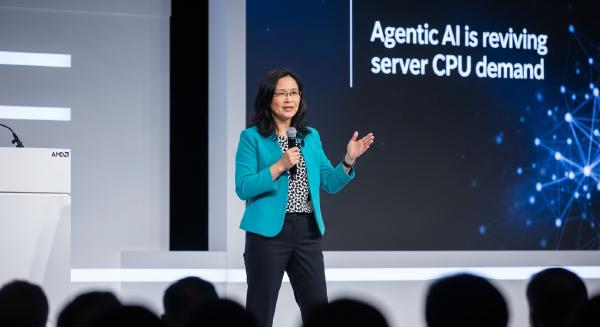
AMD executives have highlighted this trend, noting that AI agents are increasing demand for high-core-count processors and driving higher average selling prices.
The industry’s direction is clear:
- Intel now offers processors with up to 288 E-cores in certain Xeon configurations.
- High-performance x86 platforms have reached 192-core designs.
- AMD EPYC processors now scale to 256 cores.
- Arm vendors are openly discussing future processors with 512 cores or more.
As AI adoption accelerates, core count is becoming an increasingly important competitive metric.
⚡ Core Count Isn’t Everything #
Despite the industry’s focus on scaling core counts, single-threaded performance remains critical.
Many AI orchestration tasks still rely heavily on fast individual threads, especially:
- Request scheduling
- Agent coordination
- Database interactions
- Runtime environments
This explains why NVIDIA’s recently announced Vera CPU emphasizes both strong single-threaded performance and high core density.
The processor combines:
- 88 CPU cores
- Simultaneous multithreading (SMT)
- High memory bandwidth
- AI-specific optimizations
The broader industry trend suggests future server CPUs will increasingly pursue both higher core counts and stronger per-core performance simultaneously.
💻 Mobile CPUs Continue to Gain Ground #
AMD’s notebook business also delivered strong results.
Mobile processor market share increased from 22.5% to 28.3% year-over-year, continuing AMD’s steady expansion in laptops.
Several factors have contributed:
- Improved power efficiency
- Strong integrated graphics performance
- Growing adoption among OEM vendors
- Increasing popularity of AI-capable notebook platforms
The mobile segment remains one of AMD’s most important growth opportunities as AI-enhanced PCs become mainstream.
🎮 Desktop Market Growth Slows #
While AMD continues to gain overall market share, the desktop segment delivered mixed results.
The broader desktop CPU market remained relatively weak during the quarter, and AMD’s desktop performance reportedly fell short of expectations.
However, AMD still maintains a significant competitive advantage among enthusiasts thanks to its Ryzen X3D lineup.
The company’s 3D V-Cache technology continues to deliver industry-leading gaming performance, helping Ryzen processors remain highly attractive to gamers and DIY builders.
🎯 Steam Survey Shows AMD Closing the Gap #
AMD’s consumer momentum is also visible in gaming statistics.
According to the latest Steam Hardware Survey, AMD processor adoption reached another all-time high.
During May 2026:
- AMD CPU share increased by 0.79%
- Intel CPU share declined by 0.79%
- AMD approached 45% of surveyed systems
The gap between AMD and Intel has now narrowed to less than 10 percentage points, the smallest difference observed in years.
The success of Ryzen X3D processors continues to be a major factor behind AMD’s growing popularity among gamers.
🏛️ Intel Faces Mounting Pressure #
Intel has made efforts to respond.
Its Core Ultra 200 Plus series has received some of the strongest reviews Intel has seen in recent years, delivering competitive gaming and productivity performance at similar price points.
However, despite positive reception, Intel has yet to halt AMD’s steady market-share gains.
The company now faces challenges from multiple directions:
- AMD’s expanding server presence
- Ryzen X3D dominance among gamers
- Growing Arm adoption in servers
- Increasing demand for AI-optimized compute platforms
The next generation of Intel architectures will be critical if the company hopes to reverse the current trend.
🌐 Arm Continues Its Server Expansion #
While AMD and Intel remain the dominant x86 competitors, another force is quietly gaining momentum.
Arm server processor shipments reportedly nearly doubled year-over-year.
The growth reflects increasing interest in:
- Cloud-native workloads
- Energy-efficient computing
- AI infrastructure deployments
- Custom hyperscaler silicon
Major cloud providers continue investing heavily in Arm-based processors, creating additional competitive pressure on traditional x86 vendors.
🖥️ The Rest of the PC Market #
The latest Steam Hardware Survey also highlighted several broader industry trends:
Graphics Cards #
- The six-year-old GeForce RTX 3060 remains the most widely used graphics card.
- The RTX 5060 Ti recorded the strongest monthly growth among GPUs.
- Reports indicate renewed RTX 3060 shipments in some markets may further reinforce its leading position.
Operating Systems #
- Windows 11 now powers approximately 70% of Steam systems.
- Windows 10 still maintains nearly 25% share.
- Linux fell below 4% for the second consecutive month of decline.
Memory Configurations #
- 8GB VRAM remains the most common graphics memory configuration.
- 16GB system memory gained market share.
- 32GB system memory adoption declined slightly during May.
🔮 Outlook #
AMD’s record-breaking market share highlights a broader transformation underway across the computing industry.
The rise of AI infrastructure is increasing demand for:
- High-core-count server CPUs
- Large memory capacities
- Efficient power consumption
- Strong platform scalability
AMD’s EPYC lineup has positioned the company exceptionally well for this transition, while Ryzen X3D continues to strengthen its position among gamers.
At the same time, Intel is preparing its next-generation products, and Arm vendors continue expanding into the server market.
The CPU industry is entering one of its most competitive periods in decades. While AMD’s current momentum is undeniable, the race for AI-era compute leadership is only beginning.