DeepMind’s Four Paths to ASI: Scaling, Agents, and Self-Improvement
🔮 From AGI Milestones to ASI Trajectories #
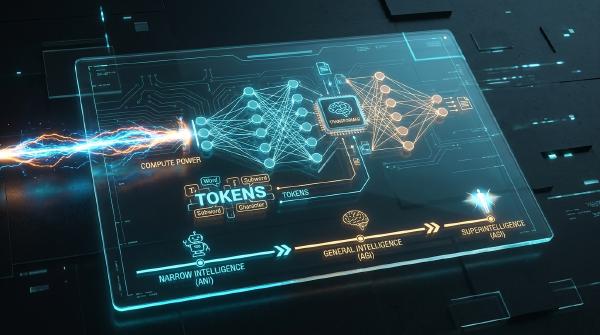
A February 2026 discussion attributed to DeepMind leadership frames the next phase of artificial intelligence not as the arrival of AGI itself, but as the transition beyond it toward Artificial Super Intelligence (ASI). The core shift is conceptual: instead of asking when AGI will emerge, the focus moves to what happens immediately after systems reach human-level cognitive capability.
ASI is defined in the report as a system capable of outperforming large-scale groups of domain experts across nearly all cognitive tasks, effectively surpassing collective human intelligence rather than individual performance.
⚙️ Why Digital Intelligence Scales Differently #
The report emphasizes that digital intelligence has structural advantages over biological cognition that compound with compute:
- Information throughput: near-instant ingestion and processing of large corpora
- Compute-scaled reasoning speed: performance improves directly with hardware scale
- Perfect replication: identical model copies can be deployed at near-zero marginal cost
These properties create a feedback loop where capability growth is tightly coupled to infrastructure expansion, allowing intelligence to scale in ways fundamentally inaccessible to human systems.
🚀 Path 1: Continuous Scaling of Models and Compute #
The first pathway assumes that continued scaling of existing paradigms—larger models, more data, and increased compute—remains sufficient to drive intelligence gains.
Key assumptions include:
- Scaling laws continue to hold under new regimes
- Data and compute availability remain sufficient
- Emergent capabilities appear as model size increases
This path represents the most direct extrapolation of current large language model development trends.
🧩 Path 2: Algorithmic Paradigm Shifts #
The second pathway focuses on structural changes in how models learn and reason, beyond simple scaling.
Research directions include:
- Continuous learning without catastrophic forgetting
- More reliable autonomous agents in open environments
- New architectures beyond Transformers
- Reinforcement learning systems with persistent world models
This path assumes that scaling alone may plateau without fundamental algorithmic innovation.
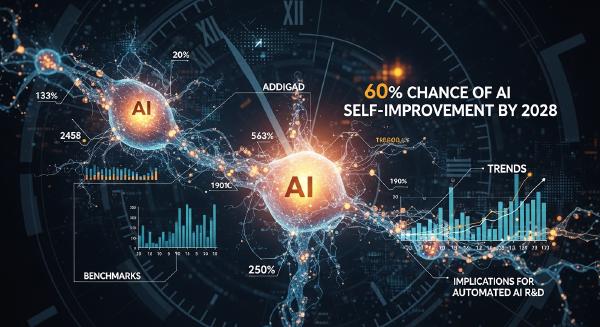
🔁 Path 3: Recursive Self-Improvement Loops #
The third pathway introduces a feedback loop where AI accelerates its own improvement cycle.
This involves three interacting mechanisms:
- Genetic evolution: improved architectures and hardware co-design
- Cultural evolution: synthetic data generation and knowledge expansion
- Division of labor: specialized AI subsystems collaborating on research tasks
Systems like self-play reinforcement learning and AI-assisted research already demonstrate early forms of this loop. If sufficiently stable, it could compress decades of algorithmic progress into much shorter timeframes.
🤝 Path 4: Multi-Agent Emergent Intelligence #
The fourth pathway shifts focus from single-model intelligence to distributed systems of cooperating agents.
Key idea:
- Many specialized AGIs coordinate like a research institution
- High-bandwidth communication enables task decomposition at scale
- Collective intelligence emerges from structured collaboration
Rather than a single superintelligent model, ASI may arise from orchestrated networks of moderately superhuman systems.
⚠️ Structural Barriers to ASI Development #
The report also identifies key constraints that may slow or reshape these trajectories.
Data and Training Constraints #
- High-quality human-generated data is approaching saturation
- Synthetic data risks feedback loops and model collapse
Economic and Infrastructure Limits #
- Semiconductor supply chains and energy demands constrain scaling
- Data center expansion introduces physical and environmental limits
Algorithmic Ceiling Risks #
- Current architectures may plateau without new paradigms
Diminishing Research Efficiency #
- Marginal gains per researcher decline over time in mature fields
- AI-driven automation may partially offset this trend
Abstraction and Grounding Gaps #
- Models may lack deep conceptual grounding in physical reality
- Generalization beyond training abstractions remains uncertain
Regulatory and Geopolitical Constraints #
- Safety concerns and policy interventions could slow deployment
- Competitive dynamics may counterbalance deliberate slowdown
🧭 Conclusion: Mapping the Transition Space from AGI to ASI #
Rather than offering precise timelines, the DeepMind framework describes a structured landscape of possible trajectories from AGI to ASI. Each path—scaling, algorithmic innovation, recursive self-improvement, and multi-agent systems—represents a plausible vector of progress, with distinct technical and economic constraints.
The central implication is not inevitability, but multiplicity: ASI may emerge through overlapping mechanisms rather than a single breakthrough. Understanding these pathways becomes essential for anticipating both capability growth and systemic risk as AI systems approach human-level performance.