
AMD Ryzen AI Halo Launch: A DGX Spark Challenger for Local AI
🚀 AMD Targets Local AI Compute with Ryzen AI Halo #
AMD has officially released the Ryzen AI Halo AI PC at an MSRP of $3,999, positioning it directly against high-end local AI systems such as Nvidia’s DGX Spark.
Built on the Strix Halo architecture, the system integrates CPU, GPU, and NPU compute into a unified SoC designed for high-throughput local inference workloads. With 128GB of unified memory and strong ROCm ecosystem support, AMD is clearly targeting developers and small teams running large language models locally rather than relying on cloud inference services.
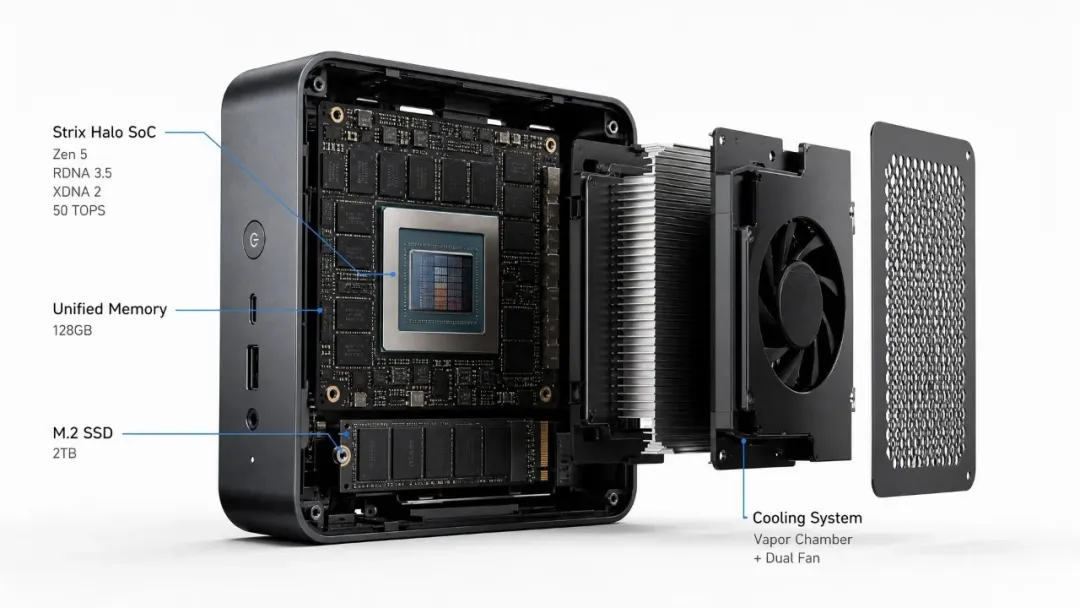
🧠 Hardware Architecture and System Design #
SoC and compute configuration #
The Ryzen AI Halo is powered by the Ryzen AI MAX+ 395 SoC, combining:
- Zen 5 CPU with 16 cores / 32 threads
- RDNA 3.5 integrated GPU
- XDNA 2 NPU delivering up to 50 TOPS
- Maximum TDP: 120W
This heterogeneous architecture is optimized for mixed workloads, where CPU orchestration, GPU acceleration, and NPU inference pipelines work in parallel to reduce latency in model execution.
Memory, storage, and form factor #
- 128GB LPDDR5X-8000 unified memory
- 2TB PCIe Gen4x4 SSD
- Compact 5.9 × 5.9 × 1.7 inch chassis
The large unified memory pool is the defining constraint breaker, enabling local execution of significantly larger transformer models without aggressive quantization or offloading.
I/O and connectivity #
The platform includes:
- USB Type-C ports (including power delivery support)
- Wi-Fi 7 and Bluetooth 5.4
- 10Gbps Ethernet
- HDMI 2.1b
This makes the system viable as both a desktop development node and a portable inference appliance.
⚙️ Software Stack and AI Ecosystem Integration #
ROCm-based AI development stack #
The system runs AMD’s ROCm ecosystem, including ROCm 7.2.2, with compatibility across:
- LM Studio
- ComfyUI
- VS Code-based AI workflows
It also supports modern open-weight model ecosystems such as GPT-OSS, FLUX.2, and SDXL.
This compatibility reduces friction for teams already working in PyTorch-like environments, as most workloads can be ported without major kernel-level changes.
📊 Performance Positioning vs Competitors #
AMD positions Ryzen AI Halo as a competitive alternative to Nvidia’s DGX Spark, emphasizing token throughput improvements across multiple large models.
| Model | Parameter Size | Throughput vs DGX Spark |
|---|---|---|
| GPT OSS | 120B | +7% |
| Qwen 3.5 | 122B | +12% |
| Qwen 3.6 | 35B | +4% |
| GLM 4.7 | 30B | +14% |
These gains directly translate into higher inference throughput, reducing latency for multi-user or iterative development workloads.
Comparison with Apple Mac mini (M4 Pro) #
Against Apple’s Mac mini (M4 Pro), AMD highlights:
- 2× higher maximum memory capacity
- Support for up to ~200B parameter models
- Up to ~4× higher AI workload performance (claimed average)
The key differentiator is memory headroom, which determines the maximum practical model size for local inference without distributed execution.
💰 Cost Efficiency and Long-Term Deployment Economics #
Cloud vs local inference economics #
AMD estimates that continuous AI workloads on Ryzen AI Halo can reduce cloud spending by approximately $750/month under heavy usage conditions.
At ~150W sustained power draw:
- Monthly electricity cost: ~$16.20
- Estimated payback period: ~6 months
Total cost of ownership model #
- 3-year hardware + power cost: ~$4,500–$4,600
- Equivalent cloud inference cost: >$25,000
This creates a strong incentive for teams running persistent workloads, particularly in model prototyping, fine-tuning experiments, and private inference pipelines where data locality matters.
🧭 Roadmap: Gorgon Halo and Next-Gen Scaling #
AMD has also announced a follow-up platform, Gorgon Halo, expected in Q3 2026.
Planned upgrades include:
- Ryzen AI MAX+ 495 SoC
- 192GB unified memory
- Support for models exceeding 300B parameters
This roadmap suggests AMD is aligning its hardware strategy toward rapid scaling of local inference capacity, potentially closing the gap with workstation-class distributed GPU systems.
🧩 Conclusion: A Shift Toward Local AI Infrastructure #
Ryzen AI Halo reflects a broader industry shift toward localized AI compute stacks that reduce dependence on cloud infrastructure.
By combining high-memory unified architecture, ROCm software maturity, and aggressive pricing, AMD positions this platform as a pragmatic alternative for developers building and running large-scale models locally.
Rather than competing solely on raw GPU dominance, the strategy focuses on total system efficiency—balancing cost, memory bandwidth, and software accessibility in a single deployable AI workstation.