
AMD ASD Update Cuts Game Loading Times by Up to 95% on RDNA GPUs
🎮 AMD Expands Shader Delivery Optimization Across RDNA #
AMD, in collaboration with Microsoft, has rolled out Advanced Shader Delivery (ASD) support across its entire RDNA GPU lineup, spanning RDNA 1 through RDNA 4 architectures.
Delivered through the Xbox PC App ecosystem and Windows 11 updates, ASD focuses on improving shader pipeline efficiency, significantly reducing both game loading times and runtime stuttering caused by shader compilation.
🧩 Universal RDNA Support and System Requirements #
Full-stack compatibility across generations #
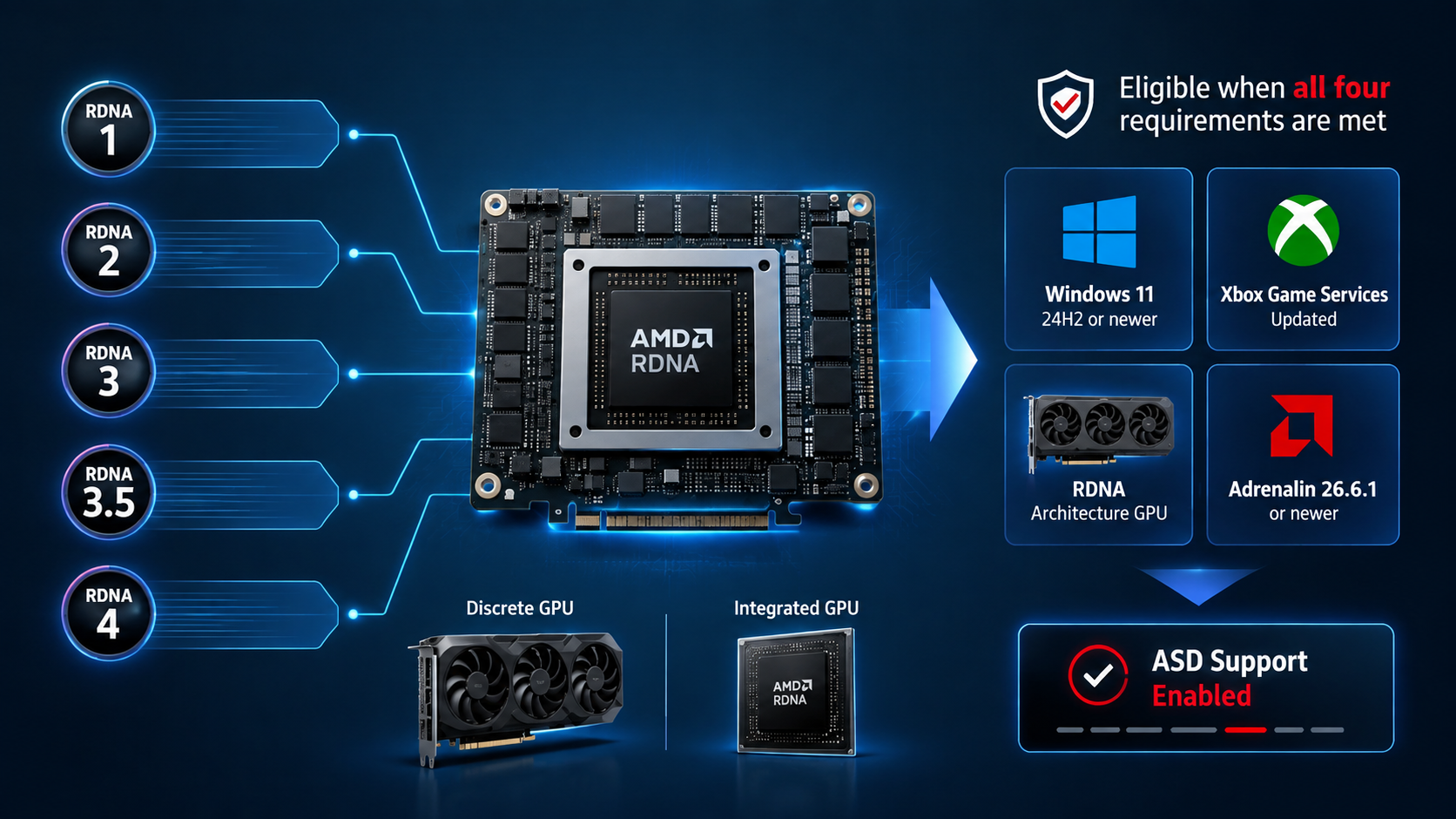
ASD is designed to work across all RDNA-based GPUs:
- RDNA 1
- RDNA 2
- RDNA 3
- RDNA 3.5
- RDNA 4
This includes both discrete GPUs and integrated graphics solutions, making it a platform-level optimization rather than a hardware-exclusive feature.
System requirements #
| Component | Requirement | Update Source |
|---|---|---|
| Operating System | Windows 11 24H2 or later | Windows Update |
| GPU Driver | AMD Software Adrenalin 26.6.1+ | AMD Software Suite |
| Gaming Services | Xbox Game Services 37.113.11003.0+ | Microsoft Store |
| Hardware | Any RDNA GPU | AMD RDNA architecture family |
This dependency stack ensures ASD integrates directly into the Windows gaming pipeline rather than relying on per-title optimizations.
⚡ Performance Impact: Loading Time and Stutter Reduction #
Real-world benchmark results #
On a test system using:
- Radeon RX 7600
- Ryzen 7 5800 (Zen 3, 8-core CPU)
Results from Forza Horizon 6 show:
- Load time reduced from ~90 seconds to ~4 seconds
- Up to 95% reduction in loading time
This improvement is primarily driven by pre-compiled shader delivery and reduced runtime compilation overhead.
Shader compilation stutter mitigation #
Beyond loading speed, ASD directly addresses one of PC gaming’s persistent performance issues: shader compilation stutter.
By shifting shader preparation earlier in the pipeline, ASD reduces:
- Frame time spikes during asset loading
- Stutter during map transitions
- Runtime CPU/GPU synchronization overhead
The result is smoother frame pacing and more consistent gameplay performance, especially in shader-heavy modern titles.
🕹️ Game Ecosystem Adoption #
Early supported titles #
Approximately 40 games already support ASD optimization, including:
- Call of Duty: Black Ops 6
- S.T.A.L.K.E.R. 2: Heart of Chornobyl
- Avowed
- Starfield
- Hogwarts Legacy
- Final Fantasy XVI
- Grand Theft Auto V (Enhanced Edition)
- The Elder Scrolls IV: Oblivion Remastered
These titles span multiple genres, indicating ASD is being positioned as a broad rendering pipeline enhancement rather than genre-specific tuning.
🛠️ Developer Integration via DirectX Agility SDK #
Simplified shader pipeline adoption #
Microsoft has integrated ASD support into the DirectX Agility SDK, enabling developers to adopt shader pre-compilation workflows with minimal friction.
Key workflow changes include:
- Uploading Shader Object Data Blob (SODB) to Xbox Partner Center
- Automatic shader pre-compilation handling
- Reduced need for per-device shader caching logic
This abstraction significantly reduces the engineering overhead associated with cross-hardware shader optimization.
🔭 Platform Outlook and Ecosystem Expansion #
Microsoft has indicated that ASD is an initial step toward broader shader delivery optimization across Windows gaming systems.
Future expansion directions include:
- Wider Windows device coverage beyond AMD hardware
- Potential support for additional GPU vendors (IHVs)
- Deeper integration with DirectX runtime scheduling
This suggests a shift toward standardized shader delivery infrastructure at the OS level, reducing fragmentation in PC gaming performance optimization.
🧠 Conclusion: Toward a Pre-Compiled Gaming Pipeline #
AMD’s ASD rollout represents a structural change in how shader workloads are handled across RDNA GPUs.
By moving shader compilation out of runtime and into a pre-delivery pipeline integrated with Windows and DirectX, the update directly targets one of the longest-standing inefficiencies in PC gaming performance.
The result is not just faster loading times, but a more stable and predictable rendering pipeline across supported titles and hardware generations.