DeepSeek Super-Agent Explained: Multi-Agent Architecture and AI Automation
While software developers are still discussing how to reproduce a bug in a team chat, an AI agent could already be investigating the issue in the background, identifying its root cause, testing a potential fix, and preparing a GitHub Pull Request for human review.
This is the direction DeepSeek is exploring with its new Super-Agent architecture.
On October 31, 2026, the DeepSeek Harness team published a technical article titled Exploring Super-agent Design: Towards a More Autonomous Agent System, outlining an architecture designed to move AI agents beyond isolated chat sessions and toward persistent, event-driven systems capable of managing multiple tasks simultaneously.
The central idea is straightforward: instead of requiring humans to manually open sessions, provide context, assign work, and monitor every execution step, the AI system itself manages task scheduling, context synchronization, parallel execution, and recovery.
DeepSeek describes an internal Super-Agent instance built on DeepSeek Harness that already participates in its daily R&D workflows.
For example, when developers discuss software defects in group chats, the internal agent can identify potentially actionable issues without being explicitly mentioned. It can attempt to reproduce the problem, investigate the source code, implement a potential fix, and submit a Pull Request for developer review.
A development task can also move continuously between different platforms. A developer might initially describe an implementation plan in an instant-messaging conversation and subsequently revise the requirements through GitHub Pull Request comments. The agent retains the relationship between these interactions and adjusts its execution accordingly.
The architectural proposal is based on five major engineering ideas:
- Two-layer Router-Worker orchestration.
- Event-driven task scheduling.
- Asynchronous multi-channel interaction.
- Separation of compute, persistent state, and execution environments.
- Independent Watchdog-based monitoring and recovery.
DeepSeek has also published an open-source implementation called dsh-superagent-prototype.
An important distinction is that this repository is a research prototype, not an official commercial Super-Agent product. Its public implementation has also been adapted from the internal system, and some architectural capabilities described in the technical article remain future development directions.
Nevertheless, the design provides an interesting look at how AI agent infrastructure may evolve from individual coding assistants into persistent autonomous collaborators.
🚀 1. The Next Bottleneck for AI Agents: Human Attention #
Over the past year, AI coding agents have become increasingly capable of handling complex software development tasks.
Modern coding agents can:
- Read and understand large codebases.
- Identify potential software defects.
- Modify source files.
- Execute shell commands.
- Run automated tests.
- Review code changes.
- Create Git commits and Pull Requests.
- Delegate subtasks to other agents.
However, as individual agent capabilities improve, another limitation becomes increasingly apparent: human attention is not scaling at the same rate as AI execution capability.
1.1 The Session-Based Agent Problem #
Most traditional AI coding assistants operate around independent sessions.
Each session maintains its own conversation history, context, execution environment, and task state.
This model works well when a developer focuses on one problem.
However, managing several unrelated tasks becomes increasingly complicated.
Consider a developer simultaneously handling:
- A production bug reported in a team chat.
- A feature implementation tracked through GitHub.
- A code-review request requiring changes to an existing Pull Request.
- A CI failure that needs investigation.
- A documentation update.
With conventional coding agents, the developer may need to open multiple sessions, manually transfer context, track execution progress, and switch between different interfaces.
DeepSeek estimates that an individual developer can generally follow only three to five active agent sessions simultaneously.
The limitation is not necessarily the model’s ability to execute tasks. It is the amount of context and coordination work that a human can reasonably manage.
1.2 Why MCP and CLI Integrations Are Not Enough #
Connecting an existing coding agent to external systems through command-line interfaces, Model Context Protocol (MCP) servers, or other integrations provides access to more information and tools.
However, simply adding integrations does not solve the underlying architecture problem.
Several limitations remain:
Synchronous session execution
A traditional ReAct loop may block while waiting for a long-running tool call to finish.
During this period, incoming requests and new instructions can be delayed.
Context fragmentation
Independent sessions maintain separate histories. A change in requirements on GitHub may not automatically become available to an agent working from an earlier chat conversation.
Task interference
When several tasks arrive in the same session, their execution details and context can become mixed.
Local-device dependency
If an agent’s execution loop, state, and development environment are all tied to one laptop, putting that device to sleep or disconnecting it can interrupt the entire workflow.
These limitations suggest that improving the underlying model is not sufficient.
AI systems also need better mechanisms for managing sessions, scheduling work, preserving context, and coordinating execution.
1.3 Four Fundamental Characteristics of a Super-Agent #
DeepSeek defines four fundamental characteristics for this architecture:
| Capability | Description |
|---|---|
| Continuous Interaction | Maintains context across multiple sessions and communication platforms |
| High-Efficiency Concurrency | Executes multiple complex tasks independently and in parallel |
| Proactive Response | Identifies actionable environmental events without requiring a new explicit prompt for every task |
| Persistence and Recovery | Maintains long-running availability and automatically handles certain execution failures |
The objective is to change the relationship between humans and AI agents.
Humans focus on defining objectives, providing important decisions, and reviewing results.
The agent infrastructure handles the operational complexity of task dispatching, context management, and execution.
🧩 2. Router-Worker Architecture: One Manager AI, Multiple Worker AIs #
The central architectural component of DeepSeek Super-Agent is a two-layer design consisting of a Router and multiple Workers.
The Router maintains global context and coordinates interactions, while Workers execute individual tasks in isolated environments.
This separates the responsibilities of task management and task execution.
2.1 Overall Architecture #
The simplified architecture can be represented as follows:
+------------------------------------------+
|             External Triggers            |
|                                          |
|  Group Chat | GitHub | Email | CI | IM   |
+--------------------+---------------------+
                     |
                     v
+------------------------------------------+
|              Router Session              |
|                                          |
|  Global Context and Coordination         |
|  Event Evaluation and Task Dispatch      |
|  Cross-Platform Interaction              |
+--------------------+---------------------+
                     |
          +----------+----------+
          |                     |
          v                     v
+---------------------+  +---------------------+
|   Worker Session 1  |  |   Worker Session 2  |
|                     |  |                     |
| Bug Reproduction    |  | Feature Development |
| Independent Context |  | Independent Context |
| Test Execution      |  | Code Review         |
+---------------------+  +---------------------+
          |                     |
          +----------+----------+
                     |
                     v
+------------------------------------------+
|             Router Session               |
|                                          |
|       Results and Status Reporting       |
+--------------------+---------------------+
                     |
                     v
+------------------------------------------+
|       Human Review and Decision          |
+------------------------------------------+
The architecture allows developers to interact with what appears to be a single assistant while multiple specialized agent sessions operate behind the scenes.
2.2 Router: The Manager and Global Coordination Layer #
The Router is a persistent session responsible for handling incoming interactions and coordinating tasks across the system.
Its responsibilities include:
- Receiving events from connected platforms.
- Identifying potentially actionable requests.
- Maintaining cross-task context.
- Associating new messages with existing tasks.
- Creating and assigning new work.
- Receiving Worker reports.
- Communicating results to users.
One important design principle is that the Router should not perform the actual implementation work.
Its primary responsibility is orchestration.
For example, when a developer reports a software defect, the Router determines whether the message represents a new task, identifies the relevant repository and context, and dispatches the investigation to a Worker.
Because this work generally involves lightweight classification and routing, DeepSeek suggests that the Router can use a smaller, faster model than the execution Workers.
It may not even require shell access.
This helps prevent the coordination layer from becoming a computational bottleneck.
2.3 Worker: Isolated Execution Agents #
Workers are independent agent sessions responsible for completing specific tasks.
Each Worker receives an assignment and operates within its own context.
Typical responsibilities include:
- Bug reproduction.
- Source-code investigation.
- Feature development.
- Automated testing.
- Pull Request review.
- Code modification.
- Documentation updates.
A Worker can also create its own Subagents when handling a particularly complicated task.
The Router does not need to understand every implementation detail.
Instead, each Worker reports its important findings, execution status, and final results to the coordination layer.
This separation offers several advantages.
Context isolation
A Worker investigating a bug does not need to carry the entire execution history of an unrelated feature-development task.
Parallel execution
Several Workers can independently execute their assignments without waiting for one another.
Flexible model selection
The system can allocate more capable models to complex execution tasks while using lighter models for routing and classification.
Reduced interaction noise
Workers do not independently send all their intermediate reasoning and tool activity to users. The Router provides a unified communication interface.
2.4 Why This Is Different From Conventional Agent Teams #
The Router-Worker architecture may look similar to common multi-agent or Agent Team frameworks, but the design objectives are different.
Traditional Agent Teams generally divide one complicated task into smaller subtasks.
A team leader analyzes the problem, develops a plan, delegates work, and coordinates the members.
Super-Agent focuses on a different problem: managing many relatively independent tasks across a continuously changing environment.
For example, one Worker may investigate a production issue, another may respond to an existing Pull Request, and a third may implement a separate feature.
The Router manages their relationships without becoming deeply involved in each task’s implementation details.
This is closer to a persistent task-orchestration service than a conventional multi-agent brainstorming system.
🔄 3. Event-Driven Architecture: Agents That Respond Without Explicit Prompts #
One of the defining features of Super-Agent is its event-driven execution model.
Traditional AI assistants primarily react to prompts entered directly by users.
Super-Agent changes the input model by treating external environmental events as potential task triggers.
3.1 Triggers: Turning External Events Into Work #
DeepSeek refers to incoming environmental events as Triggers.
Potential trigger sources include:
- Instant-messaging conversations.
- Group-chat messages.
- Emails.
- Calendar reminders.
- GitHub Pull Request comments.
- Code-review feedback.
- CI pipeline results.
- Other connected development platforms.
Instead of repeatedly waiting for a developer to describe every problem manually, the agent can observe relevant events and determine whether they require action.
For example:
A developer reports that a specific application crashes when processing a particular file.
The Super-Agent may recognize that the message contains a potential debugging request.
It can then begin reproducing the problem in the background while the discussion continues.
However, event ingestion does not mean that every incoming message should automatically trigger an agent task.
A large portion of daily communication consists of irrelevant messages, informal discussion, and routine notifications.
Calling an LLM for every event would introduce unnecessary latency and inference costs.
DeepSeek therefore introduces a two-level filtering mechanism.
3.2 Fast Path: Programmatic Event Filtering #
The first filtering layer uses deterministic program logic.
It evaluates information such as:
- Event source.
- Repository scope.
- Group membership.
- User authorization.
- Bot identity.
- Source-specific interaction rules.
These checks are relatively inexpensive and can eliminate irrelevant events before they reach the model.
For example, a system administrator can configure certain communication channels to:
- Accept only explicit requests.
- Treat messages as potential task candidates.
- Ignore unrelated events completely.
This reduces the number of model calls and limits unnecessary background activity.
3.3 Slow Path: LLM-Based Semantic Evaluation #
Events that pass the programmatic filter are forwarded to the Router for semantic evaluation.
The LLM examines the surrounding context and determines whether an incoming event represents actionable work.
For example, consider two messages:
- “The production service crashed again after yesterday’s deployment.”
- “The weather is nice today.”
A keyword-based system could struggle to distinguish their importance.
A language model can analyze the conversation context and identify whether the first message potentially requires investigation.
This creates a two-stage event-processing architecture:
| Filtering Layer | Implementation | Primary Responsibility |
|---|---|---|
| Fast Path | Deterministic program logic | Remove irrelevant events |
| Slow Path | LLM-based evaluation | Determine semantic intent and actionable work |
The combination helps control model-inference costs while maintaining flexible event interpretation.
3.4 Event Subscriptions and Direct Worker Routing #
Another important mechanism is the Subscription System.
Without subscriptions, every incoming event would need to pass through the Router before reaching its corresponding Worker.
As the number of active tasks increases, this could create unnecessary coordination overhead.
DeepSeek addresses this by allowing Workers to subscribe directly to relevant communication threads.
Consider a GitHub Pull Request:
- The Router identifies a new development task.
- It creates a Worker to investigate the issue.
- The Worker subscribes to the relevant Pull Request thread.
- Subsequent comments and updates are delivered directly to the Worker.
- The Worker adjusts its implementation according to the new instructions.
- Important outcomes are reported back to the Router.
The Router no longer needs to manually forward every update.
This is especially useful when several messages belong to the same long-running task.
The subscription relationship can also be many-to-many.
A Worker can subscribe to multiple related threads, while a thread can provide updates to multiple Workers when their tasks overlap.
This helps preserve context across different parts of a collaborative development process.
🧠 4. Context Management: Inline, Spill, and Chain of Recall #
Long-running autonomous agents face another fundamental challenge: maintaining useful context over time.
A normal chat session can accumulate a large amount of conversation history, tool output, source-code changes, and external events.
However, an LLM has a finite context window.
Simply inserting every incoming event into the Router’s context would eventually result in context overload.
DeepSeek therefore borrows ideas from computer-system memory management.
4.1 Treating the Context Window Like a Cache #
The system uses two main operations:
Inline
Information likely to be needed immediately is inserted directly into the current model context.
For example, when a developer comments on an existing Pull Request, the system can include:
- The latest comment.
- Relevant preceding messages.
- The Pull Request identifier.
- Related task information.
- A summary of current execution progress.
This reduces the number of additional retrieval operations required by the model.
Spill
Information that exceeds the available context budget or is unlikely to be needed immediately remains outside the active context.
Instead of inserting the entire content, the system retains a reference or summary.
The model can retrieve the complete information later when necessary.
This prevents irrelevant historical details from consuming valuable context capacity.
4.2 Chain of Recall #
DeepSeek extends this approach through a mechanism called Chain of Recall.
The system assigns identifiers to related objects, such as:
- Trigger events.
- Communication threads.
- Worker sessions.
- Tasks.
- Pull Requests.
- Execution records.
These references form a relationship graph.
When the Router needs historical context, it can follow the associated references step by step.
For example:
Current GitHub Comment
         |
         v
   Pull Request Thread
         |
         v
    Worker Session
         |
         v
   Original Task
         |
         v
   Related Chat Thread
         |
         v
   Earlier Design Decision
This allows the system to recover relevant information without permanently storing every detail in the active context window.
It also helps maintain continuity when a task moves between communication platforms.
The approach is especially useful for development tasks that remain active over several days or weeks.
4.3 Context Locality and Efficiency #
The underlying concept resembles memory locality in traditional computer systems.
Information that is likely to be needed soon should be readily available.
Information that is less relevant should remain outside the immediate working context and be retrieved only when needed.
This provides a more scalable approach to context management than continually expanding the conversation history.
However, Chain of Recall does not completely solve long-term memory.
DeepSeek acknowledges that recalling accurate context across periods of several weeks or months remains an open engineering challenge.
⚡ 5. Proactive Execution: Fixing Bugs Before Developers Ask #
The most distinctive feature of DeepSeek’s Super-Agent concept is proactive execution.
Rather than waiting until a user provides a fully formed task, the system can begin investigating potential problems based on environmental signals.
DeepSeek borrows the concept of speculative execution from computer systems.
5.1 What Is Speculative Execution in AI Agents? #
In traditional processors, speculative execution allows the CPU to perform operations before knowing whether their results will ultimately be needed.
The system can gain performance when its predictions are correct, while incorrect speculative work is discarded.
DeepSeek applies a similar principle to autonomous agents.
The Agent can begin background work before it knows whether the resulting solution will be accepted or even required.
Potentially useful results are delivered to developers, while unsuccessful or irrelevant attempts remain undisclosed.
This approach trades additional background computing resources for reduced human waiting time.
5.2 Silent Bug Reproduction and Fixing #
DeepSeek describes an internal workflow called “silent reproduce and fix.”
Consider the following scenario:
- Developers discuss a software bug in a team group chat.
- The Super-Agent identifies the issue as potentially actionable.
- It retrieves relevant source-code and project context.
- A Worker attempts to reproduce the problem.
- The Worker investigates potential root causes.
- It creates and tests a possible fix.
- If the reproduction succeeds and a relatively straightforward solution is found, the Agent prepares a Pull Request.
- Developers receive the result for review.
If the issue cannot be reproduced or no reliable fix is found, the system can remain silent.
This helps avoid sending developers unnecessary notifications about failed experiments.
5.3 Why Proactive Execution Matters #
Conventional coding agents wait for users to provide tasks.
Super-Agent attempts to move toward a system in which useful work can begin earlier.
The advantages include:
- Reduced manual task assignment.
- Less time spent reproducing reported issues.
- Faster identification of potential defects.
- Parallel investigation of independent problems.
- Reduced interruptions for developers.
- Better utilization of available compute resources.
However, proactive execution must operate within explicit authorization policies.
A system that continuously observes communication channels and automatically modifies source code without proper permissions could introduce serious security and operational risks.
The purpose of event filtering, authorization, and human review is to ensure that proactive execution remains controlled.
🔀 6. Asynchronous ReAct Loop: Background Execution Without Blocking Conversations #
Traditional ReAct-based agents combine reasoning and tool execution in a sequential loop.
A simplified execution sequence looks like this:
User Input
    |
    v
Model Reasoning
    |
    v
Tool Call
    |
    v
Wait for Completion
    |
    v
Tool Result
    |
    v
Model Reasoning
    |
    v
Final Response
The limitation becomes apparent when a tool operation takes a long time.
A command that runs for several minutes can prevent the agent from processing additional instructions during that period.
DeepSeek addresses this through an Asynchronous ReAct Loop.
6.1 Synchronous vs. Asynchronous Tool Execution #
Instead of waiting for a long-running tool call to finish, the Agent starts the operation in the background.
The tool immediately returns a status indicating that execution has started.
The main session can then continue processing new input.
When the background operation completes, its result is delivered as a new event.
The execution model becomes:
User Input
    |
    v
Model Reasoning
    |
    v
Start Background Task
    |
    +----------------------+
    |                      |
    v                      v
Return Started        Continue Session
    |                      |
    |                      v
    |                 New User Input
    |                      |
    |                      v
    |                 Model Reasoning
    |                      |
    +----------+-----------+
               |
               v
         Task Completion
               |
               v
        Deliver Result
               |
               v
       Continue Workflow
This architecture enables full-duplex interaction.
The agent can process new instructions while background work continues.
6.2 Start and Stop Operations #
Long-running tool calls are redesigned around asynchronous operations.
Conceptually, the system provides:
start(): Begin a background operation.stop(): Cancel an ongoing background operation.- Completion event: Deliver the result when the operation finishes.
This allows users to redirect or cancel a task without necessarily terminating the entire session.
For example, while a Worker is running a test suite, a developer can provide additional instructions through the Router.
The agent does not need to wait for the entire test operation to complete before acknowledging the new input.
An important implementation detail is that DeepSeek describes this asynchronous mechanism as implemented in DeepSeek Harness, but it was not enabled by default at the time of the architecture article.
Therefore, it should not be assumed that every existing Harness workflow automatically operates asynchronously.
6.3 Multi-Channel Interaction #
Different communication channels also require different response styles.
A group chat has limited attention bandwidth, while GitHub Pull Requests and email can accommodate more structured information.
DeepSeek proposes different interaction strategies:
| Communication Channel | Preferred Interaction |
|---|---|
| Instant Messaging | Short updates, important questions, and approval requests |
| GitHub Pull Requests | Detailed descriptions, code changes, and validation results |
| Structured summaries and actionable responses | |
| Documents | Detailed technical findings and reviewable output |
For instant messaging, DeepSeek recommends keeping individual responses relatively short, with a practical guideline of approximately 100 words or fewer.
Detailed implementation information should remain in the corresponding development platform rather than overwhelming the group conversation.
☁️ 7. Persistent Agents: Separating Compute, State, and Execution Environments #
One of the most significant architectural challenges is maintaining agent availability when the user’s local machine is unavailable.
Traditional local coding agents generally bind three components together:
- Compute: The process running the agent loop.
- State: Session history and persistent task information.
- Execution environment: Local repositories, files, toolchains, and credentials.
When these components reside on the same laptop, shutting down the machine interrupts the entire workflow.
DeepSeek proposes separating them.
7.1 Cloud-Based Agent Compute #
The Agent Loop can run inside stateless cloud containers.
The cloud execution layer handles:
- Model requests.
- Agent reasoning.
- Task coordination.
- Event processing.
- Worker management.
Because the compute layer is separated from persistent session state, individual containers can be restarted or replaced without losing the overall task history.
This also creates opportunities for horizontal scaling.
7.2 Persistent State Storage #
Session history and task information are stored in persistent databases rather than being tied directly to the lifecycle of one local process.
Important information includes:
- Conversation history.
- Task assignments.
- Worker status.
- Execution results.
- Context references.
- Communication relationships.
If the Agent Loop encounters a failure, it can recover its state and resume the corresponding workflow.
The database therefore becomes an essential component of the persistence architecture.
7.3 Local Execution Environments and Edge Daemons #
Moving the Agent Loop to the cloud does not mean every development environment should also move to the cloud.
Developers frequently maintain important local resources:
- Uncommitted source-code changes.
- Private repositories.
- Specialized build environments.
- Internal development services.
- Locally installed SDKs.
- Hardware-specific toolchains.
- Sensitive credentials.
Recreating these environments in cloud sandboxes can be expensive and may result in missing context.
DeepSeek proposes leaving the actual execution environment where it is and connecting it to the cloud agent through a lightweight local daemon.
The architecture becomes:
+----------------------------------+
|           Cloud Layer            |
|                                  |
|  Agent Loop                      |
|  Router and Workers              |
|  Persistent Session State        |
+----------------+-----------------+
                 |
             Secure Channel
                 |
                 v
+----------------------------------+
|           Local Machine          |
|                                  |
|  Lightweight Local Daemon        |
|  Repository Access               |
|  Build Toolchains                |
|  Local Files and Services        |
|  Execution Environment           |
+----------------------------------+
The local daemon receives authorized commands, performs the required operations, and returns the results to the cloud-based Agent Loop.
This approach supports a Bring Your Own Machine (BYOM) model.
A developer can continue using the existing development environment without migrating all source code, tools, and configuration into a cloud-hosted sandbox.
7.4 Automatic Recovery When Devices Go Offline #
The separation of compute and execution environments also enables more flexible device availability.
Suppose a developer closes a laptop while a task still requires local execution.
The cloud-side Agent Loop and persistent task state can remain available.
The local environment becomes temporarily unavailable, but the overall orchestration system does not necessarily have to terminate.
When the device reconnects, the local daemon can become available again, allowing eligible operations to continue.
This is an important distinction between an agent that lives inside a terminal session and one that operates as a persistent infrastructure service.
🛡️ 8. Watchdog: Monitoring Agent Progress and Automatic Recovery #
Long-running autonomous systems face failure modes that conventional process monitoring cannot always detect.
For example, a Worker may continue running without crashing but become trapped in an ineffective reasoning loop.
A task might repeatedly execute the same commands, fail to make progress, or gradually deviate from its original objective.
A simple process monitor would see that the application is still alive.
DeepSeek addresses this problem with an independent Watchdog Session.
8.1 External Control Loop #
The Watchdog operates outside the main Super-Agent architecture.
It periodically examines the health of the overall system and the progress of individual Workers.
Its responsibilities include:
- Detecting infrastructure failures.
- Identifying failed session recovery.
- Monitoring Worker execution progress.
- Detecting ineffective loops.
- Identifying deviations from task objectives.
- Attempting appropriate recovery actions.
This is more sophisticated than merely checking whether a process exists.
The Watchdog also evaluates whether the agent is accomplishing meaningful work.
8.2 Why an Independent Watchdog Matters #
If the monitoring system depends entirely on the main Agent Loop, a failure in that loop could also disable the monitoring mechanism.
An independent control process reduces this shared failure risk.
The Watchdog can also perform certain administrative operations through the agent infrastructure.
For example, maintainers may use natural-language instructions to investigate failures, adjust prompts, or modify event-triggering rules.
This makes the Watchdog a supervisory agent rather than merely a conventional health-check script.
However, automated recovery must remain subject to appropriate permissions and operational boundaries.
An agent should not be allowed to make unrestricted changes to production systems simply because its monitoring logic believes a task is stuck.
📊 9. Preliminary Benchmark Results: Parallel Scheduling Reduces Completion Time #
DeepSeek evaluated the proposed Super-Agent architecture using simulated development communication workloads.
The purpose was to measure task scheduling and collaboration efficiency rather than the actual coding ability of individual models.
9.1 Test Environment #
The experimental environment contained approximately 300 incoming messages.
These included:
- Approximately 20 actual work requests.
- Informal group conversations.
- Follow-up messages.
- Task cancellations.
- GitHub CI notifications.
Four execution configurations were compared:
- Full Super-Agent architecture.
- Super-Agent without direct Worker subscription routing.
- Single Session with Subagent tools using a neutral prompt.
- Single Session with Subagent tools using a delegation-oriented prompt.
Each configuration was executed five times.
To isolate the orchestration architecture from coding performance, actual implementation work was replaced with a tool that consumed a predefined amount of time.
The experiment therefore measured scheduling and collaboration behavior rather than the ability of a particular model to solve software engineering problems.
9.2 Task Completion Time #
The reported results were:
| Metric | Super-Agent | Single Session + Subagent (Neutral Prompt) |
|---|---|---|
| Median Completion Time (p50) | 12.4 minutes | Not reported |
| P95 Completion Time | 15.7 minutes | 29.5 minutes |
The Super-Agent architecture reduced the reported P95 task completion time from 29.5 minutes to 15.7 minutes.
This represents approximately a 46.8% reduction:
\[ \frac{29.5-15.7}{29.5}\times100 \approx46.8\% \]The results indicate that separating global coordination from individual task execution can reduce delays caused by session-level blocking.
9.3 Why the Single-Session Baseline Struggled #
The neutral-prompt single-session configuration exhibited an interesting behavior.
Although the agent had access to Subagent capabilities, it did not invoke them in any of the five experimental runs.
Instead, the main session handled the tasks itself.
Incoming messages repeatedly interrupted ongoing work, increasing the time required to complete individual requests.
The delegation-oriented prompt improved the results because the model delegated work more frequently.
However, it still delegated in only four out of five runs.
In the remaining run, it determined that the task was sufficiently simple to execute directly, creating a longer completion-time tail.
This demonstrates an important difference between architectural delegation and prompt-based delegation.
A system that depends entirely on an LLM deciding when to invoke a Subagent may produce inconsistent scheduling behavior.
Super-Agent moves this responsibility into a dedicated orchestration layer.
9.4 Cache-Read Token Consumption #
The architecture also introduces additional resource requirements.
Multiple independent Worker sessions require their own context and inference operations.
DeepSeek therefore examined how direct subscription routing affects token consumption.
The reported results were:
| Metric | Direct Routing Enabled | Direct Routing Disabled |
|---|---|---|
| Router Decisions | Baseline | Approximately 30% more |
| Cache-Read Tokens | 23.23 million | 31.77 million |
Disabling the direct routing mechanism increased cache-read tokens by approximately 37%.
The reason is that subsequent messages associated with an existing task had to pass through the Router instead of being delivered directly to their subscribed Workers.
The direct subscription mechanism therefore reduces unnecessary Router evaluations and associated inference overhead.
9.5 Understanding the Benchmark Limitations #
These results are preliminary rather than a comprehensive benchmark of production coding agents.
Several limitations should be considered:
- Only five runs were conducted for each configuration.
- The workload was synthetic.
- Coding execution was replaced with a time-consuming placeholder operation.
- The experiment focused on task scheduling rather than code quality.
- The results do not establish performance across different models or large production organizations.
The findings nevertheless provide useful evidence that multi-session orchestration can improve task completion behavior under concurrent event streams.
More importantly, they show that improving agent productivity is not simply a matter of selecting a stronger model.
The underlying scheduling and communication architecture also matters.
🔒 10. Security, Privacy, and Engineering Challenges #
Despite its promising architecture, DeepSeek acknowledges several substantial challenges before Super-Agent systems can become broadly deployable.
Persistent agents with access to communication platforms, source-code repositories, cloud infrastructure, and local development environments introduce a significantly larger security surface than conventional chat-based assistants.
10.1 Long-Term Memory #
Chain of Recall improves context retrieval, but long-term memory remains difficult.
A system handling tasks over weeks or months must accurately identify:
- Which previous decisions remain relevant.
- Which requirements have been superseded.
- Which task relationships should be preserved.
- Which historical information has become outdated.
- Which contextual details belong to separate projects.
Incorrect context retrieval can lead to outdated requirements being applied to new work.
This is particularly problematic for agents operating across multiple repositories and development teams.
10.2 Prompt Injection and Untrusted Event Sources #
Event-driven agents continuously receive information from external systems.
These inputs can include:
- GitHub comments.
- Emails.
- Group-chat messages.
- CI logs.
- External documents.
- Third-party tool outputs.
Some of these inputs may contain malicious instructions or prompt-injection attempts.
A compromised or malicious event source could attempt to manipulate an agent into executing unintended commands, revealing sensitive information, or modifying source code.
The risk becomes greater when the agent can execute commands in a local environment.
Consequently, authorization and isolation must be enforced independently of model reasoning.
10.3 Local Credential Protection #
The separation of cloud compute and local execution environments introduces another important security boundary.
The cloud-based Agent Loop needs to interact with local repositories, build tools, and services.
However, local environments may contain:
- GitHub access tokens.
- SSH private keys.
- Cloud credentials.
- Internal API keys.
- Database passwords.
- Proprietary source code.
Allowing these credentials to enter an LLM’s context could create significant leakage risks.
Future implementations need mechanisms that allow agents to use authorized credentials without unnecessarily exposing their underlying secret values to model context.
10.4 Human Intervention and Approval Mechanisms #
Autonomous execution does not eliminate the need for human oversight.
Developers must be able to:
- Inspect task progress.
- Review code modifications.
- Change requirements.
- Cancel inappropriate tasks.
- Approve sensitive operations.
- Investigate failures.
- Override automated decisions.
The challenge is designing an interface that provides enough information without overwhelming users with notifications and status updates.
The architecture must balance autonomous execution with meaningful human control.
10.5 Scaling Router and Worker Coordination #
A single persistent Router is sufficient for the workload sizes explored by DeepSeek.
However, larger deployments may require multiple Router instances.
This introduces additional questions:
- How should work be partitioned?
- How should global context be synchronized?
- When should Workers communicate directly?
- How should cross-team tasks be coordinated?
- How should context boundaries be enforced?
Agent-to-Agent (A2A) communication across independently managed Super-Agent instances is another open research direction.
🔍 11. DeepSeek Super-Agent vs. the Public dsh-superagent Prototype #
One distinction deserves particular attention: the architecture described in DeepSeek’s technical article is broader than the functionality of the public GitHub repository.
DeepSeek has released the project:
https://github.com/deepseek-ai/dsh-superagent-prototype
The repository provides a practical reference implementation for validating parts of the Super-Agent engineering approach.
However, its README explicitly states that:
- It is a research prototype, not an official commercial DeepSeek product.
- It is not production-ready software.
- The published implementation differs from DeepSeek’s internal version.
- It is not identical to the implementation described in the architectural article.
- Some of the article’s proposed designs are future directions and are not implemented in the public prototype.
11.1 What the Public Prototype Actually Supports #
The public dsh-superagent implementation is packaged as a DeepSeek Harness bundle and focuses on proactive coding assistance for a single GitHub repository.
Its current integration scope includes:
- GitHub event handling.
- Optional Feishu integration.
- Authorized task requests.
- Independent agent sessions and working directories.
- Work-item tracking.
- Pull Request delivery.
- A web panel for human interaction.
When an authorized user requests work, the system creates a corresponding task, assigns it to an isolated agent session, and returns results through the original conversation.
This is narrower than the broader architecture vision involving multiple communication channels, calendar events, emails, and generalized personal-assistant workflows.
11.2 Authorization and Controlled Proactivity #
An important aspect of the public implementation is its authorization model.
The agent should act only when an authorized person requests work or when a team-defined rule permits proactive execution.
It is not designed to indiscriminately execute every event it observes.
The documentation also recommends beginning with an observation-oriented mode that records what the agent would have done before enabling more autonomous behavior.
This provides an opportunity to validate event filters and execution policies before allowing the system to perform actual actions.
11.3 DeepSeek Harness as the Underlying Runtime #
The Super-Agent prototype builds on DeepSeek Harness, which provides the underlying agent runtime.
DeepSeek Harness handles capabilities such as:
- Session management.
- Tool execution.
- Plugin integration.
- Shell operations.
- Agent delegation.
- Runtime configuration.
For additional background, DeepSeek Harness and Cordis: The Runtime for Self-Modifying AI Agents explains how its dynamically composable plugin architecture supports more advanced agent execution environments.
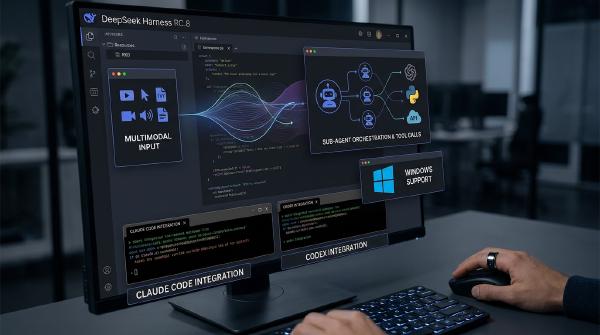
The earlier DeepSeek Harness RC.8 release and its agent orchestration improvements also provides useful context for understanding the evolution toward multi-agent coordination.
Together, these developments show that Super-Agent is not an isolated feature. It builds on a broader effort to make the Harness runtime capable of coordinating multiple specialized agents, tools, and execution environments.
🧭 Conclusion: AI Agents Are Evolving From Chat Sessions Into Persistent Systems #
DeepSeek’s Super-Agent architecture represents an important evolution in how AI agents are designed.
Traditional coding assistants focus primarily on solving individual tasks through isolated sessions.
Super-Agent addresses a different problem: how to continuously manage and coordinate multiple tasks across communication channels, development environments, and independent execution sessions.
Its most important architectural contributions include:
| Component | Primary Function |
|---|---|
| Router | Global coordination, context management, and task dispatch |
| Workers | Independent parallel task execution |
| Event-Driven Triggers | Convert external events into potential tasks |
| Fast Path / Slow Path | Filter noise before expensive model evaluation |
| Subscription Mechanism | Route subsequent events directly to related Workers |
| Inline and Spill | Optimize active context-window utilization |
| Chain of Recall | Retrieve related historical context on demand |
| Asynchronous ReAct | Execute long-running tasks without blocking interaction |
| Compute-State Separation | Maintain sessions independently of local device availability |
| Local Daemon | Connect cloud agents to existing execution environments |
| Watchdog | Monitor progress and support automated recovery |
The benchmark results also suggest that dedicated orchestration can improve task completion times under concurrent workloads, although the preliminary synthetic experiments should not be interpreted as proof of equivalent gains in production software development.
The most important shift is philosophical.
As AI models become increasingly capable of handling complex tasks independently, the bottleneck moves from the model’s ability to execute individual operations toward the system’s ability to manage many operations simultaneously.
Humans cannot continuously monitor dozens of independent agent sessions, transfer context between platforms, and manually resolve every coordination problem.
Super-Agent attempts to move this complexity into the infrastructure.
The future of AI collaboration may not be defined by how intelligently one agent responds to a prompt, but by how effectively an entire system of agents identifies, organizes, and completes work over time.
DeepSeek’s approach suggests that the next generation of AI systems will increasingly resemble persistent, event-driven computing environments rather than conventional chat applications.
For software engineering teams, this could eventually mean spending less time assigning and supervising individual coding tasks and more time defining objectives, reviewing important decisions, and validating the results produced by autonomous AI collaborators.