NVIDIA Vera Rubin DSX POD: The Rise of Out-of-the-Box AI Factories
What if deploying an AI data center became as straightforward as installing a preconfigured computer? Instead of spending months integrating servers, networking, power distribution, and cooling systems on-site, enterprises could receive a factory-assembled AI infrastructure module, connect the necessary utilities, and bring it online after final validation.
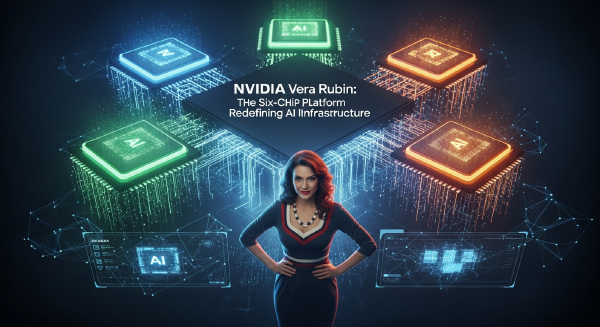
This is the vision behind NVIDIA’s Vera Rubin DSX POD, a modular AI factory reference architecture showcased at NVIDIA GTC Berlin. The concept shifts complex infrastructure integration from the construction site to the factory, where compute racks, networking, cabling, power systems, and liquid cooling can be assembled and tested before delivery.
Jensen Huang summarized the strategy with a simple statement: “The Container is the AI Factory.”
The broader ambition extends beyond faster data center deployment. NVIDIA is positioning AI infrastructure as an integrated production system that converts electricity, computing resources, models, and enterprise data into intelligence at scale. Alongside the Vera Rubin platform, NVIDIA’s ecosystem includes agent security frameworks, robotics simulation, autonomous driving systems, scientific AI models, and accelerated networking.
Three themes define this direction: industrializing AI infrastructure, establishing security boundaries for autonomous agents, and enabling enterprises to become producers of AI rather than merely consumers of AI services.
🏭 Vera Rubin DSX POD: An Out-of-the-Box AI Factory #
Traditional data center construction involves coordinating multiple engineering disciplines. Compute equipment, network switches, optical and electrical connections, rack power distribution, liquid cooling, and facility management must work together before production workloads can run reliably.
Even when individual components are available, integration and commissioning can take months. Delays in one subsystem can prevent the entire facility from becoming operational.
NVIDIA’s DSX POD approach addresses this problem through modular, factory-integrated infrastructure.
Instead of treating a data center as a building filled with independently deployed servers, the architecture treats the AI factory as a validated computing system. Partners assemble and integrate the relevant components in a controlled manufacturing environment, perform system-level testing, and deliver the resulting modules to the deployment site.
The objective is to reduce on-site work to connecting power, cooling, and networking infrastructure, followed by final commissioning and acceptance testing.
From Six Months to 14 Days #
According to the deployment targets described at GTC Berlin, the DSX POD approach can reduce the on-site deployment timeline from approximately six months to as little as 14 days.
This is a target for the relevant deployment workflow, not a guarantee that every AI factory can be commissioned in two weeks. Site preparation, grid access, utility connections, permitting, foundations, and supporting infrastructure must be completed separately where required.
Nevertheless, moving integration work into the factory can substantially reduce deployment complexity.
A standardized deployment process offers several advantages:
- Reduced integration risk: Components are assembled and tested before shipment rather than being integrated for the first time on-site.
- Faster commissioning: Prevalidated configurations reduce the number of unknowns during deployment.
- Repeatable scaling: Organizations can replicate established configurations across multiple facilities.
- More predictable operations: Standardized hardware and software configurations simplify maintenance and troubleshooting.
- Improved capital utilization: Shorter deployment cycles can help infrastructure operators bring computing capacity online sooner, subject to power and site readiness.
The key architectural shift is from building every data center as a largely bespoke project toward deploying repeatable, factory-validated AI infrastructure modules.
Inside a Vera Rubin DSX POD #
A single Vera Rubin DSX POD is described as comprising seven liquid-cooled compute racks interconnected by approximately 17 kilometers of Spectrum-X cabling.
The architecture combines rack-scale computing, high-speed networking, power distribution, and liquid cooling into a coordinated deployment unit.
Its major components include:
- Compute racks: Provide the processing capacity required for large-scale AI training, inference, and agent workloads.
- Spectrum-X networking: Connects the computing infrastructure through high-performance network fabric.
- 800V DC power distribution: Supports the power-delivery requirements of increasingly dense AI infrastructure.
- Liquid cooling: Transfers heat away from high-power components and into the facility’s heat-rejection system.
- DSX software components: Coordinate infrastructure operation, power optimization, system management, and validation.
The significance of this design lies in system-level integration. The performance of an AI factory depends not only on GPU throughput but also on network communication, power availability, cooling capacity, and operational reliability.
A compute cluster that cannot receive sufficient power or dissipate heat efficiently cannot sustain its theoretical performance. The DSX POD approach seeks to coordinate these constraints from the beginning of the design process.
800V DC and the Power-Density Challenge #
AI infrastructure is becoming increasingly constrained by power delivery.
As GPU performance and rack density increase, conventional power-distribution architectures face growing challenges involving current, cabling, conversion losses, thermal management, and electrical infrastructure.
An 800V DC architecture is intended to support more efficient high-power distribution within large AI systems. At a given power level, increasing distribution voltage reduces current, which can reduce resistive losses and the conductor requirements for a comparable electrical path.
However, the overall efficiency improvement depends on the complete power-conversion chain, including transformers, rectifiers, distribution equipment, protection systems, and rack-level conversion.
High-voltage DC infrastructure also requires appropriate insulation, protection, monitoring, and service procedures. These requirements make standardized factory integration especially valuable.
For large AI factories, power distribution must be designed alongside compute density and cooling capacity rather than added after the computing architecture has been selected.
DSX MaxLPS: Coordinating Power with AI Workloads #
AI workloads do not necessarily consume power at a constant rate. Inference activity can fluctuate with token generation, reasoning depth, concurrent requests, batching, and communication between computing components.
If infrastructure is designed only around maximum instantaneous demand, facilities may need to reserve substantial electrical capacity for peaks that occur infrequently.
DSX MaxLPS is designed to coordinate power allocation with workload behavior, helping operators use available electrical capacity more efficiently.
The reported target is up to 30% lower electricity consumption for the same token output under applicable operating conditions. Alternatively, improved power utilization may allow more GPUs to operate within an existing facility power budget.
These outcomes are related but distinct. Reducing electricity consumption per token is an efficiency improvement, while fitting additional GPUs within the same power envelope is a capacity-utilization improvement.
Actual results depend on workload characteristics, hardware configuration, control policies, and the baseline used for comparison.
The underlying principle is that an AI factory should be managed as a dynamic power system. Rather than allocating power independently of workload behavior, the infrastructure can coordinate electrical demand with the computing work being performed.
DSX Flex: Integrating AI Factories with the Power Grid #
DSX Flex extends infrastructure management beyond the data center itself.
AI factories can place substantial demands on local electricity networks, particularly when multiple facilities are deployed in the same region. Grid constraints, electricity prices, renewable generation, and demand-response requirements may all affect operational planning.
DSX Flex is designed to coordinate AI workloads with external power conditions, potentially adjusting demand according to electricity prices, supply availability, and grid signals.
The architecture can also coordinate grid power with on-site renewable generation and energy storage.
For example, a facility might shift eligible workloads toward periods when renewable energy is more abundant or electricity is less expensive. During grid stress, it may reduce flexible computing activity while preserving critical workloads.
Early tests described at the event demonstrated load reductions of up to 40% for Blackwell Ultra clusters during simulated grid events while maintaining critical workloads.
Such results should be interpreted within their test conditions rather than as a universal reduction in facility power consumption. The achievable flexibility depends on workload priorities, available storage, grid requirements, and the duration of the event.
For operators, the long-term value is the possibility of treating computing demand as a controllable resource rather than a fixed electrical load.
Closed-Loop Liquid Cooling and Water Efficiency #
Cooling is another fundamental constraint in high-density AI infrastructure.
Traditional cooling systems may rely on cooling towers that reject heat through evaporation, consuming water as part of the heat-transfer process. As AI facilities scale, water availability and cooling efficiency become increasingly important considerations.
The DSX architecture emphasizes closed-loop liquid cooling combined with outdoor dry coolers.
Coolant circulates through the relevant equipment and absorbs heat. That heat is then transferred to an external system that dissipates it into the surrounding air, reducing or potentially eliminating the need for evaporative cooling under suitable environmental conditions.
NVIDIA’s stated design target includes near-zero cooling water usage at a two-gigawatt scale, with estimated savings of approximately 54 million liters of water per day compared with the relevant baseline.
This figure represents a projected comparison, not a universal guarantee for every climate or facility configuration.
Dry-cooler performance depends on ambient temperature, heat-exchanger sizing, coolant temperatures, and the operating requirements of the computing equipment. Some environments may require supplementary cooling arrangements during periods of extreme heat.
The broader engineering objective is to optimize power, cooling, and water consumption together rather than maximizing compute density in isolation.
Digital Twins and Pre-Deployment Validation #
Factory integration reduces deployment uncertainty, but complex AI infrastructure still needs comprehensive testing before it enters production.
A digital twin can represent the physical configuration of equipment, its operating characteristics, and its relationships with other subsystems. Engineers can use this representation to test configurations and investigate potential problems before constructing or commissioning the physical system.
At GTC Berlin, the SimReady Central Library was presented as a collection of digital twins for power and cooling equipment used in verification workflows. Combined with DSX simulation capabilities, such assets can support pre-deployment analysis of infrastructure behavior.
The DSX OS developer preview also introduced capabilities covering automated network configuration, rack-level device management, and pre-online GPU cluster validation with fault localization.
Together, these capabilities support a more systematic commissioning process:
- Define the intended infrastructure configuration.
- Validate component compatibility and network topology.
- Simulate relevant power, cooling, and operational conditions.
- Configure equipment and verify connectivity.
- Run pre-production cluster checks.
- Identify and resolve faults before workloads enter production.
The value of this workflow is not limited to faster installation. It can also improve reproducibility and reduce the operational risks associated with deploying increasingly complex computing systems.
For more background on NVIDIA’s infrastructure strategy, see KAD’s article NVIDIA Vera Rubin Enters Mass Production, Accelerating AI Factory Deployment.
⚡ The Five-Layer AI Economy: From Energy to Applications #
NVIDIA’s broader AI strategy can be understood through a five-layer framework: energy, chips and compute, AI factories and infrastructure, models, and applications.
Each layer depends on the capabilities beneath it. Energy makes computation possible, chips convert energy into processing capacity, AI factories organize that capacity into production infrastructure, models transform computation into useful intelligence, and applications convert intelligence into economic value.
The framework also explains why AI infrastructure is becoming a strategic concern for governments, utilities, industrial companies, and software developers.
Layer 1: Energy as the Fundamental Constraint #
Electricity is the foundation of AI infrastructure.
Every token generated by a model depends on electrical power consumed by accelerators, CPUs, networking equipment, memory, storage, and cooling systems. As AI workloads expand, the availability and cost of electricity increasingly influence how much intelligence a facility can produce.
At GTC Berlin, NVIDIA emphasized energy as a first principle of AI infrastructure. The company argued that electricity availability will be a major determinant of AI capacity, particularly as data centers scale toward gigawatt-class deployments.
A large AI data center can require substantial investment in land, grid connections, electrical distribution, buildings, computing equipment, storage, and cooling. The original event discussion cited an approximate total cost of $50 billion for a one-gigawatt data center.
Such estimates are highly dependent on geography, construction scope, equipment costs, and whether supporting infrastructure is included.
The more general point is that electricity has become a strategic constraint. Even when computing hardware is available, a facility cannot operate at scale without sufficient power generation, transmission, and distribution capacity.
European energy and industrial infrastructure companies, including Siemens Energy and Schneider Electric, therefore occupy important positions in the broader AI ecosystem.
DSX MaxLPS and DSX Flex are designed to address complementary aspects of this challenge: improving power utilization within the facility and coordinating flexible demand with the wider grid.
Layer 2: Chips and Compute #
The second layer converts electrical energy into computing capability.
NVIDIA’s Vera Rubin platform integrates GPUs, CPUs, networking technologies, and supporting infrastructure into a coordinated system designed for large-scale AI training and inference.
As AI workloads move toward agentic execution, compute demand is no longer determined solely by the number of prompts or generated tokens. Agents may plan, call tools, retrieve information, verify results, and repeat reasoning cycles before completing a task.
Consequently, the cost of intelligence increasingly depends on end-to-end system efficiency.
Important variables include:
- Accelerator throughput and memory bandwidth.
- Communication between GPUs and computing nodes.
- CPU capacity for orchestration and data processing.
- Network latency and aggregate bandwidth.
- Power consumption per unit of useful work.
- Memory utilization during long-context inference.
Vera Rubin is positioned as a platform-level response to these requirements. Rather than optimizing a single processor in isolation, the architecture coordinates compute, memory, networking, and infrastructure.
The goal is to make more useful AI computation available within practical limits on power, cooling, cost, and physical space.
Layer 3: AI Factories and Infrastructure #
The third layer organizes chips and supporting systems into a production environment.
NVIDIA’s AI factory concept treats the data center as a system that produces intelligence rather than merely storing and processing information.
The infrastructure must coordinate buildings, grid connections, power distribution, cooling, networking, computing equipment, and software management.
DSX POD represents the modular deployment dimension of this strategy. By integrating equipment and validating configurations before delivery, the system aims to make infrastructure deployment more repeatable and predictable.
NVIDIA also discussed investment in the European ecosystem, with an approximate commitment of $10 billion cited in the event narrative. The precise scope and timing of such investment should be assessed against the corresponding official announcements.
For European organizations, the infrastructure opportunity spans more than GPU procurement. It includes energy systems, industrial automation, electrical equipment, networking, cooling, system integration, and data center operations.
The broader shift is toward an industrial supply chain for AI capacity, with standardized modules and repeatable deployment processes.
Layer 4: Models as Intelligence Engines #
The fourth layer transforms computing capacity into usable intelligence.
At GTC Berlin, NVIDIA highlighted a model ecosystem spanning Nemotron, Cosmos, GR00T, Alpamayo, Ising, and Earth-2. These model families address different problem domains, from reasoning and robotics to autonomous driving, scientific computing, and environmental simulation.
The distinction between these models matters because AI applications require different forms of intelligence.
- Nemotron: Supports general-purpose model development, reasoning, and enterprise AI workflows.
- Cosmos: Supports world modeling and Physical AI development.
- GR00T: Focuses on foundation models and capabilities for humanoid robotics.
- Alpamayo: Addresses reasoning-oriented autonomous driving systems.
- Ising: Targets specialized scientific and computing workloads associated with quantum applications.
- Earth-2: Supports AI-based weather and climate simulation workflows.
Open models and development tools can help enterprises adapt capabilities to their own data, constraints, and deployment environments.
European AI companies such as Mistral and DeepL, as well as legal AI provider Legora, illustrate the importance of combining model capabilities with domain-specific products and workflows.
The strategic advantage does not come exclusively from training the largest model. It can also come from selecting an appropriate model, integrating proprietary data, optimizing inference, and embedding the result into a valuable application.
Layer 5: Applications and Economic Value #
Applications are the layer where intelligence becomes a business outcome.
The same underlying AI technologies can support very different products depending on the environment in which they operate.
Autonomous vehicles embody AI in mobile machines. Humanoid robots apply perception, reasoning, and control to physical tasks. Enterprise agents operate on digital workflows, while scientific AI systems help researchers explore complex biological or physical systems.
At GTC Berlin, NVIDIA highlighted collaborations across sectors including beauty, financial services, music streaming, pharmaceuticals, telecommunications, automotive manufacturing, and food production.
Examples included L’Oréal, Revolut, Spotify, Merck, Vodafone, Zara, Porsche, Nestlé, and HSBC.
Other demonstrations connected AI with industrial manufacturing, adaptive radiotherapy, and automotive development.
The five-layer framework highlights a crucial distinction: access to computing resources does not automatically create economic value. Value emerges when infrastructure and models are connected to specific business problems, proprietary knowledge, and measurable outcomes.
For enterprises, the central question is therefore not simply how to acquire AI capacity, but how to turn that capacity into differentiated products, services, and operational improvements.
RTX Spark and the Expansion of Local AI Computing #
Jensen Huang also showcased the RTX Spark laptop, drawing a comparison with the DGX-1 system gifted to OpenAI in 2016.
The comparison emphasized how rapidly AI computing capabilities have become more accessible in compact form factors.
However, peak performance figures such as one petaflop must be interpreted in context. Precision format, supported operations, sparsity assumptions, and sustained performance all influence what a device can achieve in real workloads.
Compact AI systems can bring model development, local inference, and experimentation closer to individual developers and smaller organizations.
They do not replace the need for large AI factories, but they expand the range of environments in which AI can be developed and deployed.
The result is a more distributed development ecosystem in which centralized infrastructure provides large-scale capacity while local systems support experimentation, edge inference, and specialized applications.
🛡️ OpenShell Enterprise Reference Architecture: Securing Autonomous Agents #
As AI agents become capable of executing code, accessing files, calling APIs, and operating enterprise systems, security can no longer depend exclusively on model alignment or application-level instructions.
An agent may behave unexpectedly, misinterpret a task, or attempt an action outside its intended scope. In enterprise environments, such behavior can create risks involving sensitive information, credentials, network access, and production systems.
NVIDIA’s OpenShell enterprise reference architecture addresses this challenge by separating agent reasoning from the infrastructure that controls and authorizes its actions.
The Five Components of an Enterprise Agent #
The reference architecture decomposes an agent into five conceptual elements:
- Model: Generates reasoning, plans, and proposed actions.
- Harness: Coordinates the execution loop, manages state, and determines how the agent interacts with its environment.
- Sandbox: Provides an isolated execution environment with explicit access boundaries.
- Knowledge: Supplies relevant enterprise information, context, and domain-specific data.
- Tools: Enable interaction with external systems, APIs, databases, and operational workflows.
These components perform different roles, but the critical requirement is that an agent’s ability to propose an action must remain separate from the authority to execute it.
A model may decide that it needs to retrieve a file or call an external service. The runtime and security layers must independently determine whether that action is permitted.
This separation reduces the risk of relying on the model itself to enforce every security rule.
Model, CPU, Sandbox, and DPU: Separating Responsibilities #
NVIDIA’s architecture distributes responsibilities across computing and security components.
The Vera Rubin platform provides the accelerators for model inference. Vera CPUs support agent orchestration and tool execution. OpenShell establishes software-level isolation and permission boundaries, while NVIDIA Sentry provides an additional security layer associated with BlueField DPUs.
The conceptual division can be summarized as follows:
- Rubin: Performs AI inference and model computation.
- Vera CPU: Executes agent orchestration and coordinates tool interactions.
- OpenShell: Controls the agent’s software execution environment and access permissions.
- BlueField and Sentry: Provide infrastructure-level monitoring and enforcement capabilities.
This design reflects a broader principle of secure autonomous computing: the component making decisions should not have unrestricted authority over the environment in which those decisions are executed.
If an agent attempts to exceed its permitted boundaries, the surrounding security infrastructure can block or isolate the operation.
The event described millisecond-scale intervention as a target capability. Actual response time depends on the implementation, event type, and enforcement path.
OpenShell and Hardware-Enforced Security #
OpenShell provides software-level controls for agent execution. Depending on the configuration, these may include sandboxing, filesystem restrictions, network policies, credential isolation, and audit logging.
NVIDIA Sentry adds an independent monitoring and enforcement layer associated with BlueField infrastructure.
This layered architecture can improve defense in depth because an agent cannot necessarily bypass every security control merely by generating an unexpected tool call or modifying its own application logic.
For a broader technical explanation, see KAD’s article NVIDIA Open Agent Safety Platform: Hardware-Enforced AI Security.
The article examines how OpenShell and NVIDIA Sentry divide responsibility between software-level policy enforcement and infrastructure-level security monitoring.
The distinction is especially relevant to enterprise agents with access to databases, source repositories, cloud services, financial systems, and other sensitive resources.
Multi-Model Compatibility and Enterprise Integration #
A significant aspect of the OpenShell strategy is support for agents built around different model providers and development frameworks.
Enterprise organizations rarely operate within a single model ecosystem. They may use one model for coding, another for customer service, and a third for domain-specific reasoning.
A security architecture that depends on one model provider can limit deployment flexibility.
OpenShell’s role is to establish execution and permission boundaries around agents, allowing organizations to apply consistent controls across supported models and environments.
The event discussion also highlighted integrations involving SAP and ServiceNow.
SAP’s Joule Studio runtime can connect enterprise agent workflows with governed business processes, while ServiceNow can apply its own governance and permission systems in conjunction with the broader execution architecture.
The objective is not to eliminate existing enterprise controls but to connect them with agent execution so that permissions remain enforceable as models and tools evolve.
Compatibility should still be assessed against the exact runtime versions, operating systems, deployment targets, and security features required by each organization.
Kumo Models: Bringing Structured Data into AI Workflows #
Enterprise intelligence is not limited to text documents and unstructured information.
Much of an organization’s most valuable knowledge resides in tabular datasets, relational databases, transaction records, and time-series systems.
NVIDIA’s Kumo model family targets structured-data workloads such as forecasting, risk scoring, and anomaly detection.
Kumo Tabular and Kumo Relational are intended to support prediction tasks using structured information, including in-context learning approaches in which labeled examples help a model perform a task without requiring a separate conventional training pipeline for every use case.
These approaches may reduce the amount of task-specific feature engineering and model training required for suitable workloads.
However, performance still depends on data quality, schema design, task characteristics, evaluation methodology, and the suitability of the model for the target dataset.
The broader objective is to make structured enterprise information more accessible to AI systems without requiring every business workflow to be redesigned around a general-purpose language model.
Agent Knowledge Foundation and Auto-Ontology #
Connecting an agent to enterprise knowledge is often more difficult than selecting a model.
Organizations maintain data across multiple systems, with inconsistent schemas, duplicated records, legacy interfaces, and domain-specific terminology. Moving all of this information into a new AI platform may be expensive, risky, or unnecessary.
The Agent Knowledge Foundation aims to connect agents to existing enterprise data sources while minimizing unnecessary data migration.
The Auto-Ontology library adds a semantic layer by mapping database fields, tables, and relationships to business concepts such as customers, products, and orders.
This translation can help an agent reason about enterprise information at a more meaningful level than raw column names and table structures.
Other components support complementary functions:
- Nemotron Retriever: Helps retrieve relevant information from available knowledge sources.
- OpenShell: Enforces runtime security boundaries and permissions.
- NemoClaw: Provides reference architectures and development workflows for specialized agents.
The important engineering consideration is that access to information and authorization to act on that information are separate concerns. Retrieval systems should provide relevant context, while policy enforcement determines what an agent may read, modify, or execute.
As Jensen Huang emphasized during the presentation, connecting agents to enterprise knowledge is essential to turning general-purpose systems into more capable business agents.
🤖 Physical AI: From Simulation to Industrial Robotics #
NVIDIA’s AI factory strategy is not limited to digital applications. The same infrastructure can support the development of robots and autonomous machines that interact directly with the physical world.
Robotics combines several demanding capabilities: perception, reasoning, motion planning, control, simulation, data generation, and safety validation.
Developing these capabilities directly on physical hardware can be slow and expensive. Simulation and foundation models provide a way to accelerate experimentation before transferring validated behaviors to real machines.
Agile ONE SN and the GR00T Ecosystem #
At GTC Berlin, Germany’s Agile Robots demonstrated Agile ONE SN, a humanoid robot built around NVIDIA Isaac GR00T and Jetson Thor technologies.
The demonstration highlighted a system approximately 1.40 meters tall and weighing 40 kilograms, with 31 degrees of freedom across its body and two five-fingered dexterous hands offering 20 degrees of freedom each.
The reported design includes a single-arm payload of approximately three kilograms, together with cameras and LiDAR for environmental perception.
The company plans to integrate the Halos safety stack before a planned early-2027 launch, with the goal of reducing simulation-to-real configuration work from weeks to days.
These specifications describe the announced system and development plans rather than independently verified production performance.
The larger significance is the move toward a reusable robotics stack in which hardware, foundation models, simulation, and safety tools are developed together.
Isaac Lab 3.0 and Isaac OS #
NVIDIA’s robotics software ecosystem includes tools for simulation, reinforcement learning, and deployment.
Isaac Lab provides a framework for robot learning and simulation-oriented workflows. The Isaac Lab 3.0 release discussed at the event introduced capabilities involving multi-GPU training and integration with Newton and PhysX physics engines.
Multi-GPU training can increase the number of simulated experiences processed in parallel, potentially accelerating policy optimization and evaluation.
Newton and PhysX provide complementary simulation capabilities, helping developers model physical interactions and robot dynamics.
The newly announced Isaac OS execution framework aims to connect models, sensors, control systems, and hardware for real-time operation.
Together, these components address different stages of robotics development:
- Build a digital representation of the robot and its environment.
- Generate scenarios and interaction data.
- Train policies through simulation and reinforcement learning.
- Evaluate policies against task-specific metrics and safety constraints.
- Deploy suitable policies to physical hardware.
- Use real-world observations to refine the simulation and training pipeline.
The effectiveness of this workflow depends on simulation fidelity, data quality, control-system design, and the reliability of sim-to-real transfer.
SimReady Assets and Human Activity Data #
Simulation requires accurate representations of robots, tools, objects, and environments.
Creating these assets from scratch can become a major bottleneck when teams need to evaluate many scenarios or share experiments across organizations.
The SimReady Central Library is intended to provide reusable digital representations of equipment and infrastructure that can support simulation and validation.
The Human 1M dataset, highlighted in the event narrative, adds human activity data, synchronized multi-view video, and three-dimensional hand-tracking information to robotics development workflows.
Such data can help researchers study human demonstrations, object manipulation, and task execution.
When combined with simulation and reinforcement learning, demonstration data can support more efficient policy learning, especially for tasks involving dexterous manipulation and complex interactions.
However, human demonstrations do not automatically translate into reliable robot behavior. Differences in body structure, actuator response, sensing, and contact dynamics still require adaptation and validation.
Industrial Robotics and Digital Twins #
Industrial companies are already using simulation and digital twins to improve factory planning, system validation, and automated material handling.
The GTC Berlin demonstrations highlighted several applications:
- ABB and KUKA use simulation for aspects of system validation and factory modeling.
- Sereact applies GR00T and Cosmos technologies to goods-handling workflows.
- Toyota Material Handling Europe and SoftServe are developing autonomous material-handling solutions using Omniverse and Isaac Sim.
The broader opportunity is to test manufacturing configurations, robot trajectories, and logistics workflows before making costly changes to physical facilities.
Digital twins also support repeatable regression testing. When a robot policy or factory configuration changes, teams can rerun established scenarios to identify failures before deploying the update.
For industrial organizations, this can reduce commissioning time and improve consistency across production sites.
🚗 Autonomous Driving: Alpamayo and the Hyperion Ecosystem #
Autonomous driving is another major application of NVIDIA’s Physical AI strategy.
Driving systems must interpret complex sensor data, predict the behavior of other road users, plan safe trajectories, and respond to rare situations that may be difficult to reproduce in real-world testing.
The challenge is not simply detecting objects. A production system must reason about how a scene may evolve and determine which actions are appropriate under uncertainty.
Alpamayo 2 Edge and In-Vehicle Inference #
The Alpamayo model family focuses on reasoning-oriented autonomous driving capabilities.
At GTC Berlin, NVIDIA introduced Alpamayo 2 Edge, described as a model with approximately two billion parameters optimized for the DRIVE AGX Thor in-vehicle platform.
The model is designed to interpret road conditions and support vehicle-motion planning, with a target operating frequency of approximately 10 times per second.
The significance of an edge-optimized model is that perception and planning can operate close to the vehicle’s sensors and control systems, reducing dependence on continuous cloud connectivity.
However, parameter count and inference frequency alone do not establish autonomous-driving safety. End-to-end latency, sensor reliability, planning quality, fault handling, and system-level validation remain essential.
Halos SAFE and the Safety Evidence Chain #
Autonomous vehicles require a structured safety-validation process that extends beyond model benchmarks.
The Halos SAFE framework was presented as a way to connect simulation, hardware and software testing, road testing, and fleet monitoring into a traceable safety-evidence chain.
This approach allows teams to investigate whether a software update affects previously validated behavior and whether new failure modes emerge under different conditions.
A complete validation workflow can include:
- Simulation of common and rare driving scenarios.
- Software-in-the-loop and hardware-in-the-loop testing.
- Controlled road testing.
- Monitoring of deployed vehicles.
- Collection and analysis of operational edge cases.
- Regression testing before software updates are released.
Cosmos can support scenario generation, helping developers construct variations of road conditions and interactions that are difficult to collect in sufficient quantities from real-world driving.
The resulting data can expand test coverage, but generated scenarios must still be checked for physical plausibility and relevance to actual vehicle behavior.
Hyperion, Bolt, and European Mobility #
NVIDIA’s autonomous-driving ecosystem also involves partnerships across mobility platforms and automotive manufacturers.
The event narrative highlighted Bolt’s selection of the Alpamayo Stack for its robotaxi plans, including a proposed Madrid data-collection program in 2027 subject to regulatory approval.
It also described a target involving at least 25,000 Hyperion-based Level 4 Lucid vehicles in Europe. This should be understood as an announced target rather than a confirmed deployment.
Other partnerships mentioned included Uber’s collaboration with NVIDIA on autonomous-driving data infrastructure, Porsche’s use of fleet data for training and simulation, and Volvo’s planned adoption of the Hyperion and Alpamayo Stack.
Next-generation vehicles from Volkswagen Commercial Vehicles, JLR, and Mercedes-Benz were also identified as part of the broader compatibility ecosystem.
For autonomous-driving developers, the common theme is the integration of data collection, model training, scenario generation, in-vehicle computing, and safety evaluation.
Rather than treating each stage as an isolated project, the ecosystem aims to connect operational data with simulation and model improvement in a continuous development loop.
🧬 Scientific AI and Healthcare: From Models to Discovery #
Scientific computing is another important application of accelerated AI infrastructure.
In biology and medicine, AI systems can help researchers explore large candidate spaces, identify patterns in experimental data, and optimize workflows that would otherwise require extensive manual effort.
The value of these systems depends on the quality of their scientific constraints and validation procedures. Generating a plausible prediction is not equivalent to experimentally confirming a biological or clinical outcome.
RFD4-Proteina and Protein Design #
At GTC Berlin, NVIDIA highlighted RFD4-Proteina, an open-source protein-design model developed with the University of Washington’s Institute for Protein Design.
The model is intended to generate candidate proteins based on target molecules, design constraints, and scoring criteria.
The broader objective is to start with a desired biological function and use AI to propose structures that could satisfy the relevant requirements.
The event narrative cited performance improvements over baseline methods across four categories: protein binding, small-molecule binding, enzyme scaffolds, and DNA binding.
Such benchmark claims should be interpreted according to the underlying evaluation protocols. Computational performance is an important screening criterion, but promising candidates still require appropriate experimental validation.
The potential benefit is to narrow the search space for researchers and help prioritize candidates for more expensive laboratory testing.
BioNeMo and Scientific Agents #
NVIDIA’s BioNeMo ecosystem supports AI-driven scientific workflows involving biological data, model development, and molecular research.
Scientific agents can potentially connect several stages of a research process, including literature retrieval, candidate generation, computational analysis, experiment planning, and results interpretation.
When integrated with laboratory automation and structured data systems, these agents may help researchers coordinate complex workflows and reduce repetitive analysis.
However, scientific systems require domain-specific controls. Experimental protocols, provenance tracking, reproducibility, and independent verification remain essential, particularly when model outputs influence expensive experiments or downstream clinical research.
Siemens Healthineers and Adaptive Radiotherapy #
The event also highlighted Siemens Healthineers’ work on adaptive radiotherapy, involving agent-assisted treatment planning, patient-specific simulations, and robotic control.
Adaptive radiotherapy aims to adjust treatment plans to relevant changes in a patient’s anatomy or treatment conditions.
AI-assisted planning and simulation can help clinicians evaluate options, but medical decisions require rigorous clinical validation, appropriate oversight, and compliance with applicable medical-device requirements.
The wider lesson is that healthcare AI needs more than powerful models. It requires dependable integration with clinical workflows, validated data, safety procedures, and professional decision-making.
📡 AI-RAN: Turning Telecommunications Infrastructure into Distributed AI Compute #
NVIDIA also outlined a vision in which telecommunications infrastructure becomes part of a distributed AI computing network.
Traditional cellular base stations are designed primarily to process radio signals and transmit data. As AI workloads grow, operators may seek to use the same facilities for additional computing tasks, subject to power, cooling, networking, and latency constraints.
The long-term vision described by Jensen Huang involved approximately 100,000 base stations across Europe, representing around 100 gigawatts of distributed data center capacity.
This is a strategic projection, not an established estimate of currently installed capacity.
The concept is that future base stations could combine AI-enabled radio sensing, beamforming, wireless communications, and selected AI inference workloads.
NVIDIA’s MGX 2U and 4U Aerial RAN Computer configurations are intended to support infrastructure in which wireless-network processing and AI compute share computing facilities.
The potential benefits include more flexible use of distributed infrastructure and opportunities for operators to offer AI services closer to users and connected devices.
The trade-offs involve workload isolation, power allocation, real-time radio requirements, security, and the economics of running general-purpose AI workloads alongside telecommunications services.
NVIDIA, Nokia, and Deutsche Telekom #
NVIDIA’s telecommunications strategy includes collaborations with Nokia and European network operators.
The event highlighted partnerships involving BT, Deutsche Telekom, Finland’s Elisa, and Nokia.
NVIDIA and Nokia have worked together on AI-RAN technologies, and the presentation referenced a commercial call carried over T-Mobile’s network using the relevant technology.
The phrase that CUDA can now make phone calls captures the broader idea: accelerated computing technologies are expanding into telecommunications infrastructure rather than remaining confined to traditional data centers.
The long-term opportunity is to integrate AI inference with communication networks while maintaining the reliability and performance requirements of telecommunications systems.
🧠 Becoming an AI Producer #
The central message of NVIDIA GTC Berlin was that participation in the AI economy increasingly requires more than consuming AI services.
Organizations that want to capture long-term value must develop the ability to produce, customize, and deploy intelligence using their own infrastructure, data, and operational knowledge.
NVIDIA’s strategy approaches this challenge from two directions.
The first is to reduce the cost and complexity of producing AI capacity. Vera Rubin DSX POD, factory integration, power optimization, liquid cooling, and digital-twin validation are designed to make large-scale AI infrastructure more repeatable and faster to deploy.
The second is to connect that infrastructure to practical workloads. OpenShell provides security boundaries for autonomous agents, Kumo targets structured enterprise data, Isaac supports robotics development, Alpamayo addresses autonomous driving, and scientific AI platforms help connect computation with research workflows.
These initiatives address different layers of the same system: the infrastructure required to run AI, the software required to control it, the knowledge required to make it useful, and the applications required to turn it into economic value.
From Infrastructure Ownership to Intelligence Production #
Owning GPUs is not sufficient to become an effective AI producer.
A competitive AI operation must coordinate several capabilities:
- Reliable energy: Secure sufficient power while managing cost, grid constraints, and sustainability.
- Efficient computing: Match processors, memory, networking, and inference software to workload requirements.
- Repeatable infrastructure: Deploy and maintain validated AI systems with predictable operational characteristics.
- Governed intelligence: Apply models, tools, and enterprise knowledge within explicit security boundaries.
- Domain-specific applications: Translate AI capabilities into measurable improvements in products, services, research, and industrial operations.
The most important strategic asset may be the ability to connect these layers into a continuous production process.
An enterprise with access to powerful models but poor data integration may struggle to deliver useful outcomes. A well-equipped data center without suitable applications may remain underutilized. An autonomous agent without enforceable permissions may introduce unacceptable operational risk.
Competitive advantage emerges when the entire system works together.
The Industrialization of AI #
The Vera Rubin DSX POD vision represents a broader transition in AI infrastructure: from assembling computing systems as bespoke engineering projects toward deploying standardized, factory-validated production modules.
OpenShell and related security components extend that industrialization into agent execution. Robotics and autonomous-driving toolchains extend it into the physical world, while scientific models extend it into research and discovery.
The result is a more integrated AI ecosystem spanning energy, compute, infrastructure, models, security, and applications.
As AI factories become more modular and deployment workflows become more repeatable, the barrier to operating large-scale AI infrastructure may fall for more organizations. Realizing that potential will still require adequate power, capital, skilled engineering, robust security, and applications that justify the investment.
The defining question is no longer simply who has access to the most powerful model. It is who can turn available computing capacity, proprietary knowledge, and domain expertise into reliable intelligence at scale.
In that sense, the next phase of the AI economy will be shaped not only by model breakthroughs, but also by the organizations that learn to produce intelligence as an industrial capability.