Intel Razor Lake-AX Targets 700 TOPS for Robotics in 2028
Intel has outlined a new milestone in its physical AI roadmap, revealing plans to launch the Razor Lake-AX system-on-chip (SoC) in 2028 with a target AI computing performance of approximately 700 TOPS.
The roadmap was disclosed by Intel executive Cho Min-sung at the “Semiconductors Powering Humanoids” seminar held in Seoul’s Samseong-dong district on October 16, 2026, according to South Korean industry publication The Elec.
Intel also plans to introduce its next-generation Nova Lake platform in early 2027. While Nova Lake belongs to the company’s broader processor roadmap, Razor Lake-AX is positioned more specifically for high-performance robotics and physical AI applications.
For comparison, Intel’s Panther Lake platform, marketed as Core Ultra Series 3, advertises up to 180 platform TOPS. Based on these headline figures, Razor Lake-AX’s target is approximately 3.89 times Panther Lake’s maximum advertised AI throughput.
However, Intel has not yet disclosed Razor Lake-AX’s detailed architecture, power consumption, memory configuration, or the precision used to calculate its 700 TOPS target. The figure should therefore be treated as a roadmap goal rather than a measured performance result.
🤖 1. Intel’s Physical AI Roadmap: Nova Lake and Razor Lake-AX #
Intel’s disclosed roadmap identifies two major upcoming milestones:
| Product | Expected launch | Reported positioning |
|---|---|---|
| Nova Lake | Early 2027 | Next-generation processor platform |
| Razor Lake-AX | 2028 | High-performance SoC for robotics and physical AI |
The distinction between the two products is important. Nova Lake belongs to Intel’s broader client processor roadmap, whereas Razor Lake-AX is being presented as a platform for systems requiring substantial heterogeneous computing capabilities.
Physical AI refers to AI systems that interact with the real world through robots, autonomous machines, and industrial equipment. Unlike software that processes only digital information, these systems must combine perception, decision-making, and physical actions under real-world timing constraints.
Potential workloads include environmental perception, object recognition, local AI inference, motion planning, and robot control. Depending on the application, these tasks can place simultaneous demands on CPU processing, GPU parallelism, and dedicated neural-network acceleration.
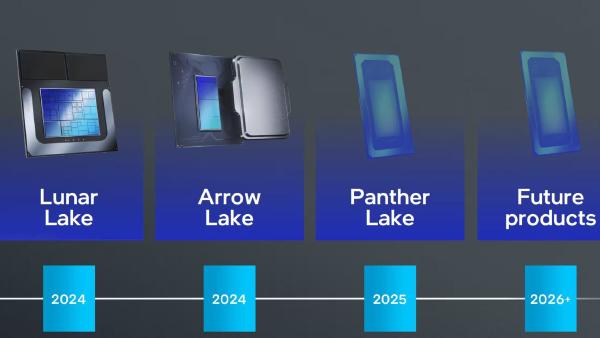
Intel has already established a foundation for this direction with Panther Lake. The company introduced Core Ultra Series 3 for embedded and industrial applications, including robotics, automation, healthcare, and smart infrastructure.
Source: Intel’s Core Ultra Series 3 launch announcement.
Razor Lake-AX would extend this strategy toward a substantially higher nominal AI-compute target and a more specialized physical AI market.
⚡ 2. What Does 700 TOPS Actually Mean? #
TOPS stands for trillions of operations per second. It is commonly used to describe the theoretical throughput of AI acceleration hardware, particularly when performing operations at reduced numerical precision.
Intel’s reported target of 700 TOPS represents a substantial increase over Panther Lake’s maximum advertised platform figure.
Comparing the headline numbers #
| Platform | Advertised or targeted AI performance |
|---|---|
| Intel Panther Lake | Up to 180 platform TOPS |
| Intel Razor Lake-AX | Approximately 700 TOPS target |
| NVIDIA Jetson AGX Orin | Up to 275 TOPS |
The nominal comparison with Panther Lake is straightforward:
\[ \frac{700}{180}\approx 3.89 \]Razor Lake-AX’s target is therefore approximately 3.9 times Panther Lake’s stated maximum platform TOPS, assuming the two figures use comparable measurement conventions.
The ratio against NVIDIA’s Jetson AGX Orin is approximately 2.55 to one. However, that comparison reflects the reported headline figures, not a verified 2.55-fold advantage in real-world application performance.
Why TOPS is not a complete performance benchmark #
Peak TOPS figures can differ in their numerical precision, supported operations, and treatment of sparsity. They also do not reveal how much of the theoretical throughput a particular application can actually use.
For example, two processors can advertise similar TOPS values but perform differently on the same neural network because of differences in accelerator architecture, memory bandwidth, software optimization, and data movement.
Panther Lake’s advertised figure is explicitly a platform-level metric. Intel describes the architecture as combining CPU, GPU, and NPU capabilities, with the highest AI-capable configurations reaching up to 180 platform TOPS.
Source: Intel’s Panther Lake architecture overview.
Intel has not yet explained how Razor Lake-AX’s 700 TOPS target will be calculated or distributed among its processing units.
Consequently, the figure is useful as an indication of Intel’s performance ambitions, but it cannot yet establish the chip’s inference speed, energy efficiency, or performance on specific robotic workloads.
🧠 3. Why a Dedicated Physical AI SoC Matters #
Razor Lake-AX’s significance lies not only in its proposed computing throughput, but also in its intended role.
A conventional PC processor must balance a broad range of workloads, including interactive applications, general-purpose computing, graphics, and power management. A physical AI platform must additionally process sensor data, execute AI models, and support control systems that interact with the physical environment.
A specialized SoC could optimize the balance between these workloads by coordinating different processing units, memory resources, and I/O interfaces within one platform.
Environmental perception #
Robots need to interpret input from cameras, depth sensors, and other devices. These tasks can include image processing, object detection, scene understanding, and sensor fusion.
Higher AI throughput could allow more sophisticated perception models or multiple models to run concurrently, provided that memory bandwidth and software efficiency are sufficient.
Local AI inference #
Running AI models directly on a robot or nearby embedded computer can reduce dependence on network connectivity and cloud inference. Local processing is particularly valuable when a system must respond quickly or operate in an environment with unreliable connectivity.
The benefit depends on more than compute capacity. Model size, memory availability, inference latency, and power consumption all affect whether a model can run efficiently on the target device.
Control and decision-making #
Robotic systems must translate perception results into actions. This requires coordination among AI inference, application logic, motion planning, and lower-level control functions.
Not every control operation needs a large AI accelerator. The architecture must instead balance high-throughput AI processing with predictable execution, peripheral access, and the timing requirements of the robot.
The exact balance Razor Lake-AX will offer remains unknown because Intel has not published its detailed hardware configuration.
For broader context, see KAD8’s analysis of physical AI and robotics.
🔬 4. Hardware Architecture: Important Details Remain Unknown #
Despite the roadmap disclosure, major questions about Razor Lake-AX remain unanswered.
Intel has not confirmed the chip’s CPU core count, integrated GPU configuration, NPU architecture, memory subsystem, power envelope, or final package design in the reported announcement.
Earlier industry reports speculated that the processor might use a large integrated GPU with 16 or 32 cores, packaged memory, and a design comparable in some respects to AMD’s Ryzen Halo platforms.
Those details remain unconfirmed. They should not be treated as specifications of the planned product.
Specifications awaiting confirmation #
| Specification | Current status |
|---|---|
| Target AI compute | Approximately 700 TOPS, as reported |
| Planned launch | 2028 |
| CPU configuration | Not disclosed |
| GPU architecture and core count | Not disclosed |
| NPU configuration | Not disclosed |
| Memory type and capacity | Not disclosed |
| Package design | Not disclosed |
| Power consumption | Not disclosed |
| Performance per watt | Not disclosed |
| Final product form factor | Not disclosed |
These details are central to evaluating a physical AI processor.
For example, a robot may operate within a strict size and power budget, making performance per watt as important as peak throughput. Memory capacity can constrain the size of locally deployed AI models, while memory bandwidth affects how efficiently the accelerator units can be supplied with data.
Cooling and operating conditions matter as well. Industrial robots, mobile platforms, and humanoids can face different thermal, mechanical, and reliability constraints from desktop computers.
Until Intel provides a fuller specification, Razor Lake-AX’s suitability for individual robotics applications cannot be assessed from its TOPS target alone.
🏭 5. Panther Lake Provides a Starting Point for Edge AI #
Intel’s existing Panther Lake platform already targets applications beyond conventional PCs.
Core Ultra Series 3 combines CPU cores, integrated Intel Arc graphics, and an NPU. Intel advertises up to 180 platform TOPS in its highest AI-capable configurations and has explicitly discussed embedded and industrial deployments.
This heterogeneous architecture allows different workloads to run on the processing unit best suited to them. CPU cores handle general-purpose processing and orchestration, GPUs accelerate highly parallel workloads, and NPUs provide dedicated neural-network acceleration.
For robotics, this flexibility can help support multiple workloads, including perception, local inference, and application control.
Intel has also developed a Robotics AI Suite and reference hardware to help developers build and deploy robotics applications on Panther Lake-based systems.
Source: Intel’s Panther Lake and edge-computing overview.
Razor Lake-AX’s 700 TOPS target suggests that Intel intends to move substantially beyond Panther Lake’s headline compute figure. What remains unclear is whether the additional throughput will come primarily from a larger GPU, a more powerful NPU, other accelerator resources, or a combination of architectural changes.
The planned product could represent a more specialized approach to physical AI, but its eventual market position will depend on details that have not yet been disclosed.
📈 6. What the Roadmap Means for Robotics #
The roadmap signals Intel’s intention to address increasingly demanding workloads beyond conventional PCs and servers.
Robotics developers need to execute more AI processing locally, especially as systems combine visual understanding, action planning, and interaction with unpredictable environments. A higher-performance SoC could enable more sophisticated models to run within the physical and power limits of an embedded platform.
However, greater compute capacity does not automatically produce better robotic behavior.
The overall system also depends on training data, model architecture, sensor quality, real-time software, motion-control systems, and integration with the robot’s mechanical design.
Energy consumption may become particularly important as computing throughput increases. A chip that delivers a high peak TOPS rating but requires excessive power or cooling may be difficult to deploy in compact mobile robots.
Software support is equally important. Developers need compatible runtimes, model optimization tools, drivers, and interfaces that allow them to use CPU, GPU, and NPU resources effectively.
Intel’s Panther Lake robotics work provides a foundation for this direction, but the available roadmap information does not yet establish Razor Lake-AX’s energy efficiency or real-world application performance.
✅ 7. Conclusion #
Intel’s Razor Lake-AX roadmap disclosure adds an important milestone to its physical AI strategy. The company is targeting a 2028 launch and approximately 700 TOPS of AI computing performance, around 3.9 times Panther Lake’s maximum advertised platform TOPS.
The intended focus is clear: high-performance robotics and physical AI systems that require substantial local computing capacity for perception, inference, and decision-making.
The implementation details remain uncertain. Intel has not confirmed the CPU, GPU, and NPU configurations, memory subsystem, power consumption, package design, or the precision used for the headline performance target.
For now, the most meaningful takeaway is that Intel is outlining a more ambitious computing target for future robotics systems. The next milestone will be seeing how that target translates into final specifications, performance per watt, software support, and measurable results on real robotic workloads.