MT Forcing: How to Preserve Image Quality and Detail in Multi-Turn AI Editing
AI image editing is becoming an iterative process. Instead of generating an image from a single prompt, users increasingly expect to refine it through a sequence of instructions: add an object, change its color, adjust its position, and modify the surrounding scene without disturbing earlier work.
That workflow exposes a persistent weakness in image-generation models. With every additional edit, visual quality can deteriorate. Textures become exaggerated, small details change, and parts of the image that were never meant to be modified may gradually drift.
Researchers from SenseTime Research, HKUST MMLab, Stanford University, and the Institute for AI Industry Research at Tsinghua University have proposed a training approach called MT Forcing to address these problems.
The method targets two related but distinct challenges in autoregressive diffusion-based unified multimodal models (UMMs):
- Image quality degradation: Artifacts and texture distortions accumulate as the model repeatedly edits its own outputs.
- Cross-turn content drift: Previously established visual details change even when later instructions do not request those changes.
MT Forcing combines two complementary training objectives: Single-Turn Distribution Matching Distillation (Single-Turn DMD), which helps maintain output quality, and Teacher-Forcing Guidance, which encourages consistency across editing turns.
The researchers evaluate the approach on SenseNova-U1 and SenseNova-U1.5, reporting improvements in image quality stability, content consistency, and instruction following.
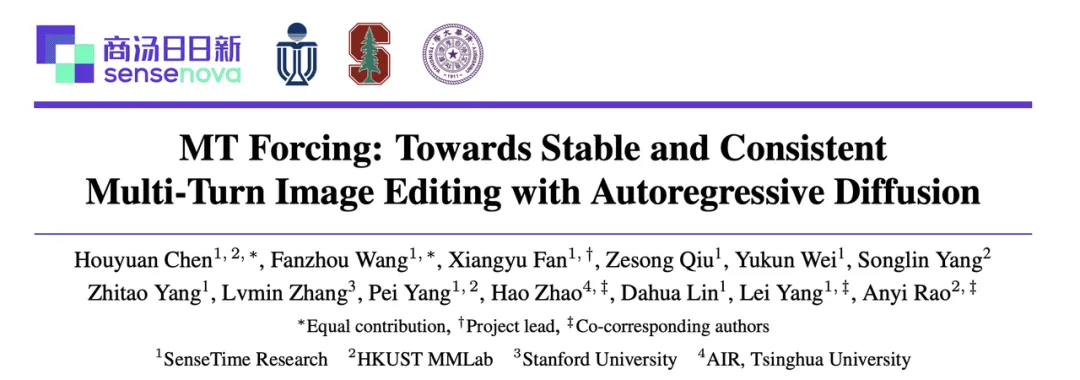
Paper: MT Forcing: Towards Stable and Consistent Multi-Turn Image Editing with Autoregressive Diffusion
Project homepage: MT Forcing
Code: GitHub repository
Model weights: Hugging Face
🧠 Why Does Image Quality Degrade After Repeated Edits? #
The underlying problem is a mismatch between the image histories models encounter during training and the histories they must handle during inference. This is commonly described as exposure bias.
During training, an image editor typically learns to process the next instruction using a reference editing history. These reference images are generally coherent and accurately represent the intended progression.
During inference, however, the model must often use its own previous outputs as the input for the next edit. Those outputs may already contain artifacts, texture distortions, or unintended modifications.
The difference becomes more significant with each turn.
Training history versus inference history #
The paper describes this distinction using conditional distributions:
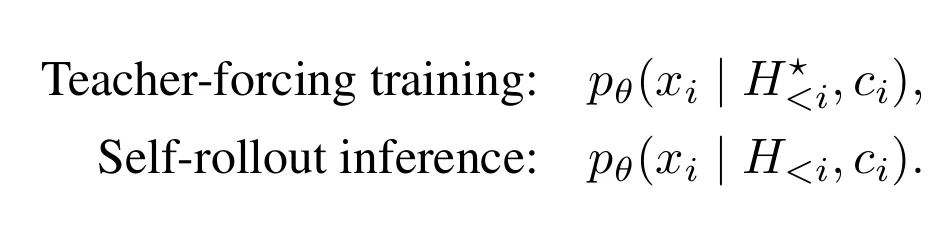
Here:
- \(H^\star\) represents the reference editing history.
- \(H\) represents the history generated autonomously by the model.
- \(c_i\) denotes the instruction at the current editing turn.
The model is trained primarily on \(H^\star\), but during actual use it must operate on \(H\). Since generated histories can contain errors, the model encounters input conditions that differ from those it learned to handle.
Consider a simple example. A user asks an image editor to add a vase to a table. The model generates the vase, but slightly changes the table texture in the process. The user then asks to make the vase blue. The next generation uses the already modified image as its input, potentially introducing another change to the table.
The user only requested a color adjustment, yet the scene continues to change.
This creates a feedback loop: imperfections in one output become part of the next input, allowing small errors to accumulate.
MT Forcing addresses this mismatch by training the student model through self-rollouts. Rather than relying exclusively on clean reference histories, the student repeatedly edits its own generated outputs during training.
This exposes the model to the conditions it will encounter at inference time. The remaining challenge is to provide reliable supervision so that learning from imperfect histories does not simply reinforce their errors.
🎯 Single-Turn DMD: Using a Clean Teacher Reference #
MT Forcing starts from two observations:
- A single editing operation generally introduces less accumulated degradation than a long sequence of recursive edits.
- Many editing operations can be combined into one instruction without changing their cumulative intent.
These observations allow the researchers to use a single-turn teacher to supervise a student that still performs edits sequentially.
Consolidating instructions without changing the editing sequence #
Suppose a user makes two requests:
- Turn 1: Add a vase.
- Turn 2: Change the vase to blue.
The student performs both operations in sequence, using its own first output as the input for the second turn.
The teacher takes a different route. It receives the original image and a consolidated instruction:
Add a blue vase.
The teacher therefore produces an image representing the cumulative editing intent without recursively modifying its own previous output.
This gives the training process a relatively clean quality reference at each stage, while the student learns to handle the imperfect histories produced by its own rollout.
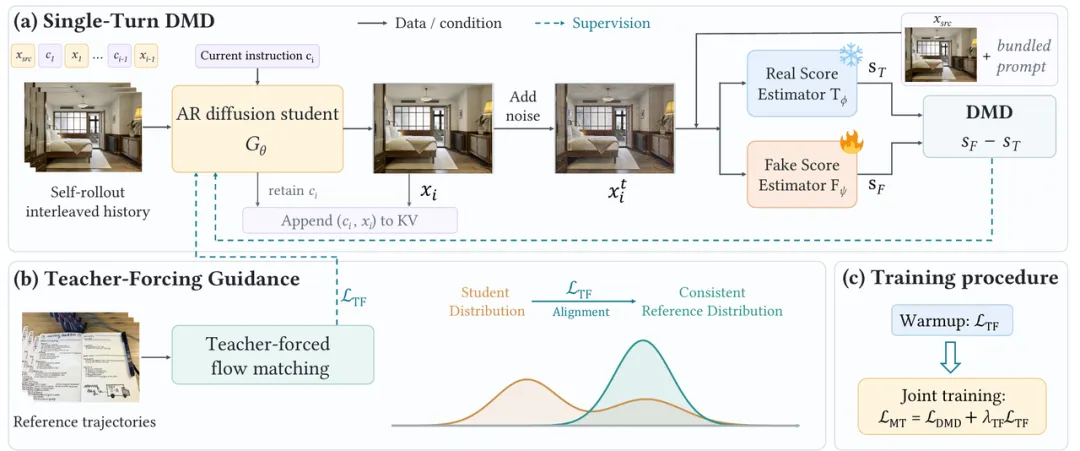
The student edits step by step using its own generated history. The single-turn teacher provides distribution-matching supervision, while reference trajectories provide a separate signal for preserving content across turns.
Matching output distributions instead of individual images #
Single-Turn DMD compares the output distribution of the student’s autonomous rollout with the teacher’s single-turn output distribution.
The training objective is:

In this formulation:
- \(C^T\) is the teacher’s condition, consisting of the original image and consolidated editing instructions.
- \(p_\theta\) represents the student distribution.
- \(p_\phi\) represents the teacher distribution.
- \(t\) denotes the diffusion noise time.
Both distributions are evaluated under the same noise-adding process so that their differences can be used as a training signal.
The key distinction is that the student is not required to reproduce one specific teacher-generated image pixel by pixel. Instead, it learns to align its output distribution with the teacher’s distribution.
That flexibility matters because multiple images can satisfy the same editing instruction. The objective is to preserve the intended visual quality and cumulative edit, not force every valid result to look identical.
By combining student self-rollouts with single-turn teacher supervision, MT Forcing gives the model experience with realistic inference histories without making it depend on recursively generated teacher outputs.
🧩 Teacher-Forcing Guidance: Preserving Details Across Turns #
Single-Turn DMD provides a cleaner quality target, but it does not fully solve content consistency.
A consolidated instruction describes what the final image should contain. It does not necessarily specify every visual detail established by earlier generations.
For example, consider a teapot with a blue decorative pattern. A user may ask the model to add the pattern in one turn and then adjust another part of the scene in the next.
The single-turn teacher knows that the teapot should have blue patterns. However, it does not know the exact shapes, spacing, and arrangement that the student generated in the previous turn.
If the teacher independently recreates the cumulative instruction each time, the teapot may remain blue while its decorative pattern changes.
The broad instruction is satisfied, but the image is no longer consistent with its editing history.
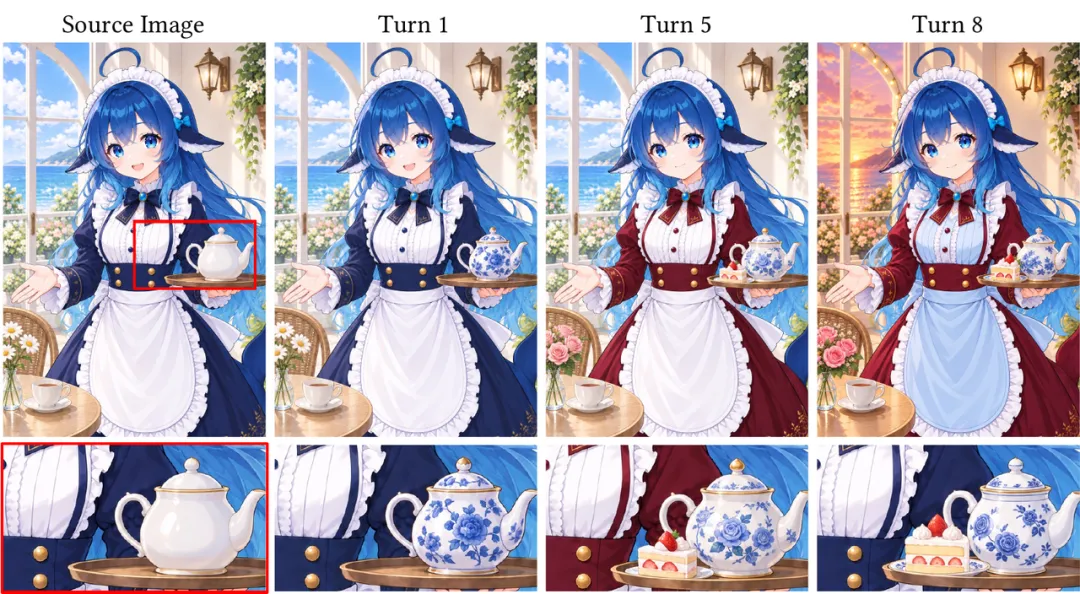
The example illustrates how independent single-turn generations can produce different teapot patterns. Zoomed-in regions make the cross-turn differences easier to see.
Learning from coherent reference trajectories #
MT Forcing introduces Teacher-Forcing Guidance to supervise the relationship between an editing history and the next output.
Rather than relying only on the teacher’s consolidated instruction, this objective uses a coherent reference editing trajectory to teach the student how visual content should evolve from one turn to the next.
The training process has two stages:
- Teacher-forced warm-up: The model first learns to retain content across turns using reference editing histories.
- Regularization during DMD training: Reference-history supervision continues at a lower weight while distribution matching is optimized.
The second stage matters because distribution-matching updates could otherwise weaken the cross-turn consistency learned during warm-up.
Combining both objectives #
The overall training objective combines distribution matching and Teacher-Forcing Guidance:
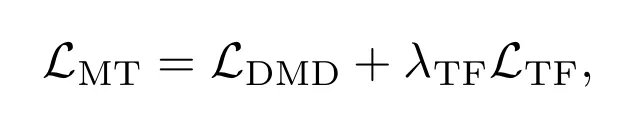
The two terms serve different purposes:
- The DMD term guides the output distribution generated from the student’s autonomous rollout.
- The TF term uses flow-matching supervision on reference histories to constrain history-dependent editing behavior.
- \(\lambda_{TF}\) controls the relative contribution of the Teacher-Forcing term.
Both objectives train the same student model, but they address different failure modes. DMD helps prevent visual quality from deteriorating, while TF encourages the model to retain details established in previous turns.
The paper’s ablation experiments illustrate why both are needed. Using DMD alone improves visual quality but can still allow details such as wood grain to shift. Using reference supervision alone helps preserve content, but does not fully prevent late-stage texture degradation.
The combined method performs better because it addresses both problems rather than treating them as interchangeable.
🖼️ Qualitative Results: Cleaner Textures and More Stable Scenes #
The researchers compare two baseline models with their MT Forcing-trained counterparts across editing rounds 1, 4, and 8.
The examples show how visual errors accumulate in longer editing sequences.
By the eighth round, the baseline car scene exhibits oversaturated lighting and harsh textures. In the snow mountain scene, spots and excessive contrast become more noticeable.
The MT Forcing results show cleaner textures and more coherent scene structures. Previously established details are also better preserved, including:
- The red body of the car
- The cargo box on the car’s roof
- Tents and skis in the snow scene
- Road signs and other background elements
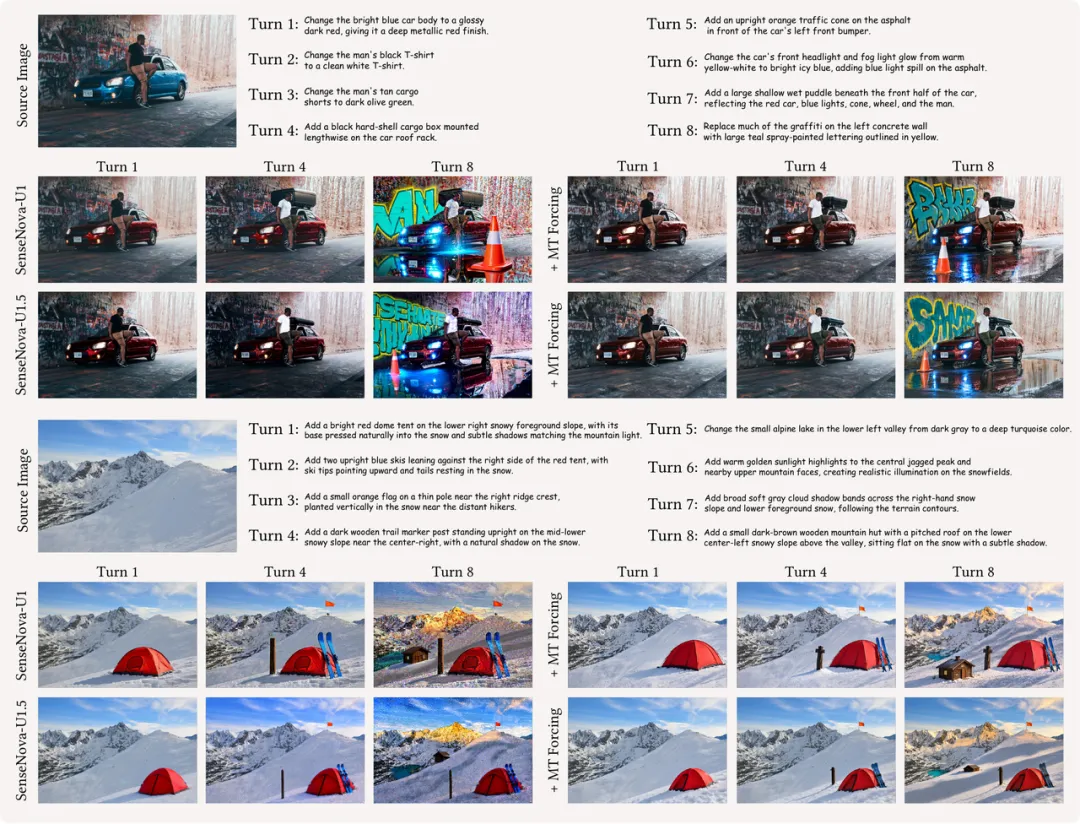
The baseline results are shown on the left, with MT Forcing results on the right. The comparison covers editing rounds 1, 4, and 8.
These examples demonstrate the method’s intended effect: later instructions can modify the requested elements without causing the entire image to drift as the editing history grows.
The paper also includes comparisons before and after training over longer editing sequences, providing additional qualitative evidence of improved stability.
📊 Quantitative Results: Better Performance Across Eight Editing Rounds #
The evaluation uses the progressive editing subset of MTEdit-Bench. It contains 100 editing sessions, each with eight consecutive instructions.
The researchers measure four aspects of performance:
| Metric | What it measures |
|---|---|
| Instruction Following (IF) | Whether the model correctly executes the current instruction |
| Content Consistency (CC) | Whether the image preserves the intended cumulative content |
| Drift Robustness Score (DRS) | Resistance to visual quality degradation across turns |
| Geometric Alignment | Spatial stability measured through displacement of matching image points |
The reported scales differ: IF and CC use a maximum score of 10, while DRS uses a maximum score of 5. Geometric alignment is measured in pixels, where lower displacement indicates greater spatial stability.
SenseNova-U1.5 results #
For SenseNova-U1.5, the eighth-round instruction-following score increased from 4.52 to 9.17 after applying MT Forcing.
Content consistency improved from 3.22 to 7.68.
The DRS results also show a substantial difference. The baseline model’s score fell from 4.09 in the first round to 3.03 in the eighth. With MT Forcing, the score remained between 4.20 and 4.35 across all eight rounds.
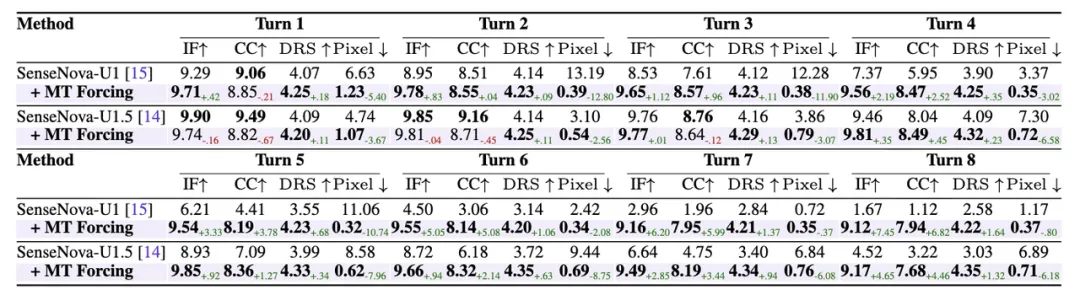
The results suggest that MT Forcing becomes particularly valuable as the editing sequence grows. The largest improvements appear in later rounds, when the baseline model has had more opportunities to accumulate errors.
Improvements on SenseNova-U1 #
SenseNova-U1 also benefits from the training method. Its eighth-round instruction-following and content-consistency scores increased by 7.45 and 6.82 points, respectively.
From the fourth round onward, all four reported metrics for both models outperform their corresponding baselines.
There is one qualification: some first-round metrics remain below the baseline. MT Forcing is primarily designed to improve sustained editing performance, so its benefits are more apparent over multiple consecutive operations than in an isolated first edit.
Geometric stability #
The researchers also measure geometric changes between adjacent outputs by calculating the average displacement of matching image points.
For SenseNova-U1.5, the reported eight-round mean displacement decreases from 6.34 pixels to 0.74 pixels, a reduction of approximately 88.4%.
This indicates that matched regions undergo much less spatial movement between consecutive outputs.
It is a useful measure of geometric stability, although it should not be interpreted as proof that every pixel or every unmodified region remains unchanged.
🔍 What MT Forcing Changes About AI Image Editing #
MT Forcing treats multi-turn image editing as two connected training problems.
The first is maintaining image quality when a model repeatedly operates on its own generated outputs. Single-Turn DMD addresses this by providing a teacher reference based on the original image and consolidated editing instructions.
The second is preserving the specific visual details established by earlier generations. Teacher-Forcing Guidance addresses this by supervising transitions along coherent reference histories.
The distinction is significant. A model can generate a visually clean image at every turn and still fail at continuous editing if it keeps changing details that users have already approved. Conversely, a model can preserve the broad scene structure while allowing textures and local image quality to deteriorate.
The two objectives are designed to improve both sides of the problem.
The reported results on SenseNova-U1 and SenseNova-U1.5 show meaningful gains on an eight-round benchmark, particularly in later editing turns. However, the evaluation does not establish that the method will perform equally well on every image-editing architecture or across arbitrarily long sessions. Its results are specific to the tested models, training setup, and benchmark.
For developers building interactive image-generation systems, the broader lesson is that multi-turn editing requires more than strong single-image generation. Models must learn to operate on their own imperfect outputs while retaining the details that users have already established.
That is the problem MT Forcing is designed to tackle.
For related work on image-generation and editing workflows, see Google Nano Banana 2.1’s approach to professional image design and AMD’s optimization of Stable Diffusion 3 Medium for local AI hardware.