NVIDIA DLSS 4.5 Ray Reconstruction: Architecture & Testing
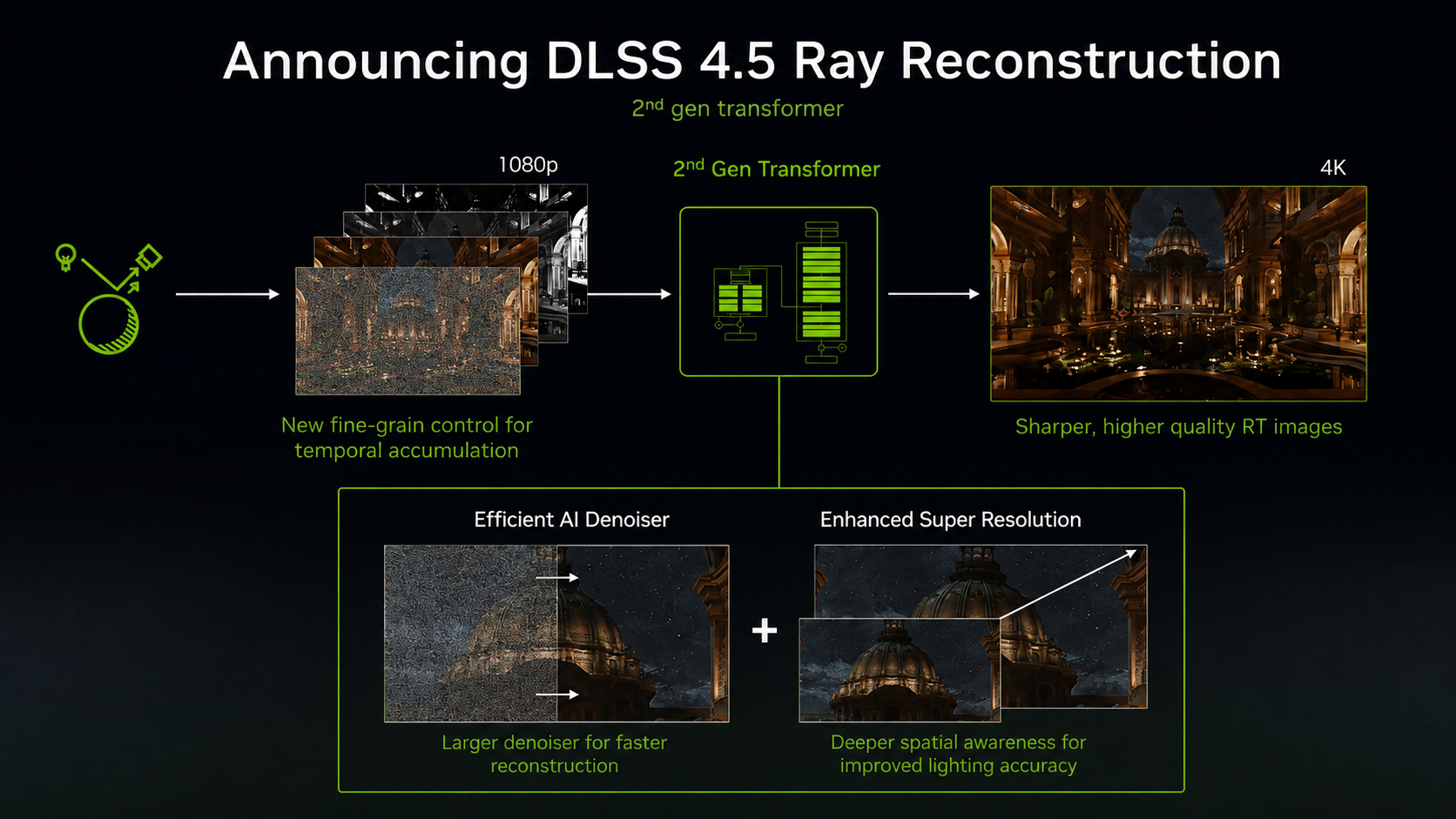
NVIDIA’s DLSS 4.5 Ray Reconstruction introduces a second-generation Transformer model designed to improve the quality and temporal stability of ray-traced and path-traced rendering.
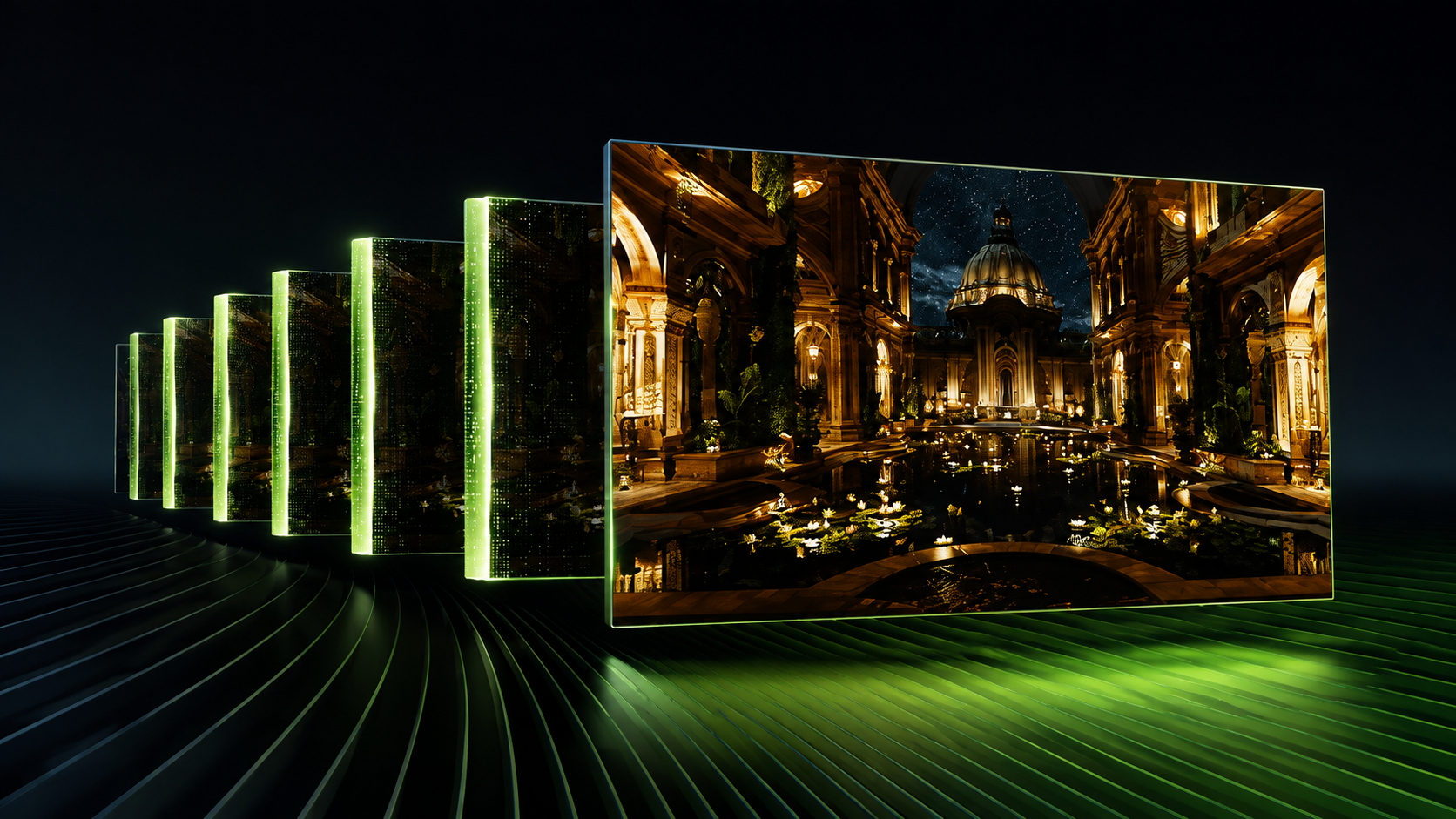
Announced at Gamescom 2026, the technology arrives as Ray Reconstruction Preset F, replacing the first-generation Transformer implementation used by Preset D with a larger and more capable neural model.
The upgrade is notable because it does not require a conventional game patch and is compatible with the full GeForce RTX 20 through RTX 50 series. NVIDIA also claims that the additional model capacity does not increase runtime overhead on RTX 40 and RTX 50 GPUs.
Rather than increasing frame rate directly like Frame Generation, Ray Reconstruction targets a different bottleneck: reconstructing high-quality pixels from incomplete ray-tracing samples while suppressing noise, ghosting, and temporal instability.
🔮 Architectural Improvements: Second-Generation Transformer #
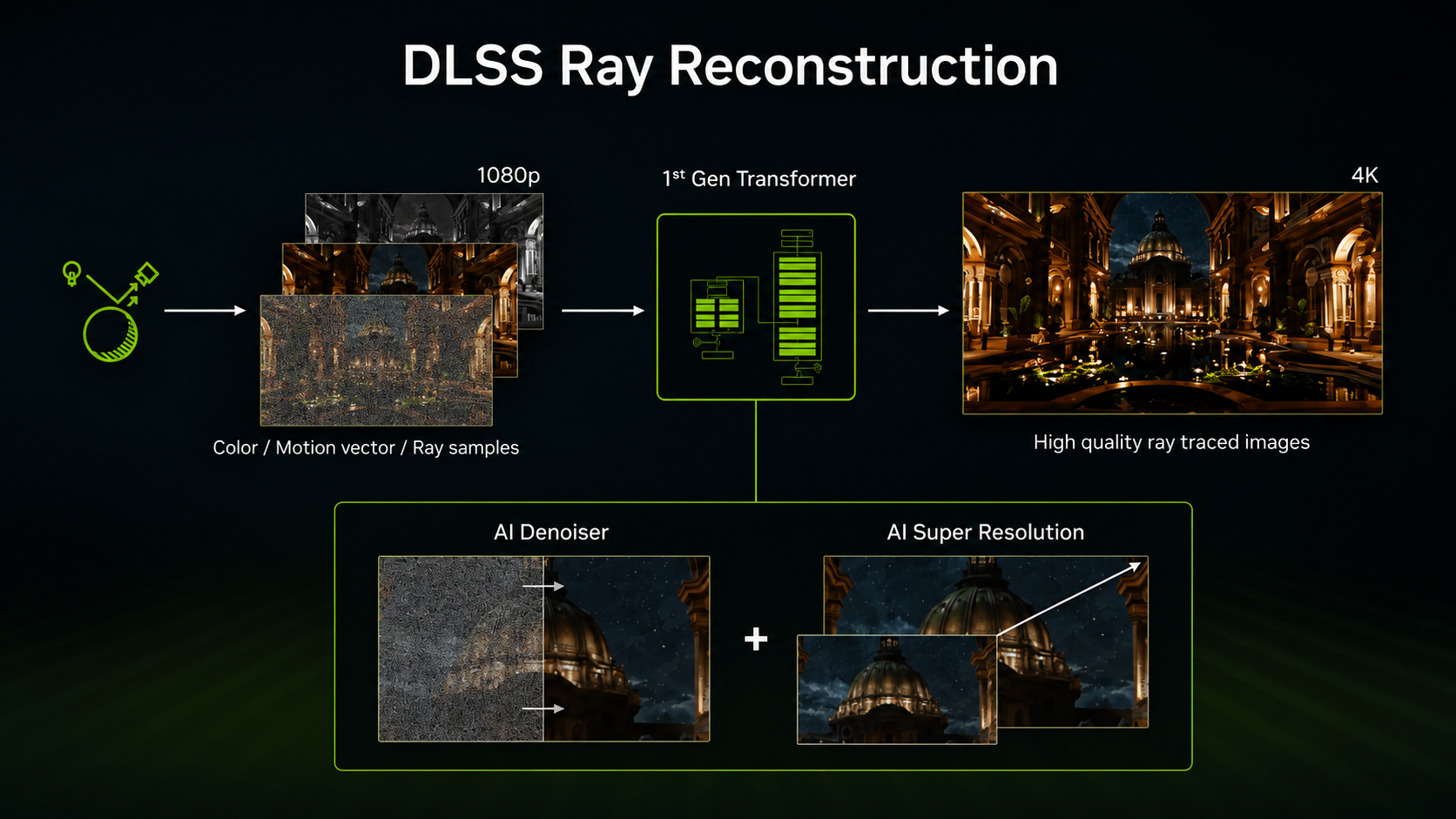
The central change in DLSS 4.5 Ray Reconstruction is the transition from the first-generation Transformer model to a substantially larger second-generation architecture.
| Metric / Pillar | First-Gen Transformer (Preset D) | Second-Gen Transformer (Preset F) |
|---|---|---|
| Model Compute Capacity | Baseline | +35% |
| Parameter Count | Baseline | +20% |
| Performance Overhead | Standard | Identical overhead on RTX 40/50 |
| Denoising Strategy | Dual hand-tuned / AI hybrid | Unified AI model |
| Temporal Stability | Standard | Improved |
The architecture increases model capacity while maintaining the same claimed runtime overhead on newer RTX hardware. This is particularly important for neural rendering because additional inference capacity normally creates a direct tension between image quality and frame-time budget.
Unified AI Denoising #
The new model replaces more traditional hand-tuned denoising components with a unified neural approach.
Ray tracing frequently leaves portions of an image insufficiently sampled, particularly in dark regions, reflections, indirect lighting, and rapidly changing scenes. Instead of merely filtering those noisy samples, the Transformer can infer higher-quality pixel information for regions where direct ray-traced information is sparse.
This allows Ray Reconstruction to function as more than a conventional denoiser. It becomes a neural reconstruction stage capable of synthesizing visually plausible information from incomplete rendering data.
Expanded Model Capacity #
Preset F increases parameter count by 20% and model compute capacity by approximately 35%.
The additional capacity provides the model with more representational power for recognizing complex relationships between spatial features, temporal history, lighting information, and material characteristics.
This is particularly useful for path-traced scenes, where the relationship between a pixel and its underlying lighting information can extend across multiple frames and spatially distant samples.
Improved Spatial and Temporal Awareness #
The second-generation Transformer uses deeper spatial and temporal information to improve reconstruction quality.
Fine details such as individual hair strands, fabric textures, wood grain, and reflective surfaces are particularly sensitive to poor temporal reconstruction. When the renderer receives insufficient samples, conventional reconstruction can produce flickering, smearing, or ghost trails.
Preset F is designed to better distinguish persistent scene structure from transient lighting and sampling noise, improving stability during camera and object motion.
Expanded Training Data #
The model also benefits from an expanded training dataset intended to improve scene recognition.
For Ray Reconstruction, training diversity matters because the neural network must generalize across different materials, lighting configurations, geometric structures, and rendering conditions.
A broader training distribution can help the model distinguish legitimate high-frequency detail from stochastic ray-tracing noise and reconstruct lighting that remains closer to ground-truth output.
Developer Control Over Temporal Accumulation #
DLSS 4.5 also provides developers with more granular control over temporal accumulation parameters.
This matters because neural reconstruction operates within a temporal pipeline rather than processing each frame independently. The balance between accumulated history and newly sampled information directly affects image stability, responsiveness, and artifact formation.
More precise controls allow developers to tune that trade-off according to the characteristics of individual game engines and rendering pipelines.
⚙️ Activation Without a Game Patch #
One of the most practical aspects of DLSS 4.5 Ray Reconstruction is that Preset F can be activated through the NVIDIA App without modifying the game itself.
At launch, more than 30 supported titles are expected to work with the override, including Cyberpunk 2077, Alan Wake 2, and Resident Evil Requiem.
Enabling Preset F #
The activation process is:
- Open the NVIDIA App.
- Select a supported game.
- Navigate to DLSS Override - Model Presets.
- Set Ray Reconstruction to Preset F.
- Launch the game and enable the NVIDIA overlay with
Alt+R. - Confirm that RR OVR Preset F is displayed.
Because the change is applied through the driver-level model override mechanism, users do not need to wait for individual game developers to release patches incorporating the new Transformer model.
This also makes direct A/B comparisons between Preset D and Preset F relatively straightforward.
🎮 Hands-On Testing on RTX 5080 #
Testing on an RTX 5080 across several path-traced titles showed that the primary benefit of Preset F is image quality rather than additional frame rate.
The most significant improvements appeared in fine geometry, reflective surfaces, dark regions, and rapidly changing lighting conditions.
Alan Wake 2 #
Test configuration: 4K, Path Tracing, DLSS 4.5 Balanced.
Preset F produced clearer fine-grained detail in several difficult reconstruction scenarios.
Individual hair curls and coat fabric folds remained more clearly defined, while wood grain and floor reflections appeared sharper. Dark areas also exhibited less visible noise.
Most importantly, the visual improvement did not come with a measurable frame-rate penalty in the comparison against Preset D.
Performance: 0% performance penalty versus Preset D.
Resident Evil Requiem #
Test configuration: 4K, Path Tracing, DLSS 4.5 Balanced.
Reflective materials provided another clear demonstration of the new model’s temporal stability.
Reflections from neon signs and store lighting on glass and wet pavement appeared cleaner, while metallic surfaces and hair highlights remained free of the temporal noise observed in more challenging reconstruction scenarios.
Repeated benchmark runs produced identical frame rates between the tested presets.
Performance: Identical frame rates across test runs.
Material Exist #
Test configuration: 4K, Path Tracing, DLSS 4.5 Quality.
Dynamic lighting transitions provided the most useful stress test in this title.
When laser effects changed or light sources were switched on and off, Preset F responded more quickly to the new lighting state. Residual ghosting and reconstruction artifacts were significantly reduced compared with the previous preset.
This type of workload is particularly challenging for temporal reconstruction because historical frame information can become invalid almost immediately after a significant lighting change.
🔬 Why the Transformer Upgrade Matters #
Ray Reconstruction sits at an increasingly important point in the modern rendering pipeline.
Path tracing can produce physically accurate lighting, but fully sampling every ray needed for a clean final image is prohibitively expensive in real-time applications. Modern renderers therefore rely on sparse sampling combined with temporal accumulation, denoising, and reconstruction.
That creates several competing requirements:
- Preserve fine spatial detail.
- Suppress stochastic ray-tracing noise.
- Maintain temporal stability.
- React quickly to changes in lighting and geometry.
- Avoid excessive reconstruction latency.
- Stay within a strict frame-time budget.
A larger Transformer model can potentially improve these trade-offs, but only if its inference cost remains sufficiently low. NVIDIA’s claim that Preset F provides 35% more model compute capacity and 20% more parameters without additional overhead on RTX 40/50 hardware is therefore one of the most significant aspects of the update.
The improvement is not simply about making the neural network larger. The hardware and software stack must also execute the larger model efficiently enough that the extra capacity does not consume the frame-time budget required by the rest of the rendering pipeline.
🖥️ RTX Compatibility and Practical Impact #
Unlike some newer DLSS features, Ray Reconstruction is not restricted to the latest generation of GPUs.
Preset F is compatible with GeForce RTX 20, RTX 30, RTX 40, and RTX 50 series hardware, giving the technology a much broader deployment footprint.
The distinction is important because Ray Reconstruction and Frame Generation solve different problems.
Frame Generation increases displayed frame rate by synthesizing additional frames between traditionally rendered frames. Ray Reconstruction instead improves the quality of the frames produced by the underlying ray-traced rendering pipeline.
Consequently, users do not need the latest RTX generation simply to benefit from improved ray-traced reconstruction.
📈 The Real Upgrade: More Quality per Frame #
DLSS 4.5 Ray Reconstruction is best understood as a quality-per-frame upgrade rather than a raw performance feature.
Preset F increases neural model capacity while preserving the claimed runtime overhead of the previous implementation on RTX 40 and RTX 50 GPUs. The practical result is improved reconstruction of difficult ray-traced content without requiring additional rendering time.
The hands-on results reinforce that design goal. In Alan Wake 2, fine textures and dark reflections become cleaner. In Resident Evil Requiem, reflective surfaces and temporal details remain more stable. In Material Exist, rapidly changing lighting produces fewer ghosting artifacts.
For path-traced rendering, these improvements address some of the most visible weaknesses of sparse ray sampling: noise, flicker, ghosting, and delayed response to lighting changes.
The broader significance is that NVIDIA continues to move neural rendering from a supplementary image-processing stage toward a central component of the real-time rendering pipeline. With Preset F, the Transformer is being given more capacity to understand spatial and temporal scene information while remaining within the same practical frame-time budget.
For RTX users, that makes DLSS 4.5 Ray Reconstruction a relatively low-friction upgrade: better path-traced image quality, broader GPU compatibility, and no additional runtime cost on modern RTX architectures.