RTX 5090 6K Gaming Benchmarks: Is 6K Worth It?
The arrival of high-refresh-rate 6K gaming monitors is pushing desktop graphics hardware into a new performance class. However, real-world testing suggests that even NVIDIA’s flagship GeForce RTX 5090 struggles to maintain high frame rates at 6144×3456 when demanding visual features such as ray tracing are enabled.
At 6K resolution, the RTX 5090 can see frame rates fall from roughly 85 FPS at 4K to around 42 FPS under comparable demanding settings. Lower-tier GPUs such as the RTX 5070 Ti face even greater limitations.
The problem is not simply GPU compute performance. A 6K gaming setup requires substantially more rendering throughput, memory bandwidth, VRAM capacity, and display bandwidth than a conventional 4K configuration. Once the cost of the monitor and graphics card is included, the resulting system can deliver considerably worse gaming value than a high-refresh-rate 4K OLED setup.
For mainstream gaming, 6K currently looks more like a premium enthusiast feature than a practical upgrade.
🖥️ 6K Gaming Pushes GPU Hardware to the Limit #
The emergence of consumer 6K gaming monitors provides a useful test of how modern GPUs handle extreme pixel workloads.
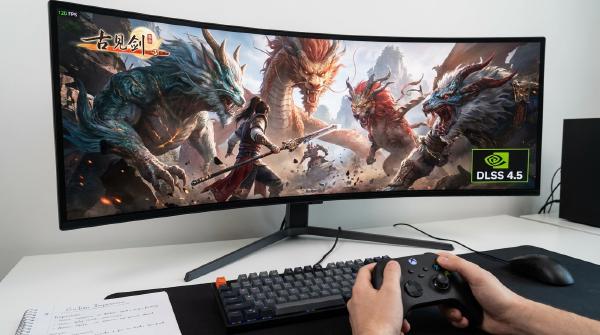
Samsung’s Odyssey G80HS is positioned as a consumer-oriented 6K gaming display, combining a 32-inch panel with a 165Hz refresh rate and support for technologies including NVIDIA G-Sync and AMD FreeSync.
Its native resolution is 6144×3456, corresponding to approximately 21.2 million pixels per frame.
For comparison:
| Resolution | Total Pixels | Relative Pixel Load |
|---|---|---|
| 1080p | 2.07 million | 1× |
| 1440p | 3.69 million | 1.78× |
| 4K | 8.29 million | 4× |
| 6K | 21.23 million | 10.24× |
A 6K frame therefore contains approximately 2.56× as many pixels as 4K.
That increase places considerably greater demands on the GPU’s shader resources, memory subsystem, ray-tracing hardware, and upscaling pipeline.
🎮 RTX 5090 Performance Drops Sharply at 6K #
The RTX 5090 remains one of the most powerful consumer GPUs available, but extreme resolution exposes the limits of even flagship hardware.
In demanding testing with Ray Tracing Overdrive enabled and DLSS configured to Performance mode, the RTX 5090 averaged approximately 85 FPS at 4K.
At 6K using the same settings, performance dropped to approximately 42 FPS.
That represents a reduction of more than 50%.
The result illustrates a fundamental limitation of native high-resolution rendering: increasing resolution does not merely make the image sharper. It substantially increases the amount of work required for every frame.
DLSS Becomes Increasingly Important #
Maintaining 60 FPS at 6K generally requires compromises.
Depending on the game, users may need to:
- Disable or reduce ray tracing.
- Lower the overall graphics preset.
- Switch to a more aggressive DLSS mode.
- Use DLSS Ultra Performance mode.
- Reduce other computationally expensive effects.
The problem with relying heavily on DLSS Ultra Performance is that it undermines one of the primary reasons to purchase a 6K display in the first place: exceptionally high image clarity.
At extreme resolutions, aggressive reconstruction can offset some of the visual benefits gained from increasing the native pixel count.
⚙️ RTX 5070 Ti Struggles Even More #
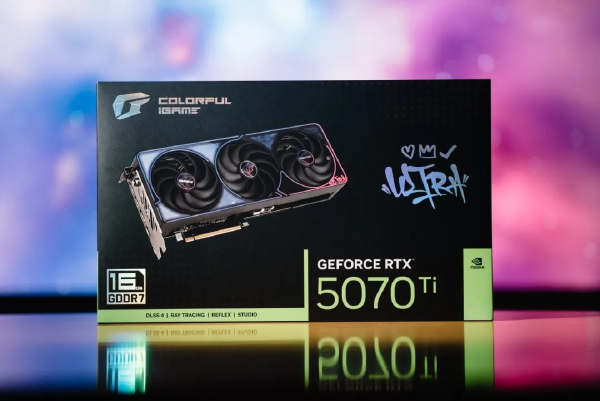
The RTX 5070 Ti sits considerably below the RTX 5090 in raw GPU performance, making it a much less practical candidate for 6K gaming.
At maximum settings, the RTX 5070 Ti reportedly averages below 40 FPS in many demanding 6K workloads.
Reaching approximately 60 FPS requires much more aggressive compromises, including lower graphics presets and DLSS Ultra Performance.
This creates an unfavorable trade-off.
A system configured around an RTX 5070 Ti and a high-refresh-rate 6K monitor may technically support the resolution, but the GPU often cannot render demanding games at a quality level that justifies the display’s capabilities.
In many cases, a high-refresh-rate 4K configuration would provide substantially better image quality, responsiveness, and consistency.
🔬 Why 6K Is So Much Harder Than 4K #
The primary challenge is pixel throughput.
A 4K frame contains approximately 8.3 million pixels. A 6K frame contains approximately 21.2 million.
At the same frame rate, the GPU must therefore process more than twice as many pixels.
At 60 FPS, for example:
- 4K requires roughly 498 million pixels per second.
- 6K requires roughly 1.27 billion pixels per second.
At 120 FPS, those figures approximately double.
This additional workload becomes even more significant when ray tracing is enabled because each frame requires additional calculations for lighting, reflections, shadows, and other effects.
The result is that maintaining high frame rates at 6K requires significantly more than simply increasing GPU rasterization performance.
🧠 Ray Tracing Makes the Gap More Obvious #
Modern games increasingly combine high-resolution rendering with computationally expensive ray-tracing effects.
Ray Tracing Overdrive-class workloads can dramatically increase GPU utilization because lighting calculations involve additional ray-generation, intersection, shading, and denoising operations.
At 4K, technologies such as DLSS can compensate for some of this workload.
At 6K, however, the underlying rendering target is substantially larger.
This means that even powerful GPUs can quickly reach a point where the display’s resolution becomes the primary performance constraint.
For users prioritizing high frame rates, reducing resolution can therefore produce a more meaningful improvement than upgrading other components of the system.
🔌 Display Bandwidth Is Another Constraint #
Rendering a 6K image is only part of the problem. The GPU must also transmit the resulting signal to the monitor at the desired refresh rate.
Modern high-end GPUs increasingly rely on DisplayPort 2.1-class connectivity to support extreme combinations of resolution and refresh rate.
NVIDIA’s Blackwell-based GeForce RTX 50-series GPUs provide the necessary display connectivity for high-refresh-rate 6K scenarios, while previous-generation RTX 40-series cards have more limited bandwidth for these configurations.
This creates an important distinction between being able to render 6K and being able to drive a 6K display at its maximum refresh rate.
A GPU that can output 6K at 60Hz does not necessarily make full use of a 6K 165Hz gaming monitor.
💰 The Economics of 6K Gaming Are Difficult to Justify #
The biggest problem with 6K gaming is arguably not technical feasibility but value.
A flagship GPU such as the RTX 5090 represents a substantial investment. Add a premium 6K 165Hz monitor, and the total platform cost becomes significantly higher than a conventional high-end 4K gaming system.
For the same budget, gamers can instead build around a high-refresh-rate 4K OLED display and a powerful GPU.
That combination offers several advantages:
- Higher sustained frame rates.
- Better motion clarity.
- Stronger HDR performance.
- More mature GPU support.
- Lower rendering requirements.
- Better price-to-performance efficiency.
The difference is especially important for competitive and fast-paced games, where frame rate and latency often matter more than extreme pixel density.
📊 6K vs. 4K: Which Makes More Sense? #
| Category | 6K Gaming | High-End 4K Gaming |
|---|---|---|
| Resolution | 6144×3456 | 3840×2160 |
| Pixel Count | ~21.2M | ~8.3M |
| GPU Requirement | Extremely high | High |
| High Refresh Rate | Difficult in demanding games | Much more achievable |
| DLSS Dependence | High | Moderate to high |
| Hardware Cost | Very high | High |
| Gaming Value | Limited | Strong |
| Productivity | Excellent | Very good |
| Content Creation | Excellent | Very good |
For gaming alone, 4K currently offers a more balanced combination of image quality and performance.
For productivity, photography, video editing, CAD, and other applications where desktop real estate and pixel density are particularly valuable, 6K can make considerably more sense.
🖥️ Where 6K Actually Makes Sense Today #
The limitations of 6K gaming do not make 6K displays inherently impractical.
The resolution is particularly attractive for professional workflows where additional workspace and pixel density directly improve productivity.
Examples include:
- High-resolution photo editing.
- 6K and 8K video production.
- 3D content creation.
- CAD and engineering applications.
- Software development with large multi-window layouts.
- High-density visualization workflows.
These workloads generally do not require the same sustained 120Hz or 165Hz rendering performance demanded by modern gaming.
Consequently, the benefits of 6K can be realized without requiring a flagship GPU to maintain extreme frame rates.
🎯 6K Gaming Remains an Enthusiast Market #
The emergence of 6K 165Hz monitors demonstrates that display technology is moving faster than practical GPU performance at extreme resolutions.
The RTX 5090 can render demanding 6K games, but achieving consistently high frame rates requires compromises. The RTX 5070 Ti faces even more severe limitations.
This does not mean 6K gaming is impossible. Rather, it means that the hardware required to make it compelling is currently expensive, and the performance compromises can undermine the advantages of the display itself.
For most gamers, 4K high-refresh-rate gaming remains the more balanced target.
6K is better understood as an enthusiast-grade and professional display technology whose gaming potential will become more attractive as GPU rendering performance, AI reconstruction, and display interfaces continue to improve.
For now, if the objective is maximum gaming performance per dollar, jumping from 4K to 6K is difficult to justify. The additional pixels are impressive, but the performance and cost penalties remain substantial.