NVIDIA Open-Sources AI Storage Tech at FMS 2026
At FMS 2026, NVIDIA made it clear that the next stage of AI infrastructure is not solely about faster GPUs. The company is increasingly focusing on the storage, networking, memory, and data-movement layers that keep those GPUs fully utilized.
One of the most notable announcements was the decision to open-source cuFile, the core API behind NVIDIA’s GPUDirect Storage technology, under a neutral GitHub organization with Google, Intel, Meta, and NVIDIA as initial maintainers.
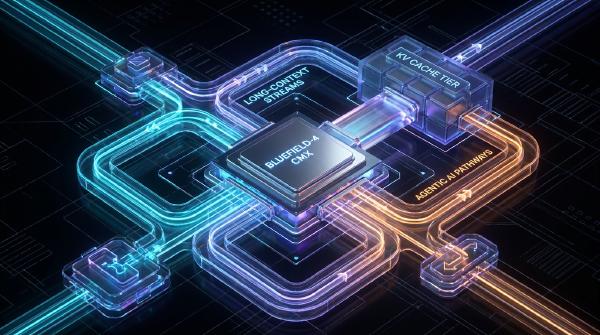
At the same time, NVIDIA introduced its broader Storage-Next initiative, bringing together more than 40 storage and flash vendors. The company also presented BlueField-4 STX and Context Memory Storage (CMX) as building blocks for a new generation of AI-native storage infrastructure.
The move raises an important question: Does NVIDIA’s open-source strategy reduce platform lock-in, or does it simply extend NVIDIA’s influence deeper into the storage stack?
🔓 NVIDIA Opens cuFile to the Industry #
At FMS 2026 in Santa Clara, NVIDIA announced that cuFile, the API that enables GPUDirect Storage to move data directly between GPUs and storage devices, is becoming an open-source project under a neutral GitHub organization.
Google, Intel, Meta, and NVIDIA will initially maintain the project.
The decision is strategically significant because storage infrastructure has traditionally been separated from GPU software. By opening the API and bringing major industry players into governance, NVIDIA can make GPU-centric storage behavior more interoperable and easier for enterprise customers to adopt.
The strategy also resembles the broader philosophy behind CUDA: establish widely adopted software interfaces, encourage a large ecosystem, and capture value through highly optimized hardware.
The difference is that NVIDIA is now attempting to apply this approach beyond GPU computing and into the data infrastructure surrounding AI workloads.
However, open-source APIs do not necessarily eliminate hardware dependence.
NVIDIA’s own performance figures continue to emphasize the advantages of its hardware platform, including substantially higher throughput for data processing and improved efficiency when compression, encryption, and GPU acceleration are combined.
That creates an interesting dynamic: the interface becomes more open while the underlying performance advantage can remain tightly connected to NVIDIA silicon.
🤝 Storage-Next Builds a Larger AI Infrastructure Ecosystem #
NVIDIA is also pushing the Storage-Next initiative, which has attracted more than 40 storage and flash vendors.
Participants include major companies such as DDN, KIOXIA, and Micron, alongside a wider ecosystem of storage manufacturers and infrastructure providers.
The objective is to establish more consistent behaviors for GPU-driven storage systems and make different components easier to integrate into AI clusters.
This matters because modern AI infrastructure increasingly treats storage as an active component of the compute pipeline rather than simply a place to keep data.
Training and inference workloads continuously move enormous quantities of model weights, datasets, checkpoints, embeddings, and intermediate data. Any bottleneck between storage and accelerators can leave expensive GPUs waiting for data.
By standardizing how these systems communicate, Storage-Next could make AI storage architectures easier to deploy at scale.
But it also gives NVIDIA considerable influence over the architecture around those standards.
⚡ BlueField-4 STX Pushes Compute Closer to Storage #
NVIDIA’s BlueField-4 STX is another major component of this strategy.
The platform combines accelerated data processing with storage infrastructure, moving tasks such as compression and encryption away from general-purpose CPUs.
According to NVIDIA’s internal benchmarks, the Vera CPU inside BlueField-4 STX can deliver up to 3.21× the throughput of x86 CPUs in a two-stage compression and encryption pipeline.
NVIDIA also claims substantial improvements in AI infrastructure efficiency, including higher token throughput, better energy efficiency, and faster data access compared with conventional CPU-centric approaches.
These figures should still be treated as vendor claims until independently verified under standardized workloads.
Nevertheless, the architectural direction is clear: instead of sending every storage operation through a conventional CPU, increasingly sophisticated processing is being moved directly into infrastructure accelerators.
That approach can reduce CPU overhead while keeping GPUs supplied with data more efficiently.
🧠 CMX Turns KV Cache Into a New Storage Layer #
Perhaps the more interesting long-term development is Context Memory Storage (CMX).
As AI agents become capable of handling longer conversations and more complex multi-step tasks, KV caches are becoming an increasingly important infrastructure problem.
During inference, models generate intermediate attention data that can be reused later. Keeping this information in expensive GPU memory is fast but costly, while moving it to conventional storage can introduce too much latency.
CMX is designed to occupy the middle ground.
The concept is effectively a persistent working-memory layer positioned between ultra-fast HBM and traditional bulk storage.
Instead of repeatedly recomputing context or pushing everything into slower storage, AI systems could retain frequently accessed context in a dedicated memory-storage tier.
This becomes particularly important for agentic AI, where a single task may involve many sequential model calls, tool executions, and context updates.
If successful, CMX could turn AI context into an infrastructure resource that is managed much like compute, memory, and storage capacity are today.
📈 AI Storage Is Becoming a Performance Problem #
The economics behind this transition are straightforward.
AI accelerators are extraordinarily expensive, so keeping them busy is critical. If GPUs spend significant amounts of time waiting for data, organizations effectively pay for compute capacity they cannot fully utilize.
Traditional storage metrics such as gigabytes per dollar are therefore becoming less sufficient for AI infrastructure.
Enterprises increasingly care about metrics such as:
- Tokens per second
- Data-access latency
- GPU utilization
- Energy consumed per inference
- Context retrieval performance
- Storage-to-accelerator bandwidth
This represents a fundamental shift in how storage infrastructure could eventually be purchased.
Instead of asking only “How many terabytes can this system store?”, customers may increasingly ask “How many tokens can this storage architecture help us generate per second?”
🏭 Storage Vendors Face a New Architectural Challenge #
NVIDIA’s reference architecture has already attracted major storage companies, including Dell Technologies, HPE, IBM, Hitachi Vantara, NetApp, VAST Data, and WEKA.
Production systems from AIC, Supermicro, and Quanta Cloud Technology are expected to follow during the second half of 2026.
For storage vendors, adopting these architectures provides an opportunity to participate in rapidly expanding AI infrastructure spending.
However, there is also a potential downside.
If NVIDIA controls critical elements including the accelerator, DPU, networking, software stack, and reference architecture, traditional storage companies could gradually become more focused on providing chassis, drives, and system integration.
In other words, the storage hardware itself risks becoming increasingly commoditized while differentiation moves upward into the software and acceleration layers.
🥊 AMD and Hyperscalers Have Their Own Strategies #
NVIDIA is not operating in a vacuum.
AMD is developing its own infrastructure ecosystem around the Pensando platform, including the Salina DPU and Vulcano AI NICs, while its Helios rack architecture provides an alternative path for large-scale AI deployments.
Meanwhile, hyperscalers continue developing proprietary infrastructure.
AWS relies heavily on its Nitro architecture for infrastructure offload, while Google and Intel have developed their own accelerator and infrastructure technologies.
Neocloud providers such as CoreWeave, Nebius, Oracle Cloud Infrastructure, and Vultr are also becoming important participants in the emerging AI infrastructure ecosystem.
The result could be a much broader competition than simply NVIDIA versus AMD GPUs.
The next battleground may involve entire infrastructure stacks spanning accelerators, DPUs, networking, storage, memory, software, and cloud orchestration.
🔭 Five Things to Watch Next #
Several developments will determine whether NVIDIA’s strategy becomes an industry standard or another proprietary ecosystem.
1. Production delivery
The first question is whether systems based on STX reference architectures actually ship on schedule during the second half of 2026 and how much of a premium customers will pay for them.
2. cuFile community development
The most important test of NVIDIA’s open-source strategy will be whether Google, Intel, Meta, and other contributors eventually develop meaningful backends for non-NVIDIA hardware.
3. Independent performance testing
NVIDIA’s claims around Vera CPU throughput, token performance, and energy efficiency will need independent validation through standardized benchmarks.
4. AMD’s response
AMD’s Pensando Salina DPU, Vulcano NICs, and Helios architecture will provide an important alternative as AI infrastructure becomes increasingly heterogeneous.
5. New storage metrics
The most fundamental change may be the industry’s transition from measuring storage primarily in capacity toward measuring it in AI workload performance.
🧭 Conclusion: Open Source Could Become NVIDIA’s New Moat #
NVIDIA’s decision to open-source cuFile may initially appear contradictory. After all, the company built much of its competitive advantage through tightly integrated hardware and software.
But open source does not necessarily weaken that strategy.
By making critical interfaces easier for the industry to adopt, NVIDIA can potentially expand the market for GPU-centric infrastructure while continuing to differentiate its own products through performance, networking, accelerators, and software.
That is what makes the Storage-Next strategy particularly interesting.
NVIDIA may not need to own every component of the storage ecosystem. It may be enough to define how those components interact.
If cuFile, STX, and CMX become widely adopted foundations for AI infrastructure, NVIDIA could extend its influence far beyond GPUs—into the storage and memory systems that determine how efficiently the next generation of AI workloads actually runs.