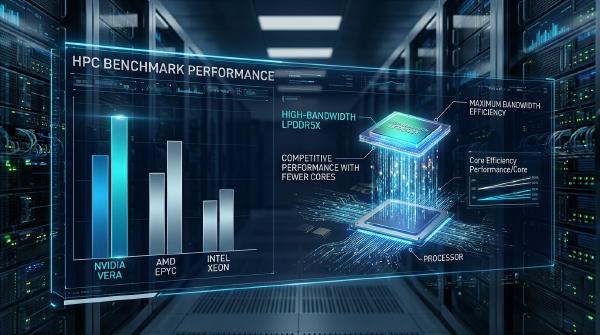
NVIDIA Vera CPU Beats AMD EPYC Zen 5 in Agentic AI Benchmarks
NVIDIA’s Vera CPU has outperformed two AMD EPYC Zen 5 processors in benchmarks targeting agentic AI infrastructure, according to results published by Daytona on October 7, 2026. The tests measured sandbox startup latency and sustained throughput while running large numbers of concurrent coding-agent workloads.
Vera provisioned 1,000 isolated sandboxes in 10.8 seconds and reached a peak throughput of 13.3 completed agent tasks per second. Under a load of 2,000 concurrent sandboxes, it continued to sustain 12.7 tasks per second, outperforming both the 128-core AMD EPYC 9755 and the 64-core, frequency-optimized EPYC 9575F in the same workload.
The results highlight an increasingly important aspect of AI infrastructure: CPU performance is not determined solely by core count or peak execution speed. As autonomous agents execute generated code, invoke tools, install dependencies, and run tests in parallel, server-level concurrency, responsiveness, and deployment density become critical factors.
Daytona’s findings are workload-specific rather than a universal ranking of server processors. Nevertheless, they provide a useful reference for understanding how CPUs perform when thousands of isolated execution environments compete for shared machine resources.
The complete methodology and reported results are available in Daytona’s original benchmark report.
📊 Sandbox Startup Performance Comparison #
A sandbox is an isolated computing environment with its own filesystem, processes, dependencies, and execution context. In agentic AI systems, sandboxes provide controlled environments in which agents can execute generated code, operate development tools, and validate their work without interfering with other tasks.
Daytona evaluated how quickly each processor could provision a large fleet of these environments and bring them into a working state.
Startup latency at 1,000 sandboxes #
The benchmark used the same coding-agent image and command sequence across the tested platforms. Each sandbox had to be provisioned and made ready to accept work.
| Processor | CPU cores | Time to start 1,000 sandboxes |
|---|---|---|
| NVIDIA Vera | 88 | 10.8 seconds |
| AMD EPYC 9575F | 64 | 32.3 seconds |
| AMD EPYC 9755 | 128 | 88.4 seconds |
Source: Daytona’s published benchmark.
Vera completed the 1,000-sandbox startup test approximately three times faster than the EPYC 9575F and eight times faster than the EPYC 9755.
The result is notable because the EPYC 9755 has substantially more CPU cores than Vera. It demonstrates that core count alone does not determine performance in this particular provisioning workload.
Sandbox creation can involve process initialization, filesystem operations, runtime setup, dependency handling, resource allocation, and coordination across numerous environments. The ability to execute these operations efficiently under high concurrency can therefore matter more than aggregate core count in isolation.
Scaling from 1,000 to 2,000 environments #
Daytona also increased the sandbox fleet to 2,000 concurrent environments to measure how Vera handled a larger provisioning burst.
NVIDIA Vera brought all 2,000 sandboxes online in 27.4 seconds. That was still faster than the 88.4 seconds required by the EPYC 9755 to bring up just 1,000 sandboxes.
The distinction is important for platforms that continuously create and terminate execution environments. Daytona reports that its infrastructure creates millions of sandboxes during a typical day, with a median sandbox lifetime of less than five minutes.
In such environments, startup latency is not a one-time initialization cost. It is a recurring component of infrastructure efficiency. Reducing the time required to prepare execution environments can improve responsiveness, increase available execution capacity, and reduce delays between successive agent tasks.
⚡ Concurrent Throughput and Sustained Performance #
Fast initialization is only one part of the problem. Once thousands of sandboxes are running, they must compete for CPU time, cache capacity, memory bandwidth, RAM, and I/O resources.
To evaluate sustained performance, Daytona increased concurrency from 44 to 2,000 sandboxes. Each environment executed the same coding-agent task: build a small broken Python package, inspect it, apply a patch, and run tests.
Peak throughput comparison #
| Processor | Reported peak throughput | Throughput at 2,000 sandboxes |
|---|---|---|
| NVIDIA Vera | 13.3 tasks/second | 12.7 tasks/second |
| AMD EPYC 9755 | Approximately 11 tasks/second | 10.9 tasks/second |
| AMD EPYC 9575F | Approximately 8 tasks/second | 8.1 tasks/second |
Source: Daytona’s published benchmark. Figures are approximate where indicated.
Vera reached the highest peak throughput and maintained a comparatively stable completion rate as concurrency increased.
At 2,000 concurrent sandboxes, Vera completed 12.7 tasks per second, approximately 17% more than the EPYC 9755 and 57% more than the EPYC 9575F.
The more significant observation is how throughput behaves under sustained load. A CPU may perform well when the number of active tasks is low but lose efficiency as more processes compete for shared resources.
Vera’s throughput declined modestly from its 13.3-task-per-second peak while continuing to process work at nearly the same rate at the highest tested concurrency. The EPYC systems also sustained substantial throughput, but their reported completion rates were lower in this workload.
These results suggest that Vera is well suited to the tested scenario, where infrastructure must maintain a large population of active execution environments rather than optimize only for short, lightly loaded tasks.
What the benchmark reveals about CPU concurrency #
The difference between peak throughput and performance under saturation is important for AI infrastructure operators.
Agent workloads frequently involve asynchronous operations, process creation, tool execution, filesystem access, and bursts of independent computation. Their performance depends on how efficiently a server can coordinate and execute many tasks that have different resource requirements.
Several factors can influence the result:
- Execution efficiency: The ability to complete individual instructions and control-heavy operations efficiently affects the latency of each agent task.
- Scheduling and concurrency: Operating thousands of environments introduces competition for execution time and shared resources.
- Memory behavior: Active agents may generate substantial memory traffic, access filesystem data, and maintain multiple processes simultaneously.
- Resource contention: Cache capacity, I/O throughput, and memory bandwidth can constrain aggregate throughput as concurrency rises.
The benchmark does not establish that Vera is faster for every CPU workload. It shows that, in Daytona’s tested agentic sandbox scenario, Vera delivered higher startup performance and sustained task throughput than the two evaluated Zen 5 processors.
🧠 Why NVIDIA Vera Targets Agentic AI Infrastructure #
NVIDIA positions Vera as a data center CPU designed for agentic AI, reinforcement learning, and data-processing workloads. Unlike a processor intended primarily to support conventional enterprise applications, Vera targets the CPU-intensive work involved in operating large AI systems.
According to NVIDIA’s published specifications, Vera incorporates 88 custom Olympus CPU cores, Spatial Multithreading, and an LPDDR5X memory subsystem delivering up to 1.2 TB/s of bandwidth.
The platform can operate in standalone CPU servers or serve as the host processor in NVIDIA’s accelerated computing infrastructure.
Additional technical details are available in KAD’s coverage of NVIDIA Vera’s CPU architecture and specifications.
Olympus cores and memory bandwidth #
Vera’s Olympus cores are designed for the general-purpose processing that surrounds AI model execution. Relevant workloads include code execution, orchestration, analytics, and other operations that require responsive control flow and efficient handling of concurrent tasks.
High memory bandwidth is also relevant when many processes compete for memory access. A processor must supply data to its execution units while managing the state, working sets, and runtime overhead of active applications.
However, memory bandwidth alone does not determine sandbox throughput. Real performance depends on the interaction among processor architecture, caching, memory latency, scheduling, software overhead, and the specific operations performed by each task.
Standalone CPUs and accelerated computing systems #
NVIDIA’s broader strategy places Vera in both standalone CPU infrastructure and tightly integrated accelerated systems.
Standalone servers can handle workloads such as orchestration, code execution, reinforcement-learning environments, and data processing without requiring every operation to run on a GPU.
In GPU-accelerated systems, the CPU continues to manage tasks that are not well suited to highly parallel GPU execution. These include system services, application control flow, runtime management, and coordination among different stages of a workload.
As agentic systems become more autonomous, these CPU-side responsibilities can expand even when GPUs remain the primary engines for neural-network computation.
The trend is part of a broader change in AI infrastructure design. As discussed in KAD’s analysis of CPU, GPU, NPU, and DPU architectures in 2026, system performance increasingly depends on matching different processing resources to the operations they execute most efficiently.
💰 Server Density and Total Cost of Ownership #
The benchmark’s operational implications extend beyond the number of tasks completed by one processor.
Daytona used its measured throughput to model an illustrative deployment requiring 1,000 completed agent tasks per second. Under that model, the company estimated that Vera would require approximately 15% fewer machines than the EPYC 9755 and 38% fewer machines than the EPYC 9575F.
These are modeled estimates based on benchmark throughput, not measurements of a fully deployed production cluster.
The underlying calculation is straightforward: when each server completes more work per second, fewer servers are required to achieve a given aggregate throughput, assuming the benchmark performance scales consistently across the deployment.
Why deployment density matters #
Higher throughput per server can influence multiple infrastructure costs:
- Server acquisition: Fewer machines may be required to meet a fixed throughput target.
- Rack space: Higher workload density can reduce the number of servers needed for a given level of service.
- Power and cooling: Consolidating workloads may reduce total infrastructure requirements, although actual savings depend on processor power consumption and system configuration.
- Networking and operations: A smaller fleet can reduce the number of physical connections, server instances, and components that operators must provision and maintain.
These benefits should not be confused with a definitive cost-per-task comparison. The Daytona estimates do not independently establish the total cost of ownership of each platform because acquisition price, actual power consumption, memory configuration, cooling requirements, utilization, and software costs also affect the economics.
A complete comparison would measure performance per watt, performance per dollar, and end-to-end cost per completed task under representative production conditions.
Even with these limitations, the results demonstrate why infrastructure density has become an important metric for agentic AI platforms. If a processor can maintain higher throughput while supporting thousands of environments, it may enable operators to serve more concurrent workloads from a smaller server fleet.
🔍 Benchmark Scope and Hardware Selection Considerations #
Daytona’s results provide a useful workload-specific comparison, but hardware selection requires more than a single benchmark.
The results reflect the company’s tested coding-agent workload and the systems used in its evaluation. They should not be generalized automatically to database processing, enterprise applications, scientific computing, general-purpose virtualization, or other workloads with different performance characteristics.
Interpreting the results #
Several considerations matter when using the benchmark to inform hardware decisions.
First, provisioning speed and sustained task throughput measure different aspects of performance. A platform that starts environments quickly may still perform poorly during sustained execution, while a system with high peak throughput may exhibit greater degradation under heavy contention.
Second, processor specifications alone do not determine complete-system performance. Memory capacity and bandwidth, storage performance, operating-system configuration, runtime implementation, power limits, and software scheduling can all affect results.
Third, benchmark results should be evaluated against deployment requirements. A platform serving thousands of short-lived agents may prioritize startup latency and high concurrency, while another application may care more about single-thread latency, memory capacity, or performance per watt.
For this reason, the most useful follow-up evaluation would reproduce the relevant workload on the actual intended server configurations and compare startup latency, throughput under saturation, power consumption, and cost per completed task.
AMD Zen 6 EPYC as a future comparison #
AMD’s Zen 6-based EPYC 9006 generation, codenamed Venice, provides an important next point of comparison. AMD announced the next-generation processors in 2026, including configurations designed for demanding data center and AI workloads.
However, Daytona’s published comparison covers the NVIDIA Vera CPU and two Zen 5-based EPYC processors. The reported results do not establish how the newer Zen 6 processors would perform on the same sandbox workload.
Any conclusion about the relative performance of Vera and Zen 6 EPYC therefore requires additional testing using comparable workloads and clearly documented system configurations.
Future comparisons should examine not only throughput but also deployment latency, performance scaling with concurrency, power efficiency, and total system economics.
✅ Conclusion: CPU Concurrency Becomes Critical for Agentic AI #
Daytona’s benchmark positions NVIDIA Vera ahead of the tested AMD EPYC Zen 5 processors in two important dimensions of agentic AI infrastructure: sandbox startup speed and sustained task throughput.
Vera started 1,000 sandboxes in 10.8 seconds, brought 2,000 online in 27.4 seconds, and sustained 12.7 completed agent tasks per second at 2,000 concurrent sandboxes. In the same test, EPYC 9755 sustained 10.9 tasks per second, while EPYC 9575F reached 8.1 tasks per second at that concurrency level.
The findings reinforce a broader architectural trend. As AI agents move beyond generating responses to executing tools, running code, and completing multi-stage workflows, the CPU becomes increasingly important to overall system performance.
For infrastructure operators, the relevant metric is not simply how quickly one task executes. It is how rapidly a machine can provision environments, how much useful work it can sustain under heavy concurrency, and how efficiently that workload can be delivered at scale.
Vera’s reported performance makes it a noteworthy option for the specific class of workloads Daytona tested. The extent to which those advantages translate into production-level cost savings will depend on real-world utilization, power consumption, system configuration, and workload characteristics.
Ultimately, agentic AI is changing how data center processors should be evaluated. Throughput under sustained concurrency, environment startup latency, and performance density are becoming increasingly important alongside traditional measures of CPU performance.