NVIDIA Vera Rubin Enters Mass Production, Accelerating AI Factory Deployment
NVIDIA has officially confirmed that its next-generation Vera Rubin AI computing platform has entered full-scale mass production. Announced during COMPUTEX 2026, the milestone dispels earlier rumors of a delayed launch and signals that NVIDIA’s next AI infrastructure generation is ready for deployment.
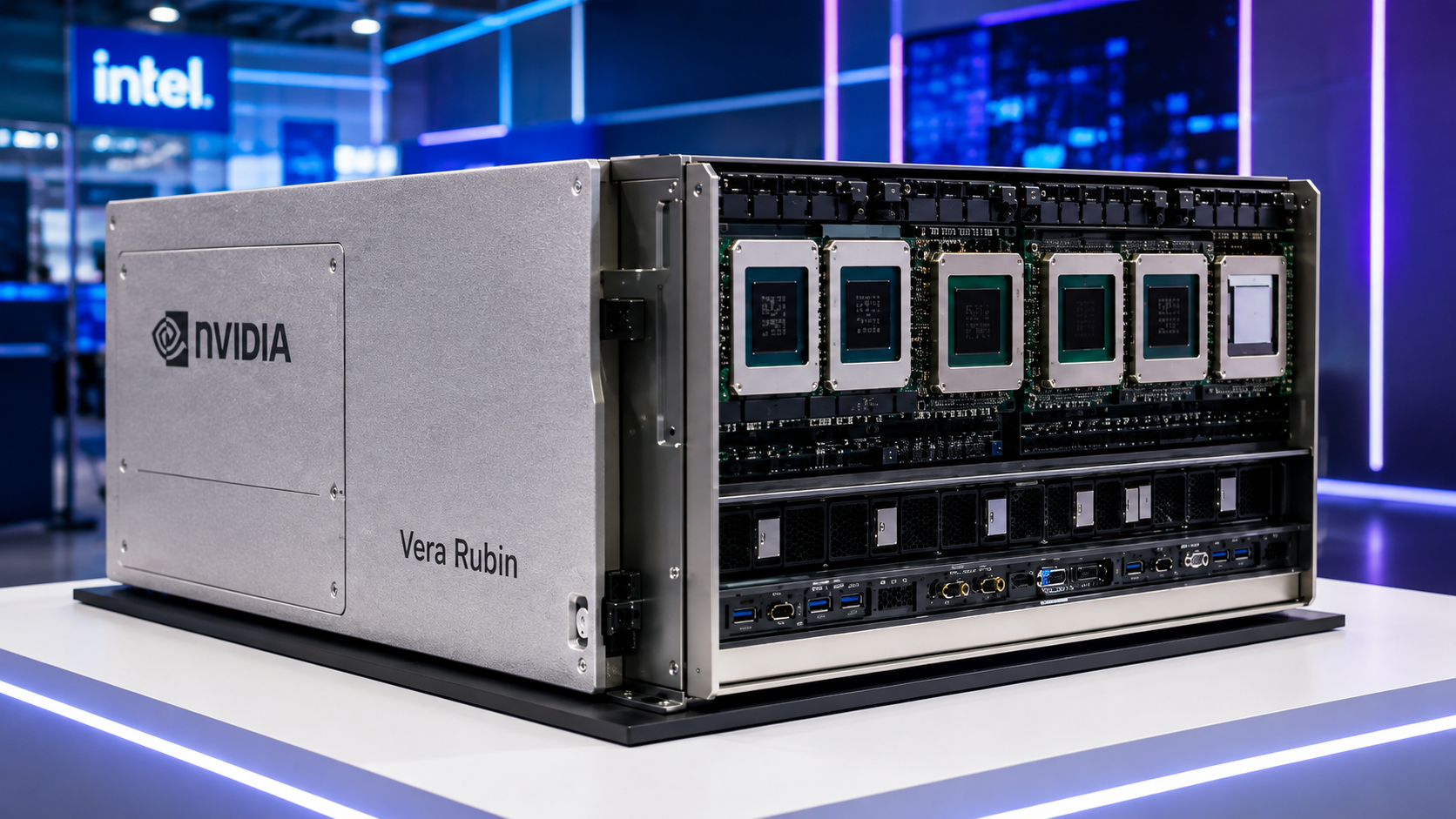
Built as a complete AI factory platform rather than a standalone processor, Vera Rubin combines new GPUs, CPUs, networking technologies, and software into a unified architecture designed for large-scale AI training and inference. NVIDIA claims the platform delivers up to 5× higher inference performance per rack than the previous generation while significantly lowering the cost of deploying large AI models and agent-based applications.
🚀 Mass Production Begins Ahead of Expectations #
For months, industry observers speculated that Vera Rubin might slip into late 2026 due to the complexity of its design and supply chain requirements. NVIDIA’s COMPUTEX announcement directly counters those concerns.
The company revealed that the Vera Rubin NVL72 platform is now in full production, following the earlier production ramp of the Vera CPU. This achievement highlights NVIDIA’s growing ability to execute large-scale AI infrastructure rollouts despite increasingly complex hardware requirements.
NVIDIA views Vera Rubin as the foundation of future AI factories—massive AI data centers designed to train, deploy, and operate next-generation AI agents and large language models at unprecedented scale.
🖥️ A Six-Chip Architecture Designed for AI Factories #
Unlike traditional server platforms built around separate CPUs and GPUs, Vera Rubin is a tightly integrated AI computing architecture composed of six major silicon components.
Together, these technologies create a highly optimized environment for AI workloads while improving scalability, efficiency, and security.
Rubin GPU #
The Rubin GPU serves as the platform’s primary AI accelerator.
Key highlights include:
- 33.6 billion transistors
- Up to 50 PFLOPs of NVFP4 inference performance
- Approximately 5× higher inference throughput than Blackwell
- Around 3.5× higher training performance
- HBM4 memory with 22 TB/s bandwidth
- 2.8× greater memory bandwidth than the previous generation
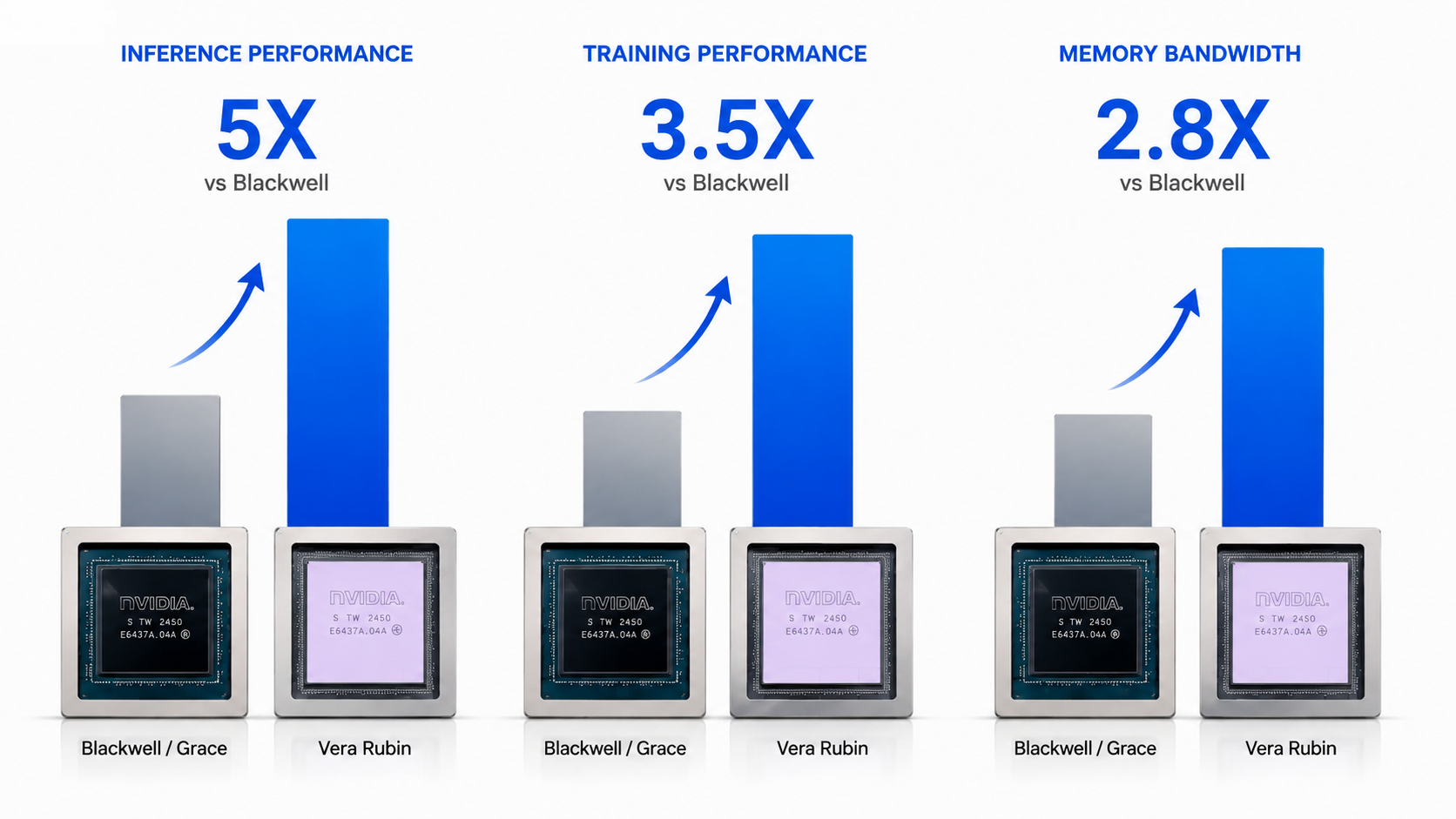
These improvements allow a single system to process significantly more AI requests while accelerating large-scale model training.
Vera CPU #
Complementing Rubin is the new Vera CPU, built on NVIDIA’s custom Olympus Arm cores.
Major specifications include:
- 88 CPU cores
- 176 threads
- Spatial multithreading architecture
- 3× larger memory capacity than Grace
- Up to 2× higher performance in data processing and CI/CD workloads
- Support for rack-level confidential computing
Rather than competing directly with traditional enterprise CPUs, Vera is optimized to maximize overall AI factory efficiency.
🌐 Next-Generation Networking and Interconnects #
AI performance increasingly depends on networking efficiency, particularly as clusters scale into thousands or even millions of accelerators.
To address this challenge, Vera Rubin integrates several new networking technologies:
NVLink 6 #
The sixth generation of NVLink dramatically expands GPU-to-GPU communication capacity.
Features include:
- Fully liquid-cooled switching architecture
- 3.6 TB/s fully connected bandwidth per CPU
- Higher scalability for rack-scale AI systems
ConnectX-9 SuperNIC #
Designed specifically for hyperscale AI deployments, ConnectX-9 delivers:
- 1.6 TB/s networking bandwidth
- Lower latency communication
- Improved efficiency for distributed AI workloads
BlueField-4 DPU #
BlueField-4 provides substantial gains over BlueField-3:
- 2× networking performance
- 6× compute performance
- 3× memory bandwidth
The DPU also enhances security, workload isolation, and infrastructure management.
Spectrum-X Silicon Photonics #
NVIDIA’s newest Spectrum-X platform introduces silicon photonics technology to AI networking.
The result is:
- Higher bandwidth density
- Improved energy efficiency
- Reduced networking bottlenecks
- Better scalability for future AI factories
🛡️ Enterprise-Grade Security and Reliability #
Large AI deployments increasingly require security features at every infrastructure layer.
Vera Rubin introduces several enterprise-focused capabilities, including:
- Rack-level Trusted Execution Environments (TEE)
- Confidential computing support
- Continuous health monitoring
- Zero-downtime diagnostic capabilities
These features are intended to support mission-critical AI deployments across enterprise, cloud, and government environments.
🤝 Broad Ecosystem Support Accelerates Adoption #
One of Vera Rubin’s most important advantages is the maturity of its ecosystem.
Major server manufacturers already preparing Vera Rubin-based systems include:
- Dell
- HPE
- Lenovo
- Supermicro
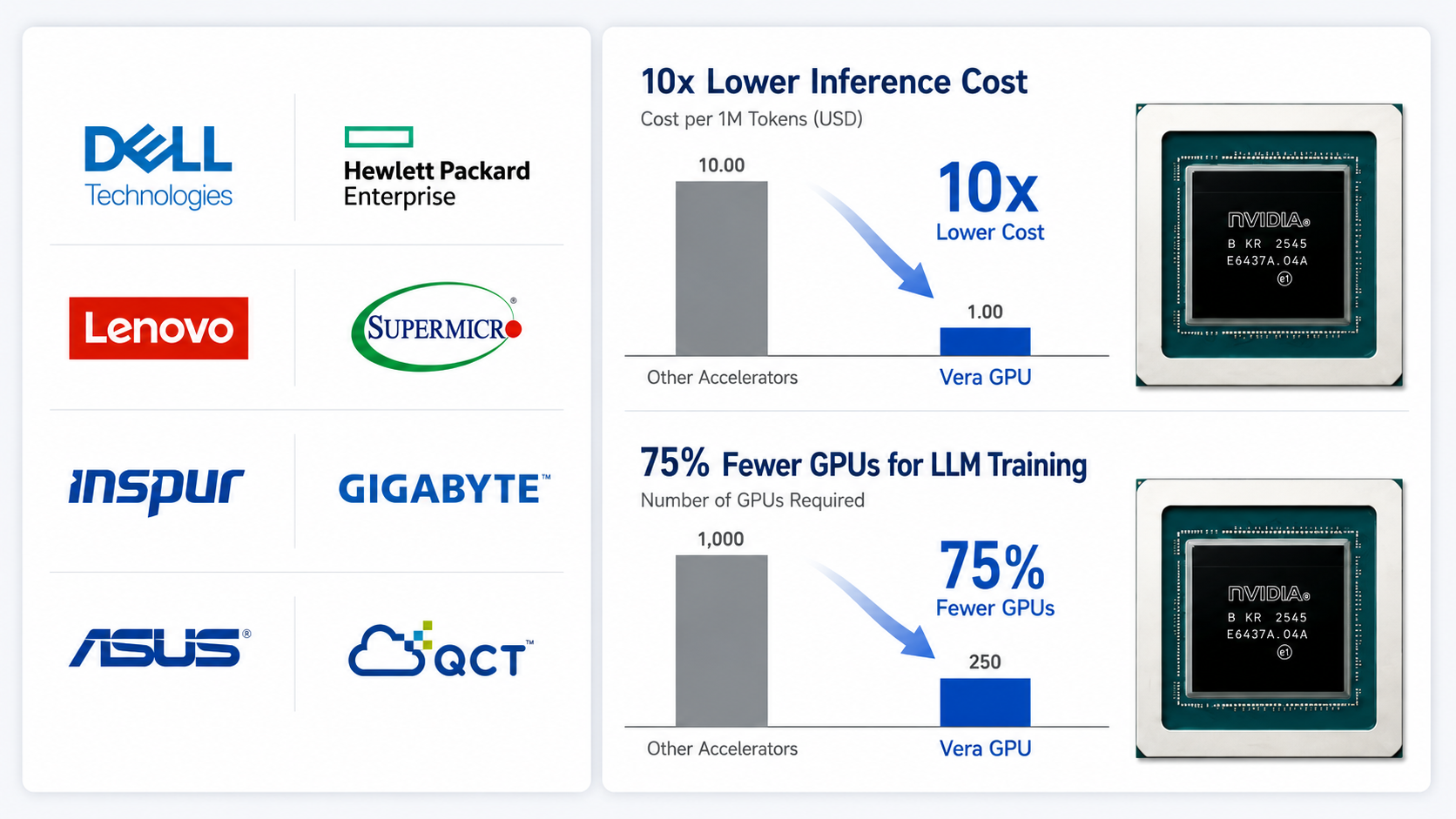
Additional partners across networking, storage, and system integration include:
- ASUS
- GIGABYTE
- Foxconn
- IBM
- QCT
This broad ecosystem allows customers to deploy fully validated solutions without extensive hardware integration efforts.
📉 Lower AI Costs and Faster Deployment #
NVIDIA claims Vera Rubin can significantly improve AI economics.
According to company estimates, the platform can:
- Reduce AI inference token costs by up to 10×
- Cut GPU requirements for MoE model training by as much as 75%
- Improve infrastructure utilization
- Increase AI factory throughput
The platform also integrates with NVIDIA’s software stack, including:
- Dynamo
- NIXL
- DOCA
Together, these tools help organizations deploy and manage large-scale AI environments more efficiently.
🏢 Solutions for Both Hyperscale and Mainstream Data Centers #
While the flagship NVL72 targets hyperscale AI factories, NVIDIA also introduced the DGX Rubin NVL8 for more conventional enterprise environments.
This dual-platform strategy allows organizations of varying sizes to access Rubin-based infrastructure without requiring the scale of a cloud hyperscaler.
As a result, businesses can begin adopting advanced AI workloads with lower deployment complexity and reduced capital requirements.
📈 Why Vera Rubin Matters #
The launch of Vera Rubin represents more than another GPU generation. It reflects NVIDIA’s broader strategy of transforming from a chip supplier into a provider of complete AI factory infrastructure.
By combining GPUs, CPUs, networking, security, software, and ecosystem support into a unified platform, NVIDIA aims to reduce the barriers that currently limit AI deployment at scale.
As enterprises increasingly adopt AI agents, large language models, and inference-heavy applications, platforms like Vera Rubin could play a central role in determining how quickly AI moves from experimentation into large-scale commercial deployment.