NVIDIA Unveils 88-Core Vera CPU, Built Specifically for the Agentic AI Era
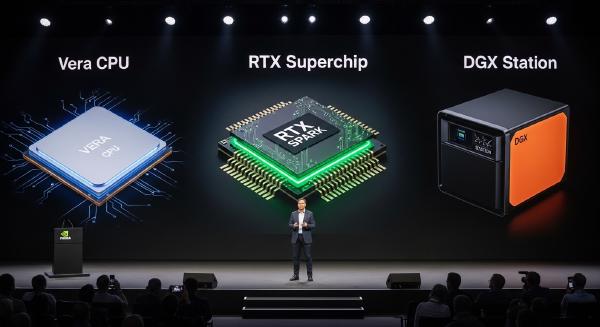
NVIDIA has officially introduced the Vera CPU, its first fully custom-designed processor and one of the most ambitious attempts yet to redefine the role of CPUs in AI infrastructure.
While NVIDIA has long dominated the GPU market, the company is now extending its influence deeper into the data center stack. Unlike traditional server processors designed primarily for general-purpose computing, Vera was engineered from the ground up to support the emerging world of Agentic AI—AI systems capable of reasoning, planning, using tools, managing context, and autonomously executing complex workflows.
According to NVIDIA, Vera can complete AI Agent workloads up to 1.8× faster than traditional x86 CPUs, while delivering significant gains in efficiency and scalability.
🚀 From AI Accelerators to Full-Stack Infrastructure #
The launch of Vera marks another step in NVIDIA’s transformation from a GPU supplier into a complete AI infrastructure provider.
The new processor will be deployed across multiple platforms, including:
- Standalone Vera-based servers
- Vera Rubin AI computing systems
- Vera BlueField-4 STX storage platforms
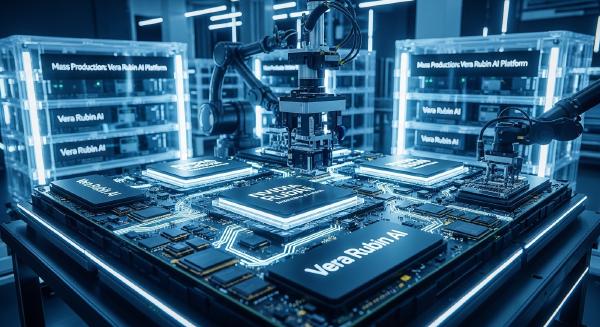
The CPU also forms a core component of the new Vera Rubin AI platform, which recently entered full-scale mass production and is expected to deploy at a significantly larger scale than the previous Grace Blackwell generation.
NVIDIA has indicated that the Vera Rubin ecosystem is already attracting broad industry adoption.
Planned deployments include major AI developers and cloud providers such as:
- Anthropic
- OpenAI
- xAI
- ByteDance
- CoreWeave
- Oracle Cloud Infrastructure
Meanwhile, leading server manufacturers including Dell, HPE, Lenovo, Supermicro, ASUS, Foxconn, GIGABYTE, QCT, Wistron, Wiwynn, Compal, and Pegatron are preparing Vera-powered systems for commercial deployment.
🔮 Built for the Age of AI Agents #
Traditional server CPUs were largely designed for applications such as databases, virtualization, web services, and enterprise software.
AI Agents introduce a very different workload profile.
Modern Agent systems frequently perform tasks such as:
- Multi-step reasoning
- Tool invocation
- Code execution
- Workflow orchestration
- Reinforcement learning
- Long-context memory management
- Data analysis
- Sandbox execution environments
These workloads often involve a mixture of sequential processing, memory-intensive operations, and frequent interactions with GPUs and external systems.
NVIDIA believes this trend will fundamentally reshape data center architecture.
As NVIDIA CEO Jensen Huang explained:
“AI Agents will become the largest user demographic of computing resources.”
Rather than merely supporting AI accelerators, Vera was designed specifically to maximize the efficiency of these emerging workloads.
⚙️ Vera Specifications #
At the heart of Vera is NVIDIA’s new Olympus architecture, based on the ARMv9.2-A instruction set.
Key specifications include:
| Feature | NVIDIA Vera |
|---|---|
| Architecture | Olympus (ARMv9.2-A) |
| Cores | 88 |
| Threads | 176 |
| L3 Cache | 162 MB |
| Memory Bandwidth | 1.2 TB/s |
| Interconnect | NVLink-C2C |
| NVLink Bandwidth | 1.8 TB/s |
| Socket Support | Dual Socket |
The processor combines high core density with extremely large memory bandwidth, making it particularly well suited for memory-intensive AI workloads.
🔥 Spatial Multi-Threading: NVIDIA’s Differentiator #
One of Vera’s most interesting innovations is its support for Spatial Multi-Threading (SMT).
Unlike conventional simultaneous multithreading implementations that share portions of execution resources between threads, NVIDIA claims its architecture enables two threads to execute simultaneously within a core more efficiently.
This approach is designed to improve utilization across AI Agent workloads that frequently alternate between computation, memory access, and orchestration tasks.
NVIDIA reports that Vera delivers:
- Up to 50% higher single-threaded performance than Grace
- Stronger performance under fully loaded conditions
- Better responsiveness for latency-sensitive AI operations
The company has also described Vera’s single-thread performance as among the strongest in the industry.
⚡ NVLink-C2C Pushes CPU-GPU Communication Forward #
Modern AI infrastructure increasingly depends on minimizing communication bottlenecks between CPUs and accelerators.
To address this challenge, Vera incorporates the latest NVLink-C2C interface.
The interconnect delivers:
- Up to 1.8 TB/s bandwidth
- 2× the throughput of Grace
- Roughly 7× the bandwidth of PCIe 6.0
This allows the CPU and GPU to exchange data far more rapidly than traditional server architectures.
For AI Agents that continuously move data between memory, storage, CPUs, and GPUs, this communication efficiency can have a major impact on overall system throughput.
🏭 The Foundation of Vera Rubin #
Although Vera is a standalone CPU, its most important role is likely within the broader Vera Rubin platform.
Unlike the Grace Blackwell generation, which focused primarily on accelerating large-scale AI training and inference, Vera Rubin is specifically optimized for Agentic AI workloads.
Within the platform:
- Rubin GPUs handle AI model execution
- Vera CPUs manage orchestration and reasoning workflows
- BlueField DPUs provide networking and security
- NVLink fabrics connect all resources into a unified system
The result is an AI factory architecture designed to maximize end-to-end productivity rather than focusing solely on raw GPU performance.
📈 NVIDIA’s Growing CPU Ambitions #
While Vera represents NVIDIA’s first fully custom CPU architecture, the company is not new to the processor market.
Its earlier Grace CPU has already achieved substantial deployment success, with nearly 2.5 million units shipped according to NVIDIA.
That experience provided the foundation for Vera’s development and gave NVIDIA valuable insight into how CPUs are used within modern AI data centers.
The company’s ambitions have also grown dramatically. NVIDIA has publicly stated that it expects to become one of the world’s largest CPU suppliers by the end of 2026, driven primarily by demand from AI infrastructure deployments.
🎯 Why Vera Matters #
The introduction of Vera reflects a broader shift occurring across the AI industry.
As AI evolves from simple inference engines into autonomous agents capable of long-running tasks, the supporting infrastructure must evolve as well. GPUs remain critical, but CPUs are increasingly responsible for coordinating workflows, managing memory, executing tools, and maintaining context.
Rather than competing directly against traditional server processors in every workload category, Vera targets a rapidly growing niche: AI-native computing environments.
If Agentic AI becomes as pervasive as NVIDIA expects, Vera may prove to be more than just another server CPU. It could become one of the foundational building blocks of the next generation of AI factories, helping redefine how data centers are designed for the era of autonomous AI systems.