
Samsung CXL Memory Modules and HBM3E Drive AI Scalability
At Memcon 2024, Samsung Electronics unveiled a new generation of scalable memory solutions, expanding its CXL (Compute Express Link) portfolio while showcasing its latest HBM3E technology. The announcements reinforce Samsung’s strategy to address one of the most pressing bottlenecks in AI infrastructure: memory scalability and efficiency.
As AI workloads continue to grow in size and complexity, traditional memory architectures are increasingly insufficient. Samsung’s approach combines high-bandwidth memory with composable, disaggregated memory systems to enable next-generation data center design.
🚀 Expanding the CXL Memory Ecosystem #
Samsung introduced enhanced CXL-based memory solutions, focusing on memory pooling and composability through its CMM (CXL Memory Module) product line.
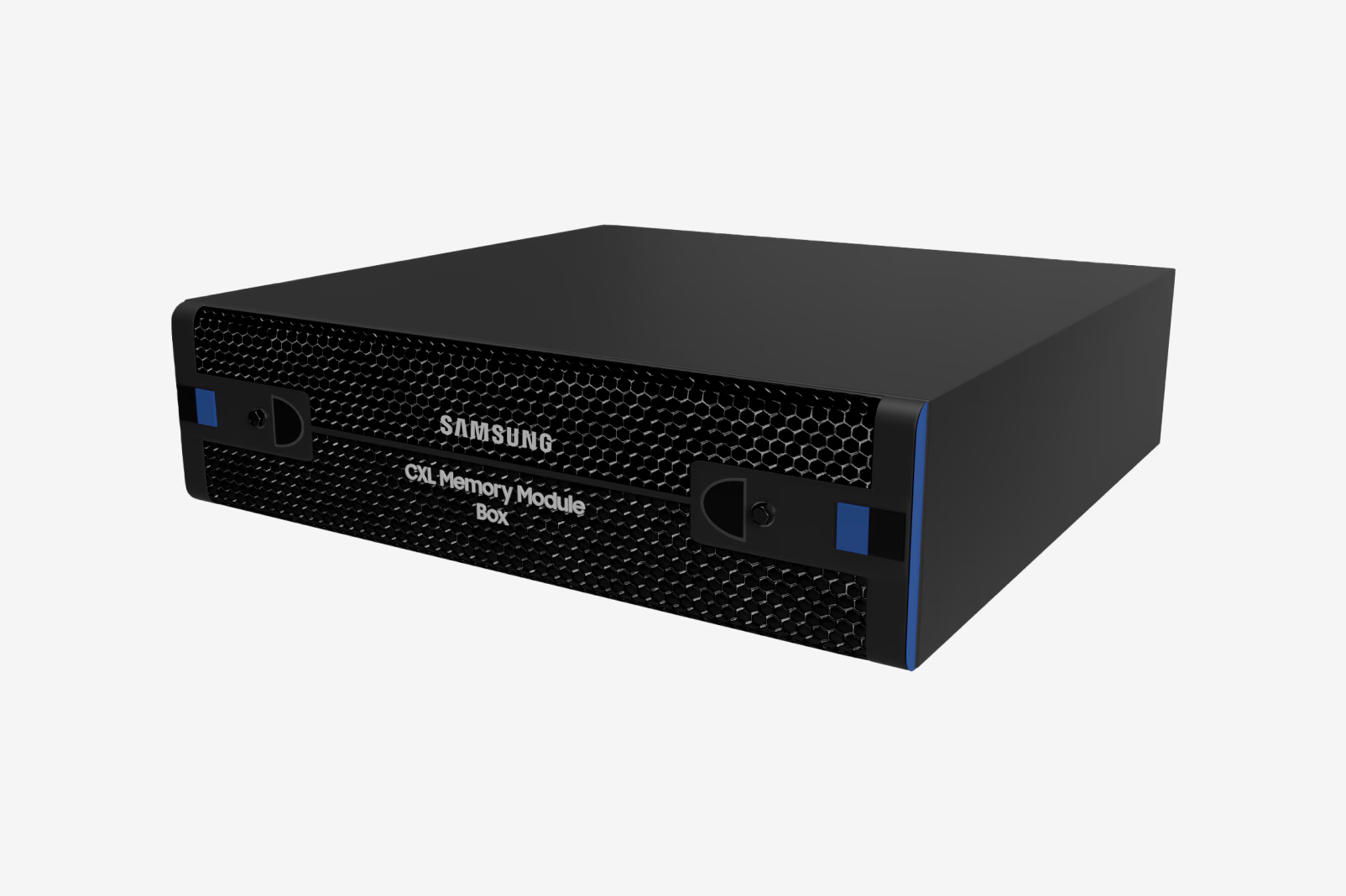
The flagship CMM-B platform represents a significant step forward:
- Supports up to eight CMM-D devices in an E3.S form factor
- Delivers up to 2TB of memory capacity per module
- Provides 60 GB/s bandwidth
- Achieves ~596 ns latency
This architecture enables memory expansion beyond traditional DIMM limitations, allowing systems to scale memory independently from compute resources.
Key use cases include:
- Large-scale AI model training and inference
- In-memory databases (IMDB)
- Real-time analytics platforms
By decoupling memory from CPU constraints, CXL enables more flexible and cost-efficient infrastructure design.
🏗️ Rack-Scale Memory with Composable Infrastructure #
In collaboration with Supermicro, Samsung demonstrated a rack-scale memory architecture built on CXL.
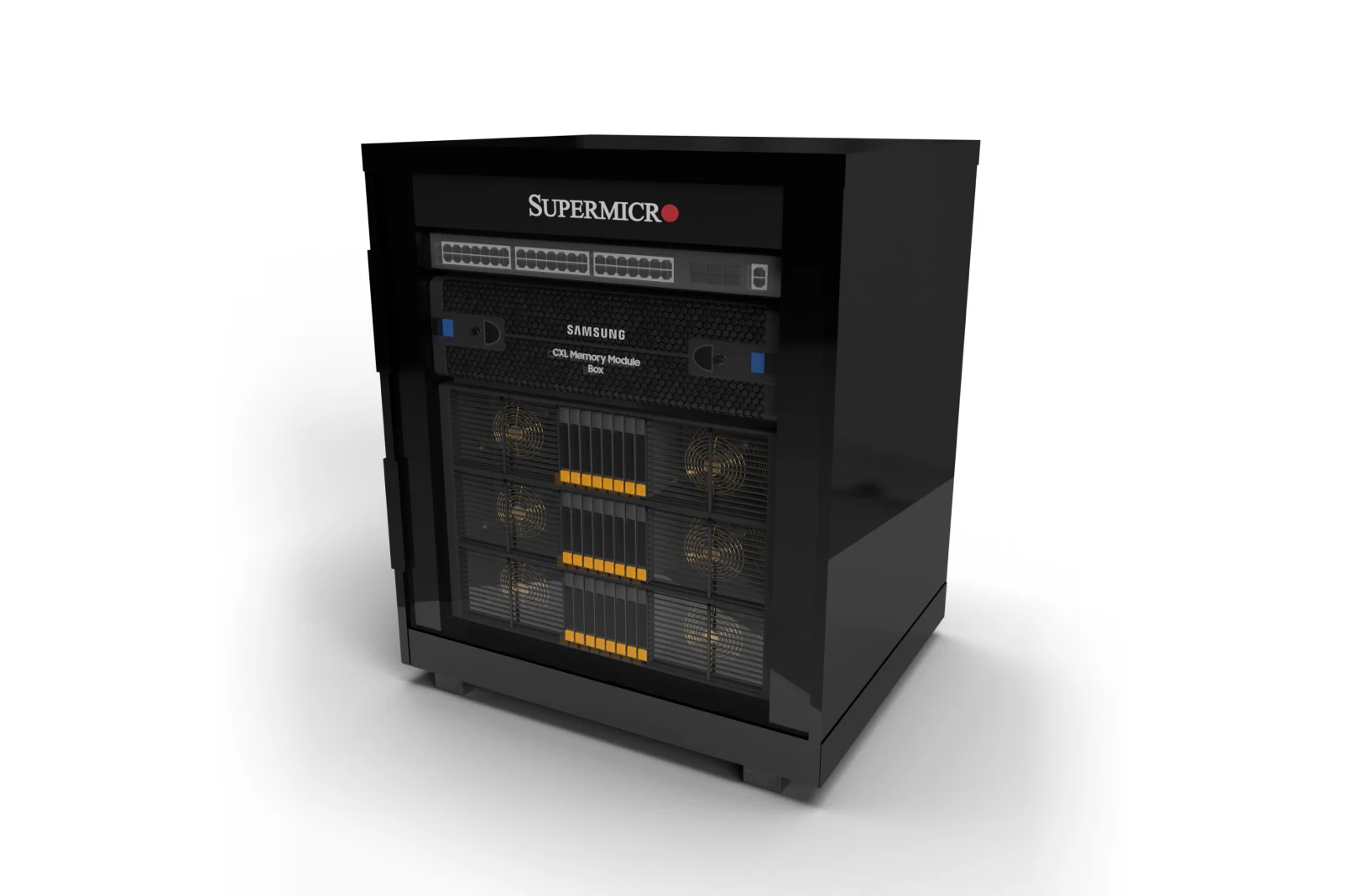
This solution introduces:
- Disaggregated memory pools accessible across servers
- Improved resource utilization compared to fixed memory architectures
- Higher throughput per server, reaching up to 60 GB/s
Unlike traditional tightly coupled systems, this composable model allows operators to dynamically allocate memory resources based on workload demand—critical for modern AI and cloud environments.
The result is a more elastic infrastructure capable of handling bursty, large-scale workloads without overprovisioning hardware.
🧠 Tiered Memory Innovation with Project Peaberry #
Samsung also introduced Project Peaberry, developed in collaboration with VMware by Broadcom.
This solution delivers the industry’s first:
- FPGA-based tiered memory system for hypervisors
- Hybrid memory module combining DRAM and NAND on a single add-in card
Key benefits include:
- Optimized memory tiering and scheduling
- Reduced system downtime
- Improved performance consistency
- Lower total cost of ownership (TCO)
By integrating hardware and hypervisor-level intelligence, this approach enables more efficient use of expensive DRAM while leveraging NAND as a secondary memory tier.
This is particularly relevant for virtualization-heavy environments where memory overcommitment and fragmentation are persistent challenges.
🔗 Advancing CXL with CMM-D and Open Ecosystems #
Samsung also highlighted its CMM-D modules, which integrate DRAM with the CXL open standard interface.
Key characteristics:
- Low-latency communication between CPU and memory expansion devices
- Standards-based interoperability across platforms
- Designed for broad ecosystem adoption
Red Hat has already validated Samsung’s CMM-D technology, marking an important milestone for production readiness and open-source integration.
Ongoing collaboration focuses on:
- Open-source CXL enablement
- Reference architectures for deployment
- Cross-vendor compatibility
This ecosystem-driven strategy is essential for accelerating CXL adoption across the industry.
⚡ HBM3E 12H: Pushing Bandwidth and Density Limits #
Alongside CXL innovations, Samsung showcased its latest HBM3E 12H DRAM.
This represents a major advancement in high-bandwidth memory:
- First 12-high stack HBM3E in the industry
- Over 20% increase in vertical density
- Improved manufacturing yield via TC NCF (Thermal Compression Non-Conductive Film) technology
HBM3E is critical for:
- GPU-accelerated AI workloads
- High-performance computing (HPC)
- Large-scale simulation and modeling
By increasing both density and efficiency, Samsung is addressing the growing demand for memory bandwidth in compute-intensive environments.
🤝 Ecosystem Collaboration Across Hardware and Software #
Samsung’s Memcon 2024 announcements emphasized strong collaboration across the stack:
- VMware by Broadcom contributing hypervisor-level memory tiering
- Red Hat enabling open-source validation and integration
- Supermicro delivering rack-scale system implementations
This full-stack approach reflects a shift in memory innovation—from isolated hardware improvements to tightly integrated hardware-software co-design.
🧩 Conclusion: Memory Becomes the New Scaling Frontier #
Samsung’s latest announcements underscore a fundamental shift in data center architecture: memory is no longer a passive component—it is a primary scaling vector for AI systems.
Key takeaways:
- CXL enables memory disaggregation and pooling at scale
- Tiered memory architectures reduce cost while maintaining performance
- HBM3E continues to push the limits of bandwidth and density
- Ecosystem collaboration is critical for real-world deployment
For system architects and infrastructure engineers, the implications are clear: designing for AI at scale now requires rethinking memory as a dynamic, composable resource rather than a fixed constraint.
As CXL adoption accelerates and HBM technologies evolve, memory architecture will play a central role in shaping the next generation of AI infrastructure.