
TSMC Maintains Lead Over Intel in Advanced AI Chip Packaging
A recent Citibank research report highlights that TSMC continues to hold a dominant position in the advanced packaging market for AI chips. Despite Intel’s efforts with EMIB-T, TSMC faces minimal near-term competitive pressure due to its mature ecosystem and established CoWoS technology.
🚀 AI-Driven Packaging Demand Growth #
The report emphasizes the explosive growth in demand for AI accelerators through 2026–2027, driven by technologies like CoWoS, SoIC, and CoPoS. Citi analysts identify advanced packaging capacity as the key bottleneck limiting global AI chip shipments, rather than logic scaling or raw compute availability.
🏗️ CoWoS Bottleneck vs Intel’s EMIB-T #
TSMC’s CoWoS (Chip-on-Wafer-on-Substrate) architecture integrates large HBM stacks with sizable logic dies on a silicon interposer, becoming the standard for AI GPUs. However, as GPU dies scale, interposer sizes approach lithography reticle limits, reducing yield and slowing capacity expansion.
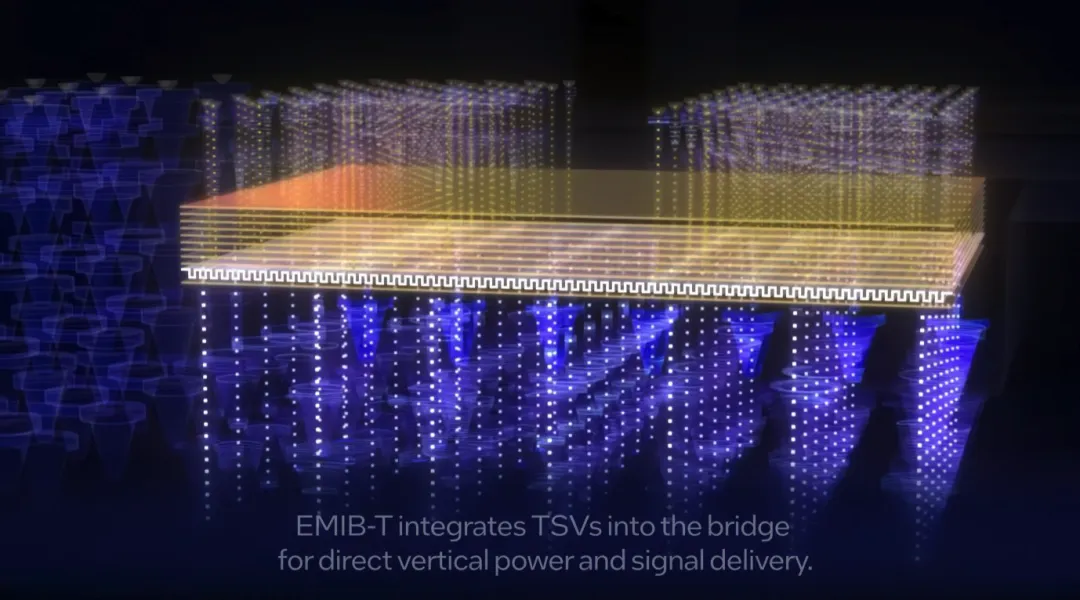
Intel’s EMIB-T offers an alternative by embedding small silicon bridges directly into an organic substrate, integrating TSVs (Through-Silicon Vias) for vertical routing of signals and power. This approach reduces interposer size and cost but introduces new substrate challenges.
CoWoS vs EMIB Architecture Comparison #
[CoWoS: Massive Silicon Interposer]
+---------------------------------------+
|   Logic Die   |   HBM3   |   HBM3    |
+---------------------------------------+
|=========== SILICON INTERPOSER ========| <-- High Cost / Reticle Limit
+---------------------------------------+
|             ABF Substrate             |
+---------------------------------------+

[EMIB-T: Localized Silicon Bridges]
+---------------------------------------+
|   Logic Die   |   HBM3   |   HBM3    |
+---------------------------------------+
|      | [Silicon Bridge] | [Bridge] |  | <-- Lower Cost / No Huge Interposer
+------+------------------+-------------+
|        ABF Substrate (with TSVs)      | <-- Higher Substrate Stress
+---------------------------------------+
While EMIB-T offers design flexibility and power efficiency advantages, the underlying ABF substrate becomes the new bottleneck for scaling.
🔒 Barriers to Intel Capturing Market Share #
Citi analysts identify two key challenges for Intel in displacing TSMC:
1. ABF Substrate Limitations #
CoWoS is constrained by silicon interposers, whereas EMIB-T shifts the stress to high-layer ABF substrates. These substrates demand precise warping control and high yields. Without rapid ABF supply chain expansion, EMIB-T scaling will mirror CoWoS bottlenecks.
2. 18A Node Evaluation vs Mass Production #
Rumors of Apple testing Intel’s 18A node highlight the industry’s standard practice of evaluating multiple foundries. Citi cautions that tape-outs do not guarantee mass-production contracts, and widespread adoption remains uncertain.
🔗 Ecosystem Lock-In (2027–2028) #
For HPC and AI chip designs scheduled for 2027–2028, switching from CoWoS to EMIB-T is increasingly impractical:
- Architecture Freeze: Major designs have largely finalized packaging and interconnect strategies.
- High Switching Costs: Moving to EMIB-T requires full redesigns of power delivery, thermal management, and signal integrity.
Comparative Summary #
| Metric | TSMC (CoWoS) | Intel (EMIB-T) |
|---|---|---|
| Core Bottleneck | Silicon Interposer Fabrication | High-Layer ABF Substrate Supply |
| Ecosystem Status | Mature, integrated with HBM and GPU designs | Emerging, evaluation stage only |
| Switching Friction | Extremely High | High, requires architectural redesign |
TSMC’s dominance stems not only from technology but also from a deeply entrenched ecosystem synchronizing GPU designers, HBM vendors, and power management ICs. Intel’s EMIB-T provides a viable alternative but lacks the ecosystem depth to challenge TSMC during the 2026–2027 AI surge.
Advanced packaging remains the critical battlefield for AI leadership, with TSMC’s CoWoS ecosystem firmly securing its position against Intel’s EMIB-T.