Why Lumentum Became a Critical AI Optical Interconnect Supplier
For years, many investors and technology observers mistakenly categorized Lumentum as a LiDAR company. The confusion largely stemmed from its historical involvement with VCSEL technology used in smartphone 3D sensing and the similarity of its name to automotive LiDAR vendors such as Luminar and Hesai. In reality, Lumentum has always been fundamentally a photonics and optical communications company.
Its recent surge in growth is not driven by autonomous driving or LiDAR adoption. Instead, the company has emerged as one of the key beneficiaries of the AI infrastructure boom, particularly in high-speed optical interconnects required by large-scale AI training clusters.
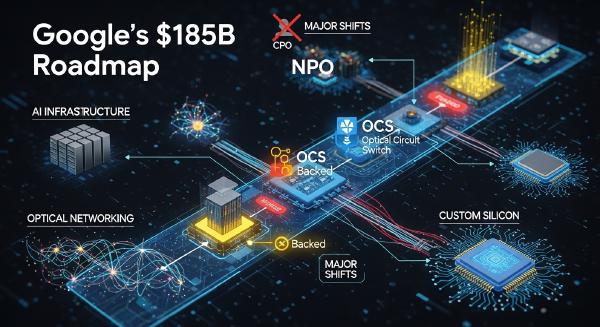
As AI computing scales beyond the limits of standalone GPUs, optical networking has become one of the most critical layers in modern data center architecture. Lumentum positioned itself at the center of this transition by expanding from optical components into system-level optical interconnect solutions.
🔍 From LiDAR Misconceptions to Deep Photonics Expertise #
Lumentum’s association with LiDAR is largely superficial. While its VCSEL technology can be adapted for LiDAR sensing applications, the company has never operated primarily as an automotive LiDAR vendor.
The company was spun off from JDS Uniphase in 2015 and inherited decades of expertise in photonics, lasers, and optical networking technologies. Its core competencies revolve around transmitting, amplifying, modulating, and sensing information using light.
Historically, Lumentum operated across several markets:
- Telecom optical networking
- Consumer electronics sensing
- Industrial and commercial lasers
- Optical communications infrastructure
For years, the market viewed Lumentum as a traditional cyclical telecom supplier whose performance depended heavily on:
- Telecom carrier capital expenditures
- Smartphone upgrade cycles
- Consumer electronics demand
This classification limited its valuation profile and often subjected the stock to sharp revenue swings and margin volatility.
🚀 AI Clusters Changed the Economics of Optical Networking #
The emergence of large language models fundamentally altered the infrastructure bottleneck inside hyperscale data centers.
In earlier generations of computing, performance gains primarily depended on faster individual processors or GPUs. In AI training environments, however, scalability increasingly depends on how efficiently thousands of GPUs communicate with each other across racks and data centers.
Training frontier AI models with hundreds of billions or even trillions of parameters requires:
- Massive GPU clusters
- Ultra-low latency communication
- Terabit-scale bandwidth
- High energy efficiency
Traditional copper interconnects struggle to meet these requirements at scale. As transmission speeds rise, copper links face significant limitations in:
- Signal integrity
- Distance
- Heat generation
- Power consumption
At hyperscale deployment levels, interconnect infrastructure can account for a substantial portion of total cluster energy consumption. Optical networking therefore shifted from being an optimization layer to an architectural necessity.
This transition created a major opportunity for companies capable of delivering high-speed optical connectivity solutions.
🧠 The Cloud Light Acquisition Transformed Lumentum #
Lumentum’s strategic pivot accelerated dramatically in 2023 when it acquired Cloud Light for approximately $750 million.
The acquisition gave Lumentum direct access to system-level optical transceiver capabilities, significantly expanding its role in AI networking infrastructure.
At the time of the acquisition:
- Cloud Light generated more than $200 million in trailing twelve-month revenue
- Nearly all revenue came from 400G-and-above optical modules
- Approximately half of revenue was tied to 800G optical products
These products aligned precisely with the networking requirements of hyperscale AI clusters operated by cloud service providers.
The acquisition allowed Lumentum to move beyond supplying individual optical components and become a vertically integrated provider spanning multiple layers of the optical networking stack.
⚙️ Building a Full-Stack AI Optical Interconnect Portfolio #
Following the Cloud Light acquisition, Lumentum established a three-layer product strategy:
Laser and Optical Components #
At the upstream level, Lumentum supplies laser chips and photonic components that form the foundation of high-speed optical communication systems.
High-Speed Optical Transceivers #
At the system level, the company now delivers advanced optical transceivers for:
- 400G networking
- 800G networking
- Emerging 1.6T platforms
These transceivers are essential for scaling AI clusters efficiently.
Co-Packaged Optics and Future Architectures #
Lumentum is also investing heavily in next-generation technologies such as:
- Co-Packaged Optics (CPO)
- Optical Circuit Switching (OCS)
These architectures aim to solve the growing bandwidth and power efficiency challenges inside AI data centers.
Unlike competitors focused solely on semiconductor chips or contract manufacturing, Lumentum now occupies a strategic middle layer that directly connects compute infrastructure at scale.
📈 Financial Performance Reflects the AI Infrastructure Boom #
Lumentum’s transformation became highly visible in its FY2026 Q3 financial results.
The company reported:
- Quarterly revenue of $808.4 million
- Year-over-year growth of 90.1%
- Non-GAAP operating margin of 32.2%
Revenue guidance also exceeded market expectations, signaling sustained demand momentum from hyperscale cloud customers.
One of the most important indicators was that several of the company’s core laser products entered supply-constrained conditions. Major cloud providers reportedly began securing long-term supply agreements to lock in production capacity.
This marked a significant shift in how the market perceives Lumentum. Rather than being viewed as a cyclical telecom supplier, the company is increasingly categorized alongside critical AI infrastructure vendors.
🌐 Why Optical Interconnects Matter in AI Infrastructure #
AI infrastructure discussions often focus almost entirely on GPUs. However, large-scale AI systems cannot function efficiently without ultra-fast communication between compute nodes.
Optical interconnects now serve as the backbone of modern AI clusters because they enable:
- High-bandwidth GPU-to-GPU communication
- Low-latency distributed training
- Scalable multi-rack architectures
- Energy-efficient networking
Without reliable optical networking, even the most powerful GPU clusters become bottlenecked by communication overhead.
As AI models continue scaling, networking bandwidth requirements are expected to grow aggressively alongside compute demand.
🔮 Long-Term Growth Drivers #
Several long-term industry trends continue to favor Lumentum’s positioning.
Migration Beyond 800G #
The optical networking industry is already transitioning toward:
- 1.6T optical modules
- 3.2T architectures
Each generational upgrade significantly increases photonics complexity and component demand.
Co-Packaged Optics Adoption #
CPO technology integrates optics directly with switching silicon, reducing:
- Power consumption
- Signal loss
- Latency
If adopted at scale, CPO could reshape AI networking architectures over the next several years.
Expansion of Hyperscale AI Infrastructure #
Cloud providers and AI platform operators continue investing heavily in:
- AI training clusters
- Inference infrastructure
- Distributed data center architectures
This directly increases demand for high-speed optical connectivity.
⚠️ Risks and Competitive Pressures #
Despite its strong positioning, Lumentum still faces meaningful risks.
Cyclical Demand Patterns #
The optical networking market remains sensitive to:
- Cloud provider spending cycles
- Inventory corrections
- Capacity digestion periods
Short-term order volatility can still impact revenue growth.
Technology Transition Risks #
The timelines for mass adoption of technologies such as:
- 1.6T optical modules
- CPO systems
- OCS deployments
remain uncertain.
Delays in industry adoption could temporarily slow growth momentum.
Intensifying Competition #
Lumentum faces growing competition from both established global players and aggressive Asian suppliers.
Competitors include:
- Coherent
- Fabrinet
- Chinese optical module manufacturers
Pricing pressure and market share competition are likely to intensify as AI infrastructure spending accelerates.
Valuation Expectations #
AI optical networking companies currently trade at elevated valuation multiples. Any disappointment in:
- Revenue growth
- Gross margins
- Capacity expansion
- Product ramp schedules
could trigger sharp valuation corrections.
🏁 Conclusion #
Lumentum’s rise illustrates how the AI boom extends far beyond GPUs and semiconductor accelerators. As AI clusters scale to unprecedented sizes, optical interconnect infrastructure has become a foundational requirement for modern computing architectures.
By combining deep photonics expertise with strategic acquisitions and vertical integration, Lumentum successfully repositioned itself from a traditional telecom optics supplier into a core enabler of AI infrastructure.
The company may not manufacture AI chips directly, but it provides the optical backbone that allows thousands of GPUs to function as a unified system. In the emerging AI era, that role is becoming increasingly indispensable.