Why Mac Mini Supply Is Tight: OpenAI, Anthropic and AI Agents
The Mac mini was never designed as a data center accelerator. It was a compact desktop for consumers and developers, valued for its low power consumption, small footprint, and relatively accessible price.
That role is changing.
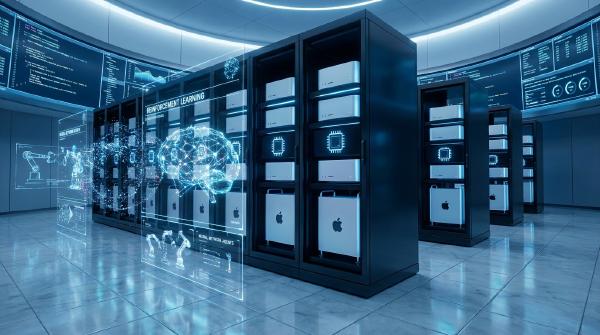
As AI agents become capable of operating graphical interfaces, executing multi-step workflows, and interacting with real applications, AI laboratories need large numbers of isolated operating environments in which those agents can train, test, evaluate, and repeatedly execute tasks. Macs provide something conventional GPU clusters do not: native access to a real macOS environment.
According to a report by The Information citing internal sources at OpenAI, the company has purchased tens of thousands of Mac mini and Mac Studio systems in recent months for reinforcement learning and computer-use agent development. Anthropic, meanwhile, has reportedly been renting substantial Mac compute capacity through Amazon AWS.
The significance is larger than a temporary hardware shortage. Macs are beginning to occupy a new position in the AI infrastructure stack.
They are not replacing Nvidia GPU clusters for frontier-model pretraining. Instead, they are becoming execution nodes, evaluation environments, trajectory-generation platforms, and local inference machines for the agent era.
🔮 Why AI Labs Need Thousands of Macs #
OpenAI and Anthropic already operate or access enormous quantities of GPU compute. The demand for Macs is driven by a different problem: AI agents need to interact with real computers.
Computer-use agents require real operating environments #
Traditional language-model training can be performed largely inside controlled numerical environments. Computer-use agents introduce another layer of complexity.
An agent may need to:
- Click buttons and navigate graphical interfaces
- Enter text into applications
- Open, move, and modify files
- Interact with browsers and desktop applications
- Manage authentication and permissions
- Execute multi-step workflows
- Recover from unexpected UI states
- Verify whether an operation produced the intended result
OpenAI’s computer-use research demonstrated this direction by training systems capable of directly interacting with graphical user interfaces.
At scale, the training infrastructure must repeatedly create operating-system environments, execute agent trajectories, record every interaction, evaluate outcomes, and feed successful or failed trajectories back into subsequent training.
That makes the physical computer itself part of the training infrastructure.
Macs become execution and evaluation nodes #
The most important distinction is that these Macs are unlikely to be replacing Nvidia accelerators for the primary training of frontier models.
A more realistic architecture looks like this:
              Central AI Training Cluster
                    Nvidia GPUs
                        │
                        │
                 Model Parameters
                        │
                        ▼
              ┌───────────────────┐
              │ Agent Controller  │
              └─────────┬─────────┘
                        │
          ┌─────────────┼─────────────┐
          │             │             │
          ▼             ▼             ▼
      Mac Node       Mac Node       Mac Node
       macOS          macOS          macOS
          │             │             │
          ▼             ▼             ▼
      Agent Task     Agent Task     Agent Task
          │             │             │
          └─────────────┼─────────────┘
                        │
                        ▼
                Trajectory Data
                        │
                        ▼
                Evaluation / RL
                        │
                        ▼
                Central Training
The Macs can provide thousands of parallel, reproducible environments for interaction-heavy workloads.
Their role can include:
- Agent execution
- Reinforcement-learning trajectory collection
- Task verification
- UI and application testing
- Local inference
- Model evaluation
- Post-training workloads
- Environment reset and replay
This division of labor is important. GPUs remain optimized for dense tensor computation and large-scale parameter updates, while Macs provide real operating-system environments in which agents can interact with applications.
Native macOS eliminates simulation gaps #
One reason physical Macs are attractive is that they eliminate some of the differences between simulated environments and real user systems.
A virtualized or simulated desktop may reproduce the appearance of an application while still behaving differently with respect to:
- UI rendering
- Window management
- Accessibility APIs
- File-system permissions
- Application compatibility
- Authentication flows
- System dialogs
- Background processes
- Hardware-dependent behavior
For a computer-use agent, these details are not peripheral. They are part of the environment the model must learn to control.
A large Mac fleet therefore functions less like a conventional server cluster and more like a distributed laboratory of real computers.
🧮 Why Apple Silicon Fits Local AI Workloads #
Apple Silicon adds another reason Macs are attractive for AI workloads: unified memory.
Unified memory changes the local inference equation #
Apple’s M-series architecture uses a Unified Memory Architecture in which the CPU, GPU, and Neural Engine can access a shared memory pool.
For local LLM inference, this avoids one of the major constraints of conventional consumer systems: limited discrete-GPU VRAM.
A workstation with a discrete GPU may have substantial system RAM but comparatively limited GPU memory. A model that does not fit into GPU VRAM must either be heavily quantized, partially offloaded, or split across devices.
Apple’s approach allows a large model to reside in a shared memory pool accessible to the system’s compute engines.
The trade-off is that unified memory is not equivalent to dedicated high-end accelerator memory in every workload. Memory bandwidth, compute throughput, software optimization, and workload parallelism still determine actual inference performance.
Nevertheless, for large quantized models, the capacity itself can be extremely valuable.
High-memory Mac Studio configurations #
The high-end Mac Studio configuration cited in the source material can reach 512 GB of unified memory with memory bandwidth of up to 1.2 TB/s.
That changes the type of model that can be loaded onto a single desktop-class machine.
Instead of asking only:
How many tokens per second can this accelerator generate?
AI developers can also ask:
Can the entire model fit locally, and can it run continuously without relying on cloud inference?
For agent workloads, the second question can be just as important.
An agent may need to maintain a model locally while continuously interacting with applications, processing documents, executing code, and evaluating intermediate results. A large shared memory pool makes this architecture considerably more practical.
Desktop thermal design matters #
Mac mini and Mac Studio systems also have an advantage over thin laptops: sustained thermal operation.
Agent workloads can run continuously for hours or days. A desktop system with active cooling is better suited to sustained workloads than a passively cooled or thermally constrained mobile device.
This makes compact desktop systems attractive as always-on nodes.
⚙️ Why the Mac Mini Is Particularly Attractive #
The Mac mini has several characteristics that become unusually valuable when thousands of machines are deployed as infrastructure.
Small footprint #
A Mac mini occupies very little physical space compared with a conventional workstation.
That makes high-density deployment easier in:
- Development labs
- Enterprise server rooms
- AI testing facilities
- Automated software-testing environments
- Private inference clusters
Low power consumption #
The Mac mini’s relatively low power requirements are important when the objective is to deploy hundreds or thousands of machines.
For distributed agent workloads, the relevant metric is not simply peak compute performance. Operators also care about:
- Performance per watt
- Cooling requirements
- Rack or shelf density
- Noise
- Power-delivery infrastructure
- Operational cost
A large fleet of low-power systems can therefore be economically attractive for workloads that do not justify expensive accelerator capacity.
Headless operation #
A Mac mini can operate without a conventional monitor, keyboard, and mouse once configured for remote management.
That makes it possible to treat the machine as an autonomous execution endpoint rather than as a traditional desktop PC.
The result is a product that was originally designed for individual users becoming a building block for distributed AI infrastructure.
🍎 Apple Is Beginning to Treat AI Infrastructure as a Market #
Apple appears to be recognizing that the demand for Macs is no longer limited to conventional desktop computing.
The Mac mini was historically positioned as Apple’s entry-level desktop. According to the Wall Street Journal, it represented only a small portion of Apple’s overall U.S. Mac sales in the preceding period.
The AI-agent market changes the economics.
A developer running a private agent continuously may want a dedicated Mac that remains online around the clock. An enterprise may want dozens or hundreds of machines for automated testing. An AI laboratory may need thousands of identical macOS environments for reinforcement-learning experiments.
That creates demand for configurations very different from the typical consumer purchase.
Enterprise demand exposes a gap in Apple’s strategy #
The emergence of AI infrastructure demand also highlights a historical weakness in Apple’s enterprise strategy.
Apple’s hardware and operating systems have strong developer appeal, but the company has not traditionally built the same enterprise engineering and developer-relations ecosystem around Mac infrastructure that companies such as Nvidia have built around data-center AI.
Reports citing former Apple enterprise AI marketing personnel have suggested that the Mac’s emergence in AI infrastructure was somewhat unexpected.
That may now be changing.
Apple reportedly held a closed-door enterprise event at Apple Park in June, with Anthropic co-founder Jared Kaplan among the attendees. The Mac mini was reportedly a major focus of the event.
The timing is notable: enterprise AI workloads are turning a consumer desktop into infrastructure.
Apple’s product positioning is shifting #
The newer generation of Mac hardware is increasingly marketed around AI-related capabilities, including:
- On-device AI
- Large-model inference
- Local model development
- Model fine-tuning
- High-capacity unified memory
- Multi-machine AI workloads
Apple has also highlighted the ability to connect multiple Macs through Thunderbolt 5 for distributed AI workloads.
According to Apple’s published specifications and marketing, multi-Mac configurations can provide substantially higher aggregate AI inference performance than a single machine under suitable workloads.
The strategic message is clear: Apple increasingly wants developers to think of Macs not merely as endpoints, but as local AI compute systems.
💰 Rising Mac Prices Reflect More Than Chip Upgrades #
The same trend creates an uncomfortable side effect for consumers.
High-memory configurations are particularly attractive to AI developers because memory capacity directly affects the size of models that can be loaded locally. That makes RAM configuration a much more important purchasing variable than it was for conventional desktop workloads.
The source material cites a starting price of RMB 6,999 for the newer M6 Mac mini in China, compared with RMB 4,499 for an M4 Mac mini with 16 GB of memory in 2024.
That represents an increase of roughly 56% in the entry price over two years.
Processor upgrades explain part of the difference, but memory and storage costs are also significant.
The broader memory market is under pressure from AI infrastructure demand, with data centers consuming enormous quantities of DRAM and NAND. At the same time, local AI systems increasingly favor machines with large memory capacities.
The result is a feedback loop:
AI Data Centers
      │
      ▼
Higher DRAM / NAND Demand
      │
      ▼
Higher Memory Costs
      │
      ├───────────────┐
      ▼               ▼
Cloud AI          Local AI
Infrastructure    Workstations
      │               │
      └───────┬───────┘
              ▼
        Higher Memory
           Demand
              │
              ▼
      Higher Hardware Costs
              │
              ▼
       Supply Constraints
Consumers are therefore competing indirectly with AI infrastructure for some of the same memory and storage resources.
📈 Mac Sales Are Already Benefiting From AI Demand #
AI-related demand is beginning to appear in Apple’s financial results.
Apple’s Mac business generated approximately $10.352 billion in Q3 FY2026 revenue, representing roughly 28.7% year-over-year growth according to the figures cited in the source material.
The Mac’s growth cannot be attributed exclusively to AI infrastructure. Consumer upgrades, professional workloads, product launches, and broader market conditions all contribute.
However, enterprise and developer demand for high-memory Macs introduces a new growth vector that did not exist at the same scale previously.
The important change is qualitative:
The Mac is no longer competing only for desktop users. It is increasingly competing for infrastructure budgets.
🖥️ Nvidia Is Moving in the Same Direction #
Apple is not alone in pushing AI compute toward the desktop.
Nvidia’s DGX Spark and the RTX Spark platform represent a parallel strategy: compressing capabilities traditionally associated with data-center AI systems into desktop-class machines.
RTX Spark targets personal AI agents #
RTX Spark combines Nvidia’s Grace CPU architecture with Blackwell GPU technology and a large unified-memory architecture.
The platform is designed around workloads such as:
- Local LLM inference
- AI development
- Personal agents
- Model experimentation
- Generative AI
- Developer workloads
Nvidia’s software advantage is particularly significant.
CUDA, TensorRT, and the broader RTX ecosystem provide an established stack for AI developers who already build around Nvidia accelerators.
This creates a fundamentally different proposition from Apple Silicon.
Apple and Nvidia have different strengths #
| Capability | Apple Silicon | Nvidia RTX / Spark |
|---|---|---|
| Memory architecture | Unified memory | Large unified-memory configurations |
| AI software ecosystem | Apple frameworks / Metal | CUDA / TensorRT / RTX |
| Operating environment | macOS | Windows / Linux ecosystem |
| Local LLM inference | Strong memory capacity | Strong accelerator performance |
| Agent workloads | Native macOS automation | Broad Windows AI ecosystem |
| Developer ecosystem | Apple developers | Mature AI/ML ecosystem |
| Power efficiency | Major strength | Higher-performance accelerator focus |
| Enterprise AI infrastructure | Emerging | Established |
| Desktop AI strategy | Mac mini / Mac Studio | RTX Spark / DGX Spark |
Neither platform completely dominates the other.
Apple’s advantage is the combination of memory capacity, power efficiency, and a native macOS environment.
Nvidia’s advantage is its enormous software ecosystem, mature accelerator architecture, and deep integration with modern AI development workflows.
🔬 Desktop AI Will Not Replace Data Centers #
It is important not to overstate this trend.
A Mac mini cluster cannot replace a large Nvidia GPU cluster for frontier-model pretraining. The two architectures solve fundamentally different problems.
Large data centers remain essential for:
- Foundation-model pretraining
- Large-scale distributed training
- Massive tensor operations
- High-throughput parameter updates
- Large batch processing
Desktop AI systems are better suited to workloads where proximity to the operating environment matters more than absolute compute density.
These include:
- Agent execution
- Reinforcement-learning trajectories
- Application testing
- Model evaluation
- Local inference
- Developer experimentation
- Private enterprise workloads
- Data-sensitive workflows
This creates a new layer in the AI infrastructure hierarchy.
                    AI Infrastructure
                           │
        ┌──────────────────┼──────────────────┐
        │                  │                  │
        ▼                  ▼                  ▼
   Data Centers       Edge / Desktop      Endpoints
        │                  │                  │
        ▼                  ▼                  ▼
  Foundation Model    Agent Execution    User Interaction
      Training        Evaluation         AI Applications
        │                  │                  │
        └──────────────────┼──────────────────┘
                           ▼
                    Distributed AI
The future architecture is therefore likely to be heterogeneous rather than centralized.
🌐 The Mac Mini Is a Signal of the Agent Era #
The most interesting part of the Mac mini shortage is not the shortage itself.
It is what the shortage reveals about where AI infrastructure is going.
For years, the dominant AI architecture was straightforward: concentrate expensive accelerators in massive data centers and expose them through cloud APIs.
Agentic AI changes that model.
An autonomous agent needs access to files, applications, browsers, operating systems, credentials, enterprise data, and user interfaces. Moving every interaction through a remote cloud environment can introduce latency, privacy concerns, compatibility problems, and operational complexity.
That makes local compute increasingly valuable.
The resulting architecture could distribute AI workloads across multiple layers:
- Cloud GPUs for large-scale model training
- Enterprise accelerators for centralized inference
- Desktop AI systems for agents and development
- Local machines for privacy-sensitive workloads
- Edge devices for latency-critical applications
The Mac mini happens to fit unusually well into this emerging middle layer.
Its compact form factor, relatively low power consumption, macOS environment, and Apple Silicon unified memory make it useful for workloads that were not part of its original design brief.
From personal computer to AI infrastructure #
The Mac’s transformation can be summarized in one sentence:
The computer is becoming part of the agent’s environment rather than merely the user’s interface to AI.
That is why OpenAI’s reported Mac purchases matter.
The company is not abandoning GPUs. It is building the physical environments in which increasingly autonomous AI systems can learn how to use computers.
Anthropic’s demand for Mac compute points in the same direction.
Apple and Nvidia are now competing for this emerging desktop AI layer, while enterprises and AI laboratories are beginning to treat high-memory desktops as infrastructure rather than consumer electronics.
The cloud is still the center of AI computation.
But the next generation of AI systems may increasingly depend on thousands—or millions—of smaller compute nodes distributed across offices, homes, laboratories, and enterprise environments.
The Mac mini’s rise is an early indication that the AI hardware race is moving beyond the data center.
The next AI battlefield may be sitting on every desk.