
192 AA Batteries Successfully Power an AMD Ryzen PC
Hardware modder Uwos Lab has demonstrated an unconventional way to power an AMD Ryzen desktop: 192 standard AA batteries. Instead of using a conventional ATX power supply, the experimental system delivered 12V DC directly to the motherboard through a DC-to-ATX adapter.
The battery-powered AM4 system successfully booted, remained stable during stress testing, and ran games without interruption. While the approach is far from practical for everyday desktop use, the experiment demonstrates how a carefully configured battery array can deliver enough power for a functional Ryzen-based PC.
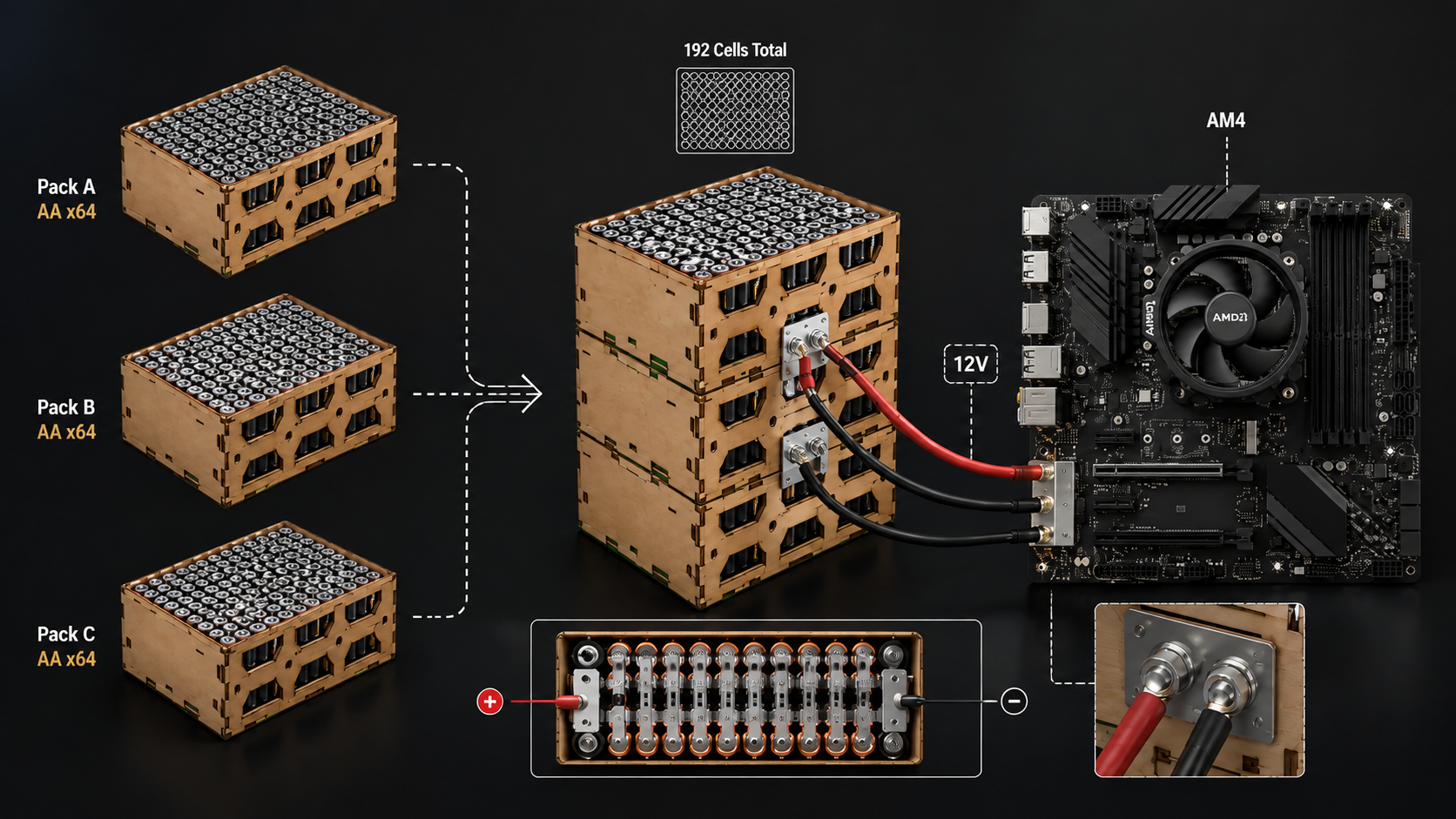
🔋 192 AA Batteries Form a 12V Desktop Power Source #
The project followed an earlier unsuccessful attempt by Uwos Lab to power a desktop using 9V batteries. For the second experiment, the modder switched to readily available AA batteries and designed a custom battery array.
The setup consisted of three independently constructed battery packs, each containing 64 AA batteries. Within each pack, eight batteries were connected in series to produce approximately 12V.
The three packs were then connected to form a single high-capacity battery source containing 192 cells.
Laser-cut wooden frames were used to organize and secure the batteries, while soldered wiring connected the individual packs into the final power system.
Direct DC-to-ATX conversion #
Rather than converting the battery output from DC to AC and then back to DC through a conventional desktop PSU, the experiment used a dedicated 12V DC-to-ATX adapter.
The adapter converts the incoming 12V DC supply into the motherboard connections required by the system, including the 24-pin ATX connector and 8-pin CPU power connector.
This approach avoids the additional conversion stage of a traditional AC-powered desktop and provides a relatively direct path from the battery array to the motherboard.
🧪 Ryzen System Passes Stress Tests and Runs Games #
After verifying that the battery array was producing usable power, Uwos Lab booted the system and tested its stability under real workloads.
The experimental PC ran Hannah Montana Linux, selected at the request of the livestream audience, and remained operational throughout multiple stability tests.
The system also ran FreeDoom, an open-source implementation inspired by the classic Doom engine, without crashes or unexpected shutdowns.
Battery runtime and voltage drop #
The battery array powered the system continuously for approximately 30 minutes during testing.
Voltage dropped from roughly 13V at the beginning of the test to 11.95V afterward. Based on the observed discharge rate, the remaining battery capacity was estimated to provide another one to two hours of operation.
That would put the theoretical total runtime at more than 90 minutes under the tested workload, although actual runtime would depend on battery chemistry, load, discharge characteristics, and the efficiency of the DC-to-ATX converter.
Approximately 100W system power consumption #
The test system did not use a discrete graphics card. Instead, it combined an AMD Ryzen G-series processor with a compatible AM4 motherboard and relied on integrated graphics.
System power consumption was approximately 100W during operation. That is a significant load for a battery-powered desktop and demonstrates that the 192-cell array was capable of sustaining considerably more than a brief boot sequence.
The experiment therefore tested not only whether the Ryzen system could start from batteries, but whether the battery configuration could sustain meaningful computing workloads.
💰 AA Batteries Make the Setup Impractical for Daily Use #
Despite successfully powering the Ryzen desktop, the configuration is not economically viable as a replacement for a conventional power supply.
The experiment relied on disposable, non-rechargeable AA batteries. With approximately 100 batteries costing around $30 at typical retail prices, purchasing 192 cells for every comparable setup would quickly become expensive.
The energy density, cost, physical size, and limited reusability of disposable AA batteries make them poorly suited to long-term desktop operation.
A rechargeable battery pack or purpose-built portable power station would be substantially more practical for anyone seeking battery-powered computing.
A successful proof of concept #
As a hardware-modification experiment, however, the project achieved its primary objective. It demonstrated that a Ryzen-based desktop can operate from a large array of conventional AA batteries when the voltage and power delivery system are properly configured.
The project also highlights an important distinction between technical feasibility and practical engineering. Supplying approximately 100W to a desktop from batteries is possible, but doing so economically and efficiently requires a much more suitable energy-storage technology than disposable AA cells.
Future experiments could explore alternative battery technologies, including repurposed rechargeable cells, although any such modification would require careful consideration of cell matching, protection circuitry, current delivery, thermal management, and electrical safety.
For now, the 192-AA-battery Ryzen PC remains exactly what it was intended to be: an entertaining but technically meaningful demonstration of unconventional desktop power delivery.