AMD RDNA 5 Leak: RX 10000 Specs, EXPO ULL Memory, and FSR 8X Revealed
AMD appears to be preparing one of its most comprehensive graphics platform upgrades in years. Recent leaks have revealed extensive specifications for the upcoming RDNA 5 architecture, widely rumored to power the Radeon RX 10000 series. At the same time, the first independent benchmarks for AMD EXPO Ultra Low Latency (ULL) DDR5 memory have demonstrated measurable gaming improvements, while newly discovered entries inside Radeon drivers suggest that FidelityFX Super Resolution (FSR) is preparing for its largest feature expansion yet.
Taken together, these developments span hardware architecture, memory optimization, and AI-assisted graphics technologies, signaling AMD’s continued effort to strengthen its competitiveness across the PC gaming ecosystem.
🚀 RDNA 5 Specifications Leak: A New Generation Takes Shape #
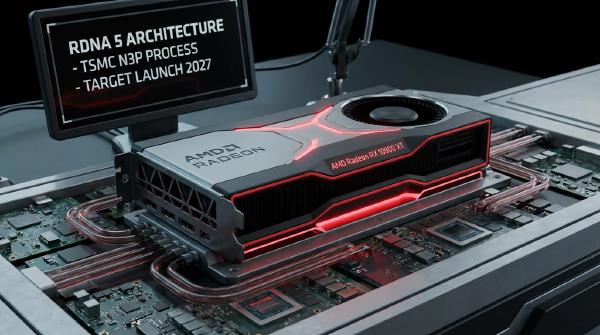
According to information circulating within the enthusiast community, AMD’s next-generation RDNA 5 graphics architecture carries the internal codename Alpha Triton (AT) and is expected to be manufactured using TSMC’s N3P process technology.
The largest silicon variant, known internally as AT0, reportedly integrates 192 Compute Units (CUs). However, this fully enabled die is expected to target AI accelerators rather than consumer graphics cards. Gaming products will instead utilize partially enabled versions of the architecture.
The leaked lineup currently consists of four primary desktop GPUs.
RX 10050 XT (AT4) #
The entry-level desktop model reportedly features:
- 24 Compute Units
- 12–16GB LPDDR5X memory
- Estimated rasterization performance comparable to the GeForce RTX 3070
- Expected pricing between $300 and $350
RX 10060 XT (AT3) #
Moving into the mainstream enthusiast segment, the RX 10060 XT is rumored to include:
- 48 Compute Units
- 16–24GB LPDDR5X memory
- Rasterization performance approaching the RTX 4080 Super
- Estimated price between $450 and $550
RX 10070 XT (AT2) #
Targeting the upper enthusiast market:
- 68 Compute Units
- 16–24GB GDDR7 memory
- Performance targeting NVIDIA’s RTX 5080
- Expected pricing between $700 and $800
RX 10090 XT (AT0) #
The flagship gaming model reportedly includes:
- 96 Compute Units
- 24–36GB GDDR7 memory
- Gaming performance approaching the RTX 5090
- Estimated price between $1,000 and $1,200
Notably, the leaked roadmap does not mention an RX 10080 XT model.
Clock frequencies reportedly range from approximately 3.5 GHz on entry-level products to roughly 3.0 GHz on the flagship, while memory bandwidth scales from around 160 GB/s to 1.71 TB/s depending on memory configuration.
💾 LPDDR5X Arrives on Desktop GPUs? #
Perhaps the most surprising aspect of the leak is AMD’s apparent decision to employ LPDDR5X memory on its lower-end desktop graphics cards.
Historically, discrete desktop GPUs have relied almost exclusively on GDDR memory due to its superior bandwidth. LPDDR memory has primarily been associated with notebooks, handheld gaming systems, and mobile devices.
Why LPDDR5X? #
Although LPDDR5X delivers lower raw bandwidth than GDDR7, modern GPU architectures increasingly compensate through advanced compression techniques, including:
- Delta Color Compression (DCC)
- Depth Buffer Compression
- Frame Buffer Compression
These technologies reduce effective memory traffic, allowing lower-bandwidth memory to deliver competitive real-world gaming performance under many workloads.
AMD’s decision may serve multiple objectives:
- Lower overall manufacturing costs
- Reduced board power consumption
- Smaller PCB complexity
- Validation of LPDDR technologies for future APUs and handheld gaming platforms
If accurate, this would represent one of AMD’s most unconventional desktop GPU memory strategies to date.
⚡ RDNA 5 Architectural Improvements #
Beyond memory configuration, RDNA 5 is expected to introduce meaningful architectural enhancements.
According to the leak:
- Ray tracing performance could improve by roughly 2× over RDNA 4.
- Traditional rasterization performance is expected to increase by approximately 10% generation over generation.
This suggests AMD may prioritize closing the ray tracing performance gap while continuing incremental improvements to conventional rendering.
🎮 EXPO Ultra Low Latency DDR5 Delivers Measurable Gaming Gains #
Another recent development concerns AMD’s EXPO Ultra Low Latency (ULL) memory profile, first introduced during Computex 2026.
Independent testing has now begun to validate AMD’s official performance claims.
EXPO ULL allows users to enable optimized memory timing profiles directly through the motherboard BIOS, simplifying latency tuning without requiring extensive manual adjustment.
Test Configuration #
Early benchmarks utilized:
- Ryzen 7 9700X
- G.Skill Trident Z5 NeoX DDR5-6000 CL36 EXPO ULL
- Standard DDR5-6000 CL30 kit
- DDR5-5600 CL40 kit
This comparison highlights how optimized memory profiles perform relative to both premium and mainstream DDR5 configurations.
Gaming Performance Results #
Testing produced the following average improvements.
| Game | Average FPS Gain | 1% Low Improvement |
|---|---|---|
| F1 25 | +4.3% | +3.8% |
| Cyberpunk 2077 | +4.5% | +5.5% |
| Baldur’s Gate 3 | ≤2% | Minor |
The observed results closely match AMD’s advertised average improvement of approximately 4% across a larger collection of games.
Importantly, improvements in 1% low frame rates indicate smoother gameplay with reduced frame pacing inconsistencies.
💰 Is EXPO ULL Worth the Premium? #
At launch, a 32GB EXPO ULL memory kit carries an approximate premium of $30 over equivalent non-ULL products.
Compared to certain enthusiast memory kits commanding substantially larger premiums, EXPO ULL currently occupies a relatively attractive pricing position.
Manual Memory Tuning vs. EXPO ULL #
Experienced overclockers may already achieve similar or even better latency characteristics by manually adjusting:
- primary timings
- secondary timings
- tertiary timings
- memory controller parameters
However, manual optimization requires:
- significant BIOS tuning
- extensive stability testing
- a capable CPU memory controller (IMC)
EXPO ULL instead offers a validated, one-click optimization profile designed to deliver lower latency while maintaining platform stability.
For users seeking simple performance improvements without extensive tuning, this convenience may justify the modest price premium.
🔮 Radeon Drivers Hint at Major FSR Evolution #
The third major development comes from hidden entries discovered within AMD’s latest Radeon graphics drivers.
These findings suggest AMD is preparing significant enhancements for the FidelityFX Super Resolution ecosystem.
Among the newly discovered options are:
- 8× Frame Generation
- FSR Ray Regeneration
- Neural Radiance
While none of these features have been officially announced, their presence strongly indicates ongoing development.
8× Frame Generation #
Current FSR frame generation inserts a single AI-generated frame between two rendered frames, effectively doubling output.
The newly discovered implementation references 8× frame generation, potentially allowing multiple synthesized frames between traditionally rendered frames.
If successfully implemented, this would exceed the current generation multiplier available in NVIDIA’s frame generation technology.
Such an approach could dramatically increase perceived frame rates in GPU-limited workloads while reducing the rendering burden placed on the graphics processor.
FSR Ray Regeneration #
Another notable discovery is Ray Regeneration, which appears to function as an AI-assisted ray tracing denoiser.
Traditional real-time ray tracing relies on denoising algorithms to reconstruct clean lighting from a limited number of ray samples.
Machine learning-based reconstruction techniques can improve:
- reflection quality
- indirect lighting
- shadow stability
- temporal consistency
while simultaneously reducing computational overhead.
A dedicated AI reconstruction pipeline would represent another significant step toward narrowing the visual quality gap between rasterization and full ray tracing.
Neural Radiance #
Driver references also mention Neural Radiance, suggesting AMD may be developing AI-assisted global illumination reconstruction.
Although no official technical details have been disclosed, similar approaches generally leverage neural networks to reconstruct lighting information using sparse ray tracing samples.
Potential benefits include:
- higher image quality
- reduced rendering costs
- improved lighting realism
- enhanced ray tracing efficiency
📈 AMD’s Graphics Ecosystem Continues to Expand #
These three developments illustrate AMD’s increasingly holistic strategy for future gaming platforms.
Rather than focusing solely on GPU hardware performance, AMD is simultaneously investing in multiple complementary technologies:
- Next-generation GPU architecture through RDNA 5
- Lower-latency memory optimization with EXPO ULL
- AI-assisted rendering enhancements via next-generation FSR
Together, these technologies aim to improve overall gaming performance across multiple layers of the graphics pipeline.
While the leaked RDNA 5 specifications and hidden FSR features remain unofficial until AMD provides formal confirmation, they collectively suggest that the company is preparing one of its most significant Radeon platform updates in recent years.
If these technologies arrive largely as described, RDNA 5 could mark an important milestone in AMD’s ongoing effort to strengthen its position across enthusiast gaming, AI-assisted graphics, and next-generation PC hardware.