24GB RTX 5080 Release Date: Is the RTX 5090 Discontinued?
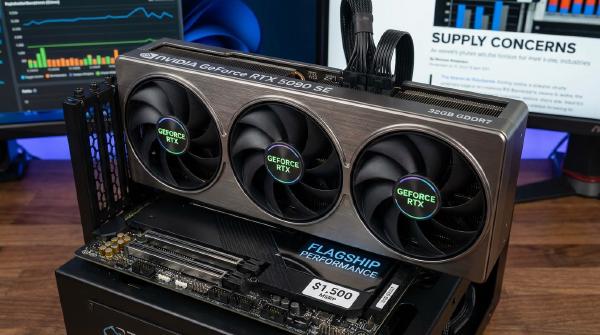
NVIDIA may be preparing changes to its high-end GeForce graphics card lineup, with two reports from Taiwanese technology outlet BenchLife drawing attention to a potential 24GB GeForce RTX 5080 and tighter supply of the flagship RTX 5090.
According to the reports, NVIDIA could launch a 24GB GDDR7 version of the RTX 5080 in the first quarter of 2027, potentially replacing the existing 16GB model rather than selling both versions simultaneously. At the same time, board partners are reportedly no longer receiving new shipments of the GB202 silicon used in the RTX 5090, with available graphics cards relying primarily on existing inventory.
These developments could have important implications for high-end gaming, local AI workloads, GPU pricing, and NVIDIA’s allocation of manufacturing capacity between consumer and professional graphics products.
However, neither report has been officially confirmed by NVIDIA. The proposed RTX 5080 upgrade, its release schedule, and the reported RTX 5090 supply adjustment should therefore be treated as unverified industry rumors rather than established product announcements.
🔎 24GB RTX 5080: What the Latest Rumor Says #
According to BenchLife, NVIDIA plans to introduce a GeForce RTX 5080 with 24GB of GDDR7 memory in Q1 2027. The report suggests that the new configuration could directly replace the existing 16GB version instead of becoming a separate, higher-tier model sold alongside it.
If accurate, the change would address one of the main differences between the RTX 5080 and more expensive graphics cards: available video memory.
The current RTX 5080 offers substantial GPU computing capability, but its 16GB memory capacity can become a consideration for users working with demanding games, large 3D scenes, high-resolution creative projects, and certain local AI models.
An increase to 24GB would provide more room for these workloads without necessarily requiring buyers to move to a flagship or workstation-class GPU.
Reported Launch Timeline #
The rumored launch window is the first quarter of 2027, covering January through March.
However, the report also states that NVIDIA’s add-in board partners have not yet received development documentation or a bill of materials for the proposed card. Partners reportedly received verbal indications that the necessary materials would be provided soon.
If this account is accurate, the reported preparation status leaves room for changes to the schedule. Graphics card manufacturers typically need technical specifications, board-design information, component requirements, firmware details, and validation time before bringing a new configuration to market.
The lack of reported partner documentation does not prove that a launch will be delayed. It does, however, make it difficult to treat Q1 2027 as a firm release date.
For now, the timeline remains a rumor rather than a confirmed NVIDIA launch commitment.
Will the 24GB Model Replace the 16GB RTX 5080? #
One of the more notable claims is that the 24GB model could replace the current 16GB RTX 5080 instead of being sold as an additional variant.
If that happens, NVIDIA would effectively increase the standard memory capacity of its second-tier flagship gaming GPU. Buyers might gain more headroom for demanding workloads, although the effect on retail pricing and availability would depend on NVIDIA’s product strategy and supply conditions.
Several questions remain unanswered:
- Would the 16GB model be discontinued immediately or remain available during a transition period?
- Would the 24GB version retain the same GPU core configuration and memory interface?
- Would NVIDIA introduce other changes to clock speeds, power limits, or board design?
- Would the new model carry a higher suggested retail price?
- Would availability differ across regions and board partners?
Until NVIDIA publishes an official specification sheet, none of these details can be considered settled.
🧠 Current RTX 5080 Specifications vs. the Rumored 24GB Model #
The standard GeForce RTX 5080 launched on January 30, 2025, as part of NVIDIA’s Blackwell-based RTX 50 series. Its officially published specifications provide a useful baseline for evaluating the rumored memory upgrade.
| Specification | Current RTX 5080 | Rumored 24GB RTX 5080 |
|---|---|---|
| Architecture | NVIDIA Blackwell | Expected to remain Blackwell |
| CUDA cores | 10,752 | Unconfirmed |
| Video memory | 16GB GDDR7 | 24GB GDDR7 |
| Memory interface | 256-bit | Unconfirmed; potentially unchanged |
| Memory bandwidth | Based on official memory configuration | Unconfirmed |
| Power requirements | Official model specifications apply | Unconfirmed |
| Release date | January 30, 2025 | Rumored Q1 2027 |
| Pricing | Original U.S. MSRP of $999 | Unconfirmed |
The most clearly reported change is the increase in memory capacity. No reliable confirmation establishes that the proposed model would include more CUDA cores, higher clock speeds, a wider memory interface, or other architectural improvements.
It is therefore premature to describe the 24GB version as a faster RTX 5080 in every respect. More VRAM can improve performance when memory capacity is the limiting factor, but it does not automatically increase GPU processing throughput.
Why the Memory Configuration Matters #
Increasing capacity from 16GB to 24GB represents a 50% increase in available VRAM.
That additional capacity could help applications retain more data in GPU memory instead of moving assets between system memory and VRAM or reducing the size of the workload to fit within the available allocation.
Potential beneficiaries include:
- Games using high-resolution textures and demanding ray-tracing settings.
- 3D rendering applications handling larger scenes and assets.
- Video production workflows involving high-resolution media.
- Local AI inference with models that need more memory for weights and runtime data.
- Development workflows that combine GPU computation with large datasets.
The actual benefit depends on the workload. If an application already fits comfortably within 16GB, moving to 24GB may produce little or no performance improvement.
By contrast, when a workload exceeds the smaller card’s practical memory capacity, the larger configuration could prevent substantial performance degradation or make previously impractical projects possible.
Would Memory Bandwidth Increase? #
Not necessarily.
VRAM capacity and memory bandwidth are separate specifications. Capacity determines how much data can be stored in graphics memory, while bandwidth measures how quickly data can be transferred between memory and the GPU.
If NVIDIA retains the current 256-bit memory interface, the new card’s bandwidth would depend on the effective GDDR7 data rate and memory implementation.
A larger memory capacity alone does not guarantee higher bandwidth. The 24GB model could offer more room for data without significantly changing the rate at which that data moves.
Until NVIDIA confirms the memory configuration and operating speeds, claims about bandwidth improvements should remain speculative.
🏷️ Is the 24GB RTX 5080 Actually an RTX 5080 SUPER? #
Previous rumors have suggested that NVIDIA could introduce an RTX 5080 SUPER with 24GB of GDDR7 memory. This has led to speculation that the newly reported 24GB RTX 5080 may be the same product under a different name.
At present, there is not enough verified information to establish that connection.
The two reports could refer to the same planned card, a revised product strategy, or separate configurations discussed at different stages of development. NVIDIA has not publicly confirmed the final name or product positioning.
Why Product Naming Matters #
A memory upgrade does not necessarily require a new product suffix. GPU manufacturers sometimes revise configurations within an existing product family, while larger changes to performance, power, or hardware specifications may justify a new model designation.
If NVIDIA markets the 24GB card as an RTX 5080 SUPER, buyers might reasonably expect a more substantial refresh than a memory-capacity change alone. However, a product name does not guarantee a particular level of performance improvement.
The important specifications will be the actual hardware configuration, supported features, power consumption, price, and independent benchmark results.
Until those details become available, it is best to refer to the card as the rumored 24GB RTX 5080 rather than assume that it will launch as an RTX 5080 SUPER.
🏭 RTX 5090 Supply: Are New GB202 Chips Being Withheld? #
The second report from BenchLife concerns the supply of the GB202 silicon used in the GeForce RTX 5090.
According to the report, board partners are no longer receiving new GB202 chip shipments for RTX 5090 production. Variants designed for the Chinese market, including the RTX 5090 D and RTX 5090 D V2, are also reportedly affected.
If accurate, this would mean that current retail availability depends increasingly on chips and finished graphics cards already allocated to manufacturers and distribution channels.
However, a reported reduction in chip shipments does not necessarily mean that NVIDIA has formally discontinued the product.
What the GB202 Supply Adjustment Could Mean #
The GB202 is the silicon used in the RTX 5090, NVIDIA’s flagship GeForce graphics card. The chip is also relevant to professional graphics products within NVIDIA’s broader GPU portfolio.
According to BenchLife, NVIDIA may be redirecting GB202 production capacity toward higher-margin RTX PRO workstation graphics cards, including the RTX PRO 6000 and RTX PRO 5500.
This would represent a possible shift in production allocation rather than definitive evidence that the RTX 5090 has reached the end of its commercial life.
The distinction matters because manufacturers can adjust production volumes, prioritize particular customers, or reduce shipments without officially ending a product’s lifecycle.
Several scenarios remain possible:
- NVIDIA could temporarily restrict new GB202 allocations to GeForce products.
- Board partners could continue selling RTX 5090 cards assembled from existing chip inventory.
- NVIDIA could prioritize professional products with different pricing and demand characteristics.
- Future consumer GPU supply could change if production priorities or market conditions shift again.
These are possible interpretations of the report, not confirmed NVIDIA decisions.
Has NVIDIA Officially Discontinued the RTX 5090? #
No official end-of-life announcement is established by the reports described here.
The reported interruption in new chip shipments should not be confused with a formal product discontinuation. A GPU can become difficult to find at retail while remaining an active product, and a manufacturer can reduce production without immediately withdrawing existing stock from sale.
The distinction between reduced supply and end-of-life status is especially important for an expensive flagship card. Retailers and board partners may continue selling remaining inventory long after new chip allocations have changed.
For more background on the same issue, see KAD8’s related report: RTX 5090 Discontinuation Rumor: NVIDIA May Prioritize AI GPUs.
That article also discusses the reported GB202 allocation shift and the possibility of a 24GB RTX 5080, while emphasizing that NVIDIA has not confirmed the rumored changes.
💰 Could RTX 5090 Prices Rise Further? #
If new RTX 5090 chip shipments are restricted while demand remains strong, retail prices could face additional upward pressure.
The RTX 5090 already occupies a premium price tier. Its combination of high-end gaming performance, 32GB of GDDR7 memory, and substantial compute resources also makes it attractive for selected AI and professional workloads.
When supply falls below demand, retailers may raise prices or sell through available inventory without immediate replenishment. The effect can vary considerably across regions, manufacturers, and individual card models.
Why Existing Inventory Matters #
Graphics card availability depends on more than the number of chips shipped in a given week. Finished cards may already be held by manufacturers, distributors, and retailers.
If the reported GB202 allocation change is accurate, these inventories could continue supplying the market for some time. The speed at which they are depleted would depend on demand, existing stock levels, and whether additional shipments resume.
Consequently, an interruption in new chip supply does not necessarily lead to an immediate shortage at every retailer.
The more important indicators will be sustained inventory levels, restocking frequency, and actual transaction prices.
The $4,299 Retail Listing #
The supplied report mentions an RTX 5090 briefly listed at Walmart for $4,299 before selling out quickly.
A single retail listing does not establish the market-wide price of the card. The listing could reflect a particular model, seller, inventory situation, or pricing strategy.
Nevertheless, such examples illustrate why consumers should distinguish between the original manufacturer suggested retail price and the prices actually available in stores.
If supply becomes more constrained, buyers may encounter substantial premiums over the original MSRP. They should compare multiple retailers, verify seller reputation, and avoid assuming that a high listing price represents the card’s normal value.
📊 What a 24GB RTX 5080 Could Mean for Gamers and AI Users #
A 24GB RTX 5080 could provide an interesting middle ground for users who need more VRAM than the standard RTX 5080 offers but do not want to purchase an RTX 5090.
Its value would depend on price and performance, not just memory capacity.
Gaming at High Resolutions #
Modern games can consume considerable VRAM when using high-resolution textures, advanced lighting, ray tracing, and other demanding graphics settings.
When a game exceeds the practical memory capacity of a graphics card, performance may deteriorate because the system must manage data that cannot remain resident in VRAM efficiently. The result can include inconsistent frame times, stuttering, or lower performance in especially demanding scenes.
An increase to 24GB could provide more headroom for these scenarios.
However, many games will not benefit equally. If a title uses less than 16GB of VRAM under the selected settings, the extra capacity may have little effect on frame rates.
GPU compute performance, memory bandwidth, game-engine behavior, and driver optimization will continue to matter.
3D Rendering and Professional Content Creation #
Artists working with large scenes, detailed textures, complex geometry, and GPU-accelerated rendering can benefit from additional graphics memory.
A larger VRAM pool may allow more scene data to remain on the GPU, reducing the need to simplify a project or move resources between memory pools.
This could be particularly useful for creators who regularly work with large assets but do not need every feature of a professional workstation card.
Still, VRAM capacity alone does not establish rendering performance. The GPU’s compute resources, supported rendering engine, memory bandwidth, and software optimization remain important.
Local AI and Language Models #
A 24GB graphics card may also be useful for local AI inference, particularly when running quantized language models or image-generation workloads.
The amount of memory required depends on more than a model’s parameter count. Weight precision, quantization, context length, KV cache, runtime buffers, and other active applications all affect the total requirement.
A 24GB GPU may accommodate some workloads that are difficult to run within 16GB, but it will not automatically run every model with a similar nominal size. Nor does more VRAM guarantee faster token generation.
For developers, the key question is whether the additional memory allows a target model or workflow to run more effectively without sacrificing too much compute performance or exceeding the available budget.
For related hardware context, KAD8 has also covered the RTX 5090 and RTX 5080 specifications, including their original memory configurations and product positioning.
⚠️ What Remains Unconfirmed? #
Although the reports provide specific claims, several important details remain unknown.
| Question | Current status |
|---|---|
| Will a 24GB RTX 5080 launch? | Rumored; not officially confirmed |
| Is Q1 2027 the final release window? | Unconfirmed |
| Will the 24GB card replace the 16GB model? | Reported possibility; unconfirmed |
| Will the card be called RTX 5080 SUPER? | Unknown |
| Will CUDA core counts change? | No confirmed information |
| Will memory bandwidth increase? | No confirmed information |
| Has NVIDIA officially discontinued the RTX 5090? | No official discontinuation established by these reports |
| Are new GB202 shipments being redirected to RTX PRO products? | Reported by BenchLife; not officially confirmed |
| Will RTX 5090 retail prices rise further? | Possible if supply tightens, but not guaranteed |
These uncertainties are important because product rumors can change as manufacturers adjust specifications, manufacturing plans, and market positioning.
The absence of public confirmation does not prove that the reports are false. It simply means that the information should not yet be treated as a finalized product roadmap.
🛒 Should You Buy an RTX 5080 or RTX 5090 Now? #
The decision depends on your current hardware, workload, budget, and willingness to wait for a product that may or may not arrive on the reported schedule.
Consider the Current RTX 5080 If You Need a GPU Now #
The existing 16GB RTX 5080 is an established product with published specifications and real-world performance data.
If it meets your gaming or professional requirements at an acceptable price, waiting for an unconfirmed 24GB revision may not be worthwhile. The rumored model could arrive later than expected, cost more, or offer benefits that are irrelevant to your workload.
Buyers who regularly encounter VRAM limits have a stronger reason to monitor developments, but they should still compare current alternatives before delaying an upgrade.
Consider the RTX 5090 Only at a Price You Can Justify #
The RTX 5090 remains a high-end option for demanding gaming, rendering, and selected AI workloads. However, if its supply becomes constrained, paying a substantial premium over its normal market value may be difficult to justify.
Before purchasing, compare actual in-stock prices and confirm the seller’s return policy and warranty terms. Do not assume that a temporarily scarce product will become more valuable or that prices will continue rising.
If you need the card for professional work, evaluate the cost against the time saved and the income or productivity the hardware can realistically support.
Waiting Makes Sense for Some Buyers #
Waiting for an official announcement may be reasonable if:
- You specifically need 24GB of VRAM.
- Your current system can handle workloads until 2027.
- You want to compare the final specifications and pricing.
- Your purchase decision depends on whether the 16GB RTX 5080 will be replaced.
- You are considering an RTX 5090 but want to see how supply develops.
The trade-off is uncertainty. There is no guarantee that the rumored card will launch on schedule or that its price will be attractive.
📝 Conclusion: A 24GB RTX 5080 Is Possible, but Nothing Is Final #
The latest BenchLife reports suggest two potentially significant changes to NVIDIA’s high-end graphics card lineup: a 24GB GDDR7 version of the GeForce RTX 5080 could arrive in Q1 2027, while shipments of the GB202 silicon used in the RTX 5090 may be restricted as production capacity shifts toward professional graphics products.
If accurate, these developments could affect consumer GPU availability, pricing, and the range of options available to gamers and local AI users. A 24GB RTX 5080 would offer 50% more VRAM than the current model, potentially making it more suitable for memory-intensive gaming, rendering, and AI workloads.
However, increased VRAM does not automatically mean higher overall performance, and the proposed card’s final specifications, name, price, and release date remain unknown.
Likewise, the reported reduction in RTX 5090 chip shipments does not establish that NVIDIA has officially discontinued the flagship. Existing inventory may continue reaching retailers, and production priorities could change.
For now, consumers should treat both reports as unconfirmed supply-chain information. The most reliable basis for a purchase remains the performance, availability, and price of products that can actually be bought today. NVIDIA’s official announcements and final hardware specifications will determine whether these rumors translate into meaningful changes for the GeForce lineup.