
📖 Background #
As the semiconductor industry shifts toward chiplet-based architectures, Arm is positioning itself at the center of this transformation.
Rather than manufacturing chips, Arm’s strategy focuses on ensuring its CPU IP and system architecture remain foundational in multi-die silicon platforms. This includes:
- CPU chiplets based on Arm cores
- Application-specific custom chiplets
- Interconnect and system-level standards
To achieve this, Arm is building partnerships and driving standardization efforts, extending its long-standing influence from traditional SoC design into the chiplet era.
🚀 Arm’s Chiplet Strategy #
Arm’s approach to chiplets is centered on ecosystem enablement rather than vertical integration.
Key objectives include:
- Ensuring Arm-based compute IP is widely adopted in chiplet designs
- Supporting both standardized and custom chiplet implementations
- Enabling interoperability across vendors
A critical component of this strategy is leveraging AMBA, which has served as the backbone of SoC interconnects for over two decades. By extending AMBA concepts into chiplet-based systems, Arm aims to provide continuity between monolithic and disaggregated designs.
🧩 Strategic Partnerships #
Arm is actively collaborating with key industry players to accelerate chiplet adoption.
Alphawave Semi Collaboration #
One of the most important partnerships is with Alphawave Semi, a leader in high-speed connectivity IP.
Key elements of this collaboration:
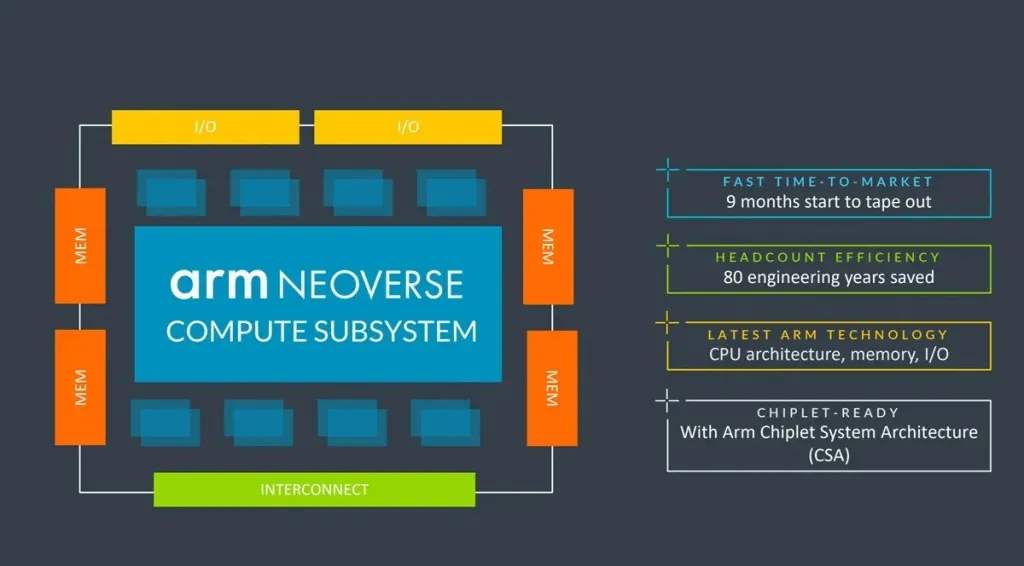
- Integration of Neoverse Compute Subsystem (CSS) with custom chiplets
- Support for UCIe (Universal Chiplet Interconnect Express)
- Compatibility with Arm interfaces such as AXI and CHI
This enables seamless integration of:
- Memory interfaces (HBM, DDR)
- High-speed I/O (Ethernet)
- Advanced interconnects (CXL)
Additionally, the partnership focuses on optimizing power, performance, and area (PPA) across advanced nodes, including 3nm and 2nm.
Socionext Collaboration #
Arm is also working with Socionext to develop:
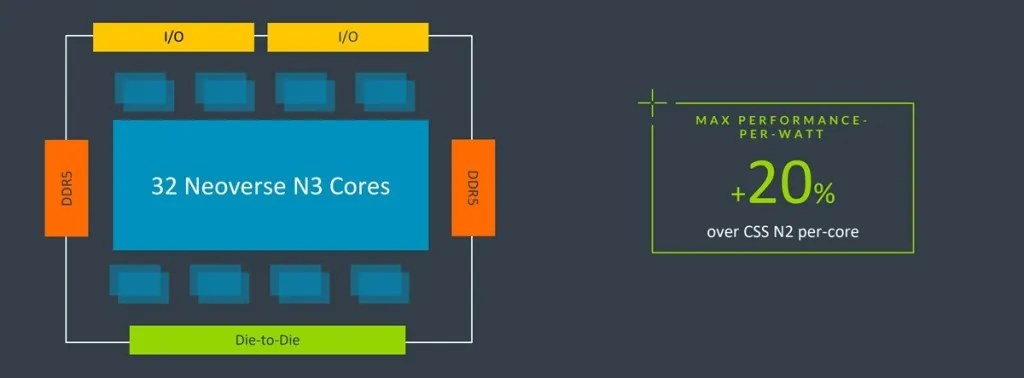
- A 32-core CPU chiplet
- Built on 2nm-class process technology
- Designed for flexible multi-chip configurations
This highlights Arm’s push toward scalable compute building blocks that can be reused across different system designs.
🧠 Standardization and CSA Initiative #
A major pillar of Arm’s blueprint is standardization.
Arm Chip System Architecture (CSA) #
Arm has introduced the CSA (Chip System Architecture) initiative to:
- Enable reuse of IP blocks such as PHY and soft IP
- Define optimal partitioning strategies for chiplet systems
- Reduce fragmentation across the ecosystem
With over 20 partners involved, CSA aims to establish a common design language for chiplet-based systems.
🔌 Interconnect Evolution #
Arm is extending its interconnect leadership into the chiplet domain.
Key efforts include:
- Updating AMBA specifications for both on-die and off-die communication
- Supporting industry standards such as:
- UCIe for die-to-die connectivity
- PCIe for high-speed interfaces
- CXL for memory and accelerator integration
This approach ensures that chiplet-based systems can:
- Maintain compatibility with existing ecosystems
- Scale across different vendors and applications
- Simplify system integration
⚙️ Chiplet Partitioning Framework #
A core challenge in chiplet design is determining how to partition a system into multiple dies.
Arm’s strategy focuses on:
- Decomposing traditional SoCs into reusable chiplets
- Defining standardized partitioning schemes
- Enabling modular system design
This modularity allows:
- Faster design cycles
- Greater flexibility in product customization
- Improved scalability across workloads
Partnerships with connectivity IP providers further simplify this process by ensuring that interconnect and data movement are efficiently handled.
🔍 Why This Matters #
The transition from monolithic SoCs to chiplet-based systems introduces new complexities:
- Interconnect standardization
- Cross-vendor compatibility
- Efficient data movement
Arm’s approach addresses these challenges by combining:
- Proven interconnect standards (AMBA)
- Industry-wide collaboration (CSA, UCIe)
- Scalable compute IP (Neoverse CSS)
This positions Arm as a central enabler of the chiplet ecosystem rather than just an IP provider.
🔮 Outlook #
Chiplets are rapidly becoming the foundation of next-generation semiconductor design, especially in:
- Data centers
- AI and machine learning
- High-performance computing
Arm’s investments in standardization, partnerships, and modular design frameworks suggest a long-term commitment to shaping this transition.
If successful, Arm’s chiplet blueprint could:
- Accelerate industry adoption
- Reduce development complexity
- Expand the reach of Arm-based systems across new markets
🧾 Summary #
- Strategy: Enable chiplet ecosystems through IP, standards, and partnerships
- Key Technologies: AMBA, CSA, UCIe, Neoverse CSS
- Partnerships: Alphawave Semi and Socionext
- Focus: Modular design, interoperability, and scalability
- Impact: Faster development and broader adoption of chiplet architectures
Arm’s chiplet blueprint reflects a shift from designing individual chips to enabling entire multi-die ecosystems, where standardization and collaboration define the future of semiconductor innovation.